The Passport Premium
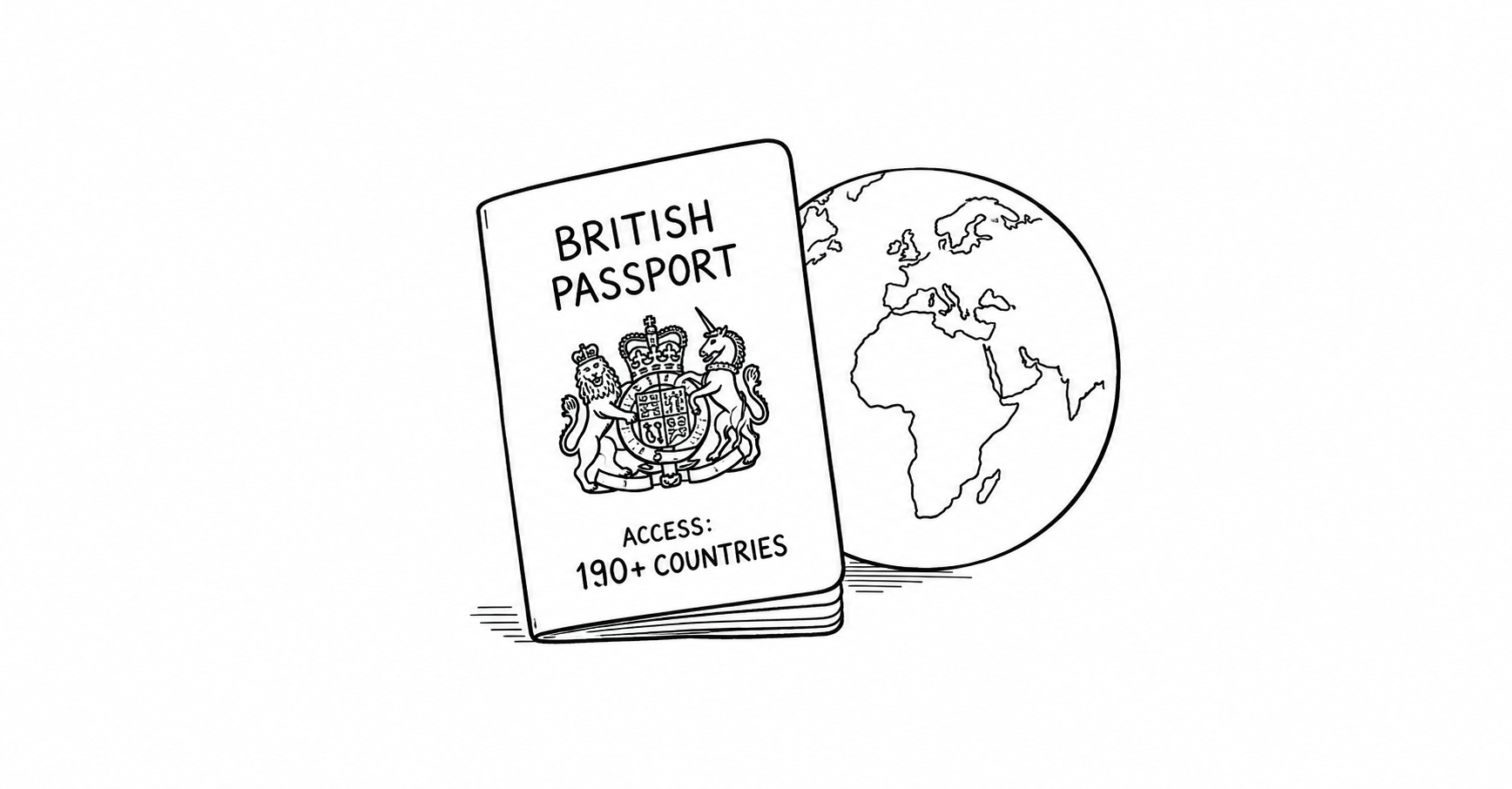
In 1990, a British passport let you visit about 55 countries without a visa. Today, it lets you visit more than 190 — nearly every country on earth. The passport hasn’t changed much. What changed is the architecture of the international agreements that make it useful.
Mobility, it turns out, is a negotiated asset. And like most assets, its distribution is deeply unequal.
The world’s most powerful passports — held by citizens of Japan, Germany, Sweden, the United Kingdom, the United States — function as nearly frictionless access documents. Holders can move across borders for business, tourism, or residency exploration with minimal bureaucratic overhead. The paperwork is largely invisible, because someone else already handled it decades ago through treaties and reciprocal agreements.
The least powerful passports — Afghanistan, Iraq, Syria, Pakistan — face visa requirements from most of the world. Each trip abroad requires a separate application, a stack of documentation, evidence of financial solvency, proof of intent to return. Denial rates are high. Lead times are long. The friction isn’t incidental. It’s the policy.
The economic consequences of this gap compound in ways that aren’t fully captured when we talk about global inequality. Remote work has opened new options for location independence, but those options distribute along passport lines. The American freelancer who can work from Lisbon for six months faces a different bureaucratic universe than the Pakistani freelancer who wants to do the same. Tax residency schemes in Portugal, Spain, Greece, and Panama — programs explicitly designed to attract mobile foreign income — are accessible to exactly the nationalities that already have the most mobility.
Golden visa programs make the connection between citizenship and wealth even more literal. For $250,000, $500,000, or more, a dozen countries will sell you residency — and eventually citizenship — that comes with its own passport and the access that goes with it. These programs treat citizenship as a commodity explicitly. The admission price is the point.
The people who buy golden visas are usually not fleeing persecution or poverty. They’re hedging. A wealthy Brazilian might acquire a Portuguese passport as a backup option — European Union access, healthcare, stability, a place to go if things get bad at home. A Chinese entrepreneur might acquire citizenship in a Caribbean nation, not because they plan to live there, but because the passport offers banking access that their home passport complicates.
Tax residency is the other dimension. Where you’re a citizen increasingly affects not just where you can go but what you owe and to whom. The United States taxes its citizens on worldwide income regardless of where they live, making renunciation an active financial consideration for Americans who’ve settled abroad. Portugal’s Non-Habitual Residency regime, before it was modified, offered a decade of favorable tax treatment to new arrivals. These schemes treat nationality as a financial instrument.
The philosopher and legal scholar Ayelet Shachar wrote about this years ago, calling birthright citizenship a “birthright lottery” — the single largest distributor of life chances in the world, allocated entirely at random. The framing was provocative but accurate. Where you’re born determines the quality of the document you’re issued, which determines your ability to move, work, bank, and invest across borders, which compounds over a lifetime.
What’s changed in recent years is that the lottery’s stakes have gotten higher. Remote work has made location more flexible and therefore more valuable. Climate change is making some locations less viable and therefore increasing the value of options elsewhere. Geopolitical instability is making the hedging instinct more rational. The passport isn’t just a travel document anymore. For a growing share of the global professional class, it’s a portfolio position.
Whether that makes citizenship a form of wealth depends on what you think citizenship is supposed to be. The optimistic reading is that expanded access and golden visa programs are democratizing mobility — that wealth can now buy your way into the club that luck of birth used to gatekeep. The more uncomfortable reading is that we’re watching the explicit financialization of something that was supposed to be a political identity, and that the price of entry reveals who it was always really for.