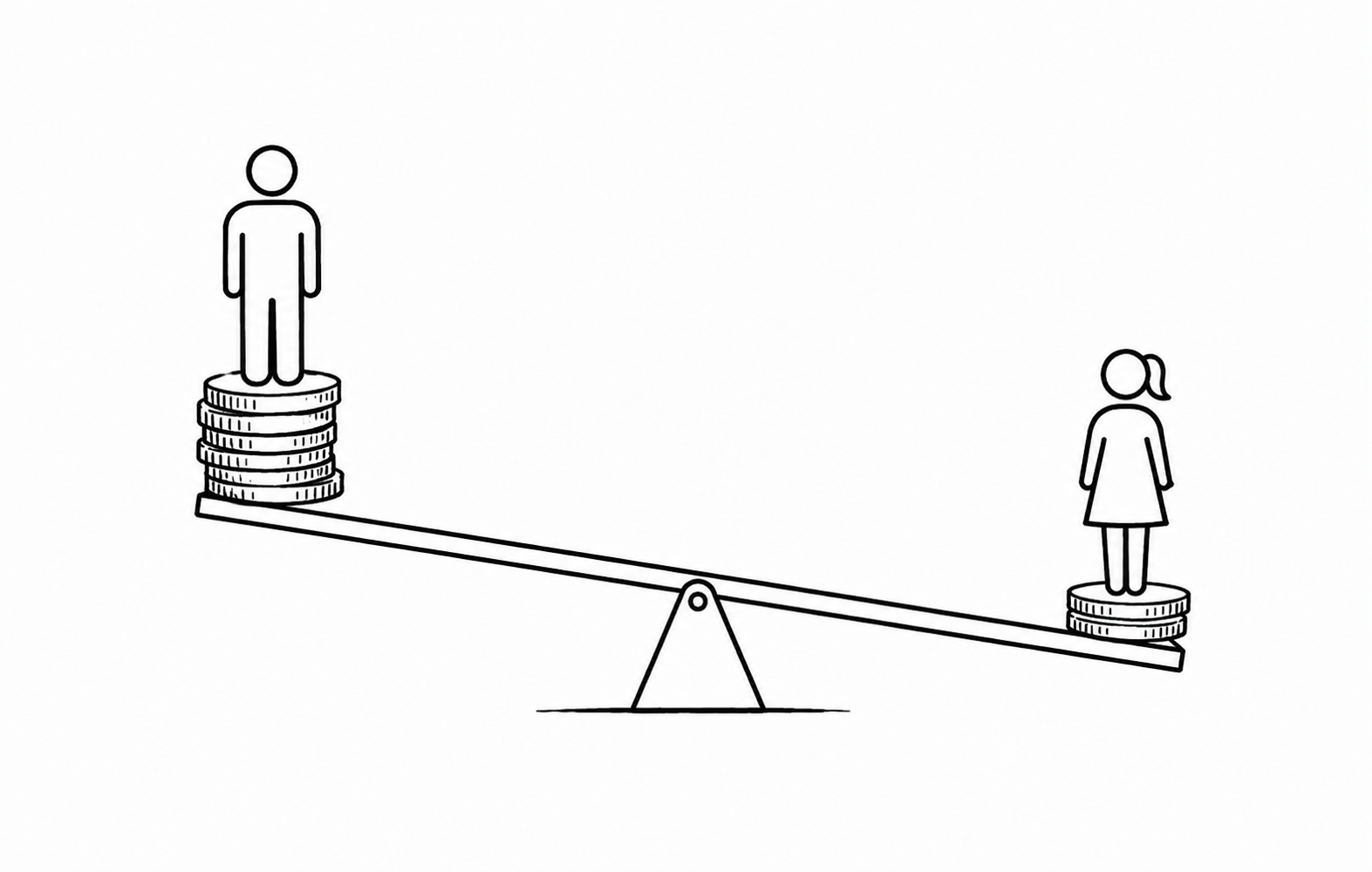
Unpaid Labor Math: Women’s Effective Earnings Drop From 61% to 32% of Men’s Once Care Work Is Counted
A new global inequality report puts a number on the gap that conventional wage statistics have always hidden.

The World Inequality Report 2026, published by the World Inequality Lab and edited by economists Lucas Chancel, Ricardo Gómez-Carrera, Rowaida Moshrif, and Thomas Piketty, found that women globally earn 61% of what men earn per working hour when only paid work is counted — a gap that’s been documented and debated for years. The number that hasn’t been counted, in most standard wage statistics, is what happens when unpaid domestic and care labor gets added to the ledger. Once it is, women’s effective hourly earnings fall to 32% of men’s. Women also work more total hours than men once that labor is included: 53 hours a week on average, compared to 43 for men. And globally, women capture just 25% of total labor income, a figure the report says has barely shifted since 1990.
The mechanism behind that gap is measurement, not just discrimination. Conventional labor statistics — the ones that produce the more familiar 61% figure — only count work that gets a wage attached to it. Cooking, cleaning, childcare, and elder care don’t show up in GDP, don’t build a pension, and don’t appear on a payroll, even though the report’s own data shows women performing more total hours of combined paid and unpaid labor than men in every region measured. That’s not an accounting oversight. It’s a structural choice about what counts as economic activity in the first place, and the choice has a direct effect on which labor gets compensated and which gets treated as a background condition that makes paid work possible for everyone else.
That choice has compounding effects beyond the hourly wage gap itself. The report notes that the disproportionate weight of unpaid responsibilities restricts women’s career opportunities, limits political participation, and slows wealth accumulation over time — each additional hour of unpaid care work correlates with a real reduction in a woman’s odds of holding paid employment or pursuing higher education, according to separate UN Women research cited alongside the broader inequality data. The same dynamic shows up domestically: U.S.-specific gender pay gap research finds the wage gap widens sharply at the point women become mothers, not before, which is the clearest evidence that the gap tracks caregiving responsibility rather than skill, ambition, or qualification. Women with identical degrees to men in the same fields still earn less, and the gap grows, rather than shrinks, the longer a woman stays in the workforce and accumulates caregiving responsibilities alongside it.
What the World Inequality Report adds to that existing picture is scale and a single global number that makes the underlying mechanism impossible to read as a series of disconnected national pay gaps. The 32% figure isn’t a measure of overt discrimination in a paycheck. It’s a measure of what happens when an economy declines to assign monetary value to roughly half the labor sustaining it, and then evaluates productivity, GDP, and economic growth using only the half it counted. The report’s authors frame this directly as an efficiency problem as much as a fairness one: an economic system that systematically undervalues a defined category of labor isn’t just unjust to the people performing it — it’s measuring its own output incorrectly, which means every downstream policy decision built on that incomplete measurement inherits the same blind spot.
This is fundamentally a power question, not just a wage statistic. The 32% figure represents who controls the definition of what counts as productive economic activity — a definition currently set by national accounting standards, labor statistics agencies, and the institutions that build policy on top of both, none of which were designed with unpaid care labor inside their frame. Closing that gap doesn’t just require paying women more for the work that’s already counted. It requires changing what gets counted in the first place, and that’s a far slower, more contested fight than adjusting a wage scale — because it means rebuilding the measurement systems entire economies currently run on.
— SSC Society Desk | Social Storytellers Collective
Free, daily structural analysis like this lands in your inbox every weekday morning. Subscribe: https://246481934.hs-sites-na2.com/newsletter