
Companies Stopped Reporting on DEI. They Still Want Credit for Doing It.
Fortune 500 disclosure to a major diversity index fell 65% this year. The companies say their actual programs didn’t change.
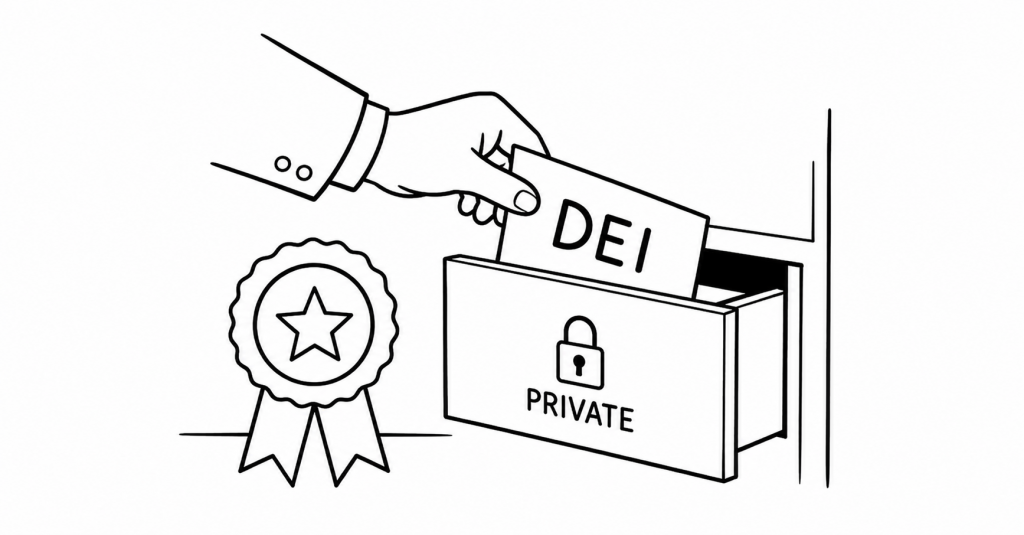
Just 131 Fortune 500 companies submitted their diversity, equity, and inclusion policies to the Human Rights Campaign Foundation’s 2026 Corporate Equality Index, down from 377 the year before — a 65% drop in voluntary disclosure. The Human Rights Campaign Foundation attributed the pullback to a political and regulatory environment where employers are “navigating heightened scrutiny and competing expectations around workplace inclusion.” Among the companies that did participate, the report found year-over-year increases across nearly every measured category: non-discrimination protections, equitable benefits, workforce training, and employee resource groups. The organization’s stated conclusion was specific: the retreat is happening in disclosure, not in the underlying practices.
Google, Meta, and Microsoft illustrate that distinction directly. All three confirmed this year they will not publish the gender and racial breakdown of their workforces, ending a practice that in Google’s case ran eleven consecutive annual reports dating back to 2014, when the company first released the data under pressure from civil rights groups. Alphabet Workers Union president Parul Koul called the decision “a glaring omission,” arguing it signals alignment with the federal government’s posture on corporate diversity programs rather than a change in what’s happening inside the companies. None of the three has stated that its internal diversity programs have been eliminated. What’s changed is whether employees, investors, or the public have a standardized way to verify that claim.
The Conference Board’s research adds a harder data point to that ambiguity. Among S&P 500 companies, the share reporting DEI metrics tied to executive pay fell from 68% in 2024 to 35% in 2025 — a near-halving in roughly a year — and 21% of companies reduced or removed DEI-related targets entirely. Disclosure of women in management fell 16%. Disclosure of racial and gender diversity on corporate boards fell 31% and 28%, respectively. Andrew Jones, the report’s coauthor, framed the shift carefully: companies are “selectively reframing commitments, reducing public exposure, and embedding oversight more quietly yet firmly into governance,” rather than necessarily abandoning the underlying work. That framing is itself the crux of the problem — it asks employees, investors, and watchdog organizations to trust that quieter governance is equivalent to public accountability, with no independent way to confirm it.
That trust gap matters because disclosure has historically functioned as the actual mechanism of accountability, not a formality layered on top of real programs. A company’s DEI report was the document an employee, journalist, or shareholder could point to when asking whether stated commitments matched outcomes. Removing the report doesn’t necessarily end the underlying commitment, but it does end the public’s ability to check it — and the companies making this choice are doing so at the exact moment federal pressure has made public DEI commitments newly risky to maintain. The Trump administration’s March 26 executive order specifically targeted “racially discriminatory DEI activities” among federal contractors and subcontractors, with HRC noting many of the companies that declined to participate in this year’s index are federal contractors themselves. Reduced disclosure isn’t happening in a vacuum. It’s happening as a direct, traceable response to new legal exposure tied to having anything documented at all.
What companies are betting on is that the reputational benefit of having been a longtime DEI leader survives the act of going quiet about it — that Google’s eleven years of prior reports, or a company’s past CEI participation, continues to function as a credential even after the verification mechanism behind that credential disappears. That’s a real test of whether public trust in corporate diversity commitments was ever actually built on disclosure, or just on the existence of disclosure as a category, regardless of whether anyone could check it. Workers inside companies that have scaled back DEI practices are already reporting the cost of that ambiguity directly: a separate HRC analysis found 54.2% of employees at organizations that pulled back DEI initiatives reported experiencing workplace stigma or bias in the past year, more than double the rate at companies that maintained their programs. The data a company stops publishing doesn’t disappear. It just stops being available to the people who’d use it to hold the company to what it claims.
— SSC Society Desk | Social Storytellers Collective
Free, daily structural analysis like this lands in your inbox every weekday morning. Subscribe: https://246481934.hs-sites-na2.com/newsletter