The Black Contractors the Obama Center Left Unpaid
A civic project built around inclusion is now testing whether diversity commitments protect small firms after the contract chain gets too long.
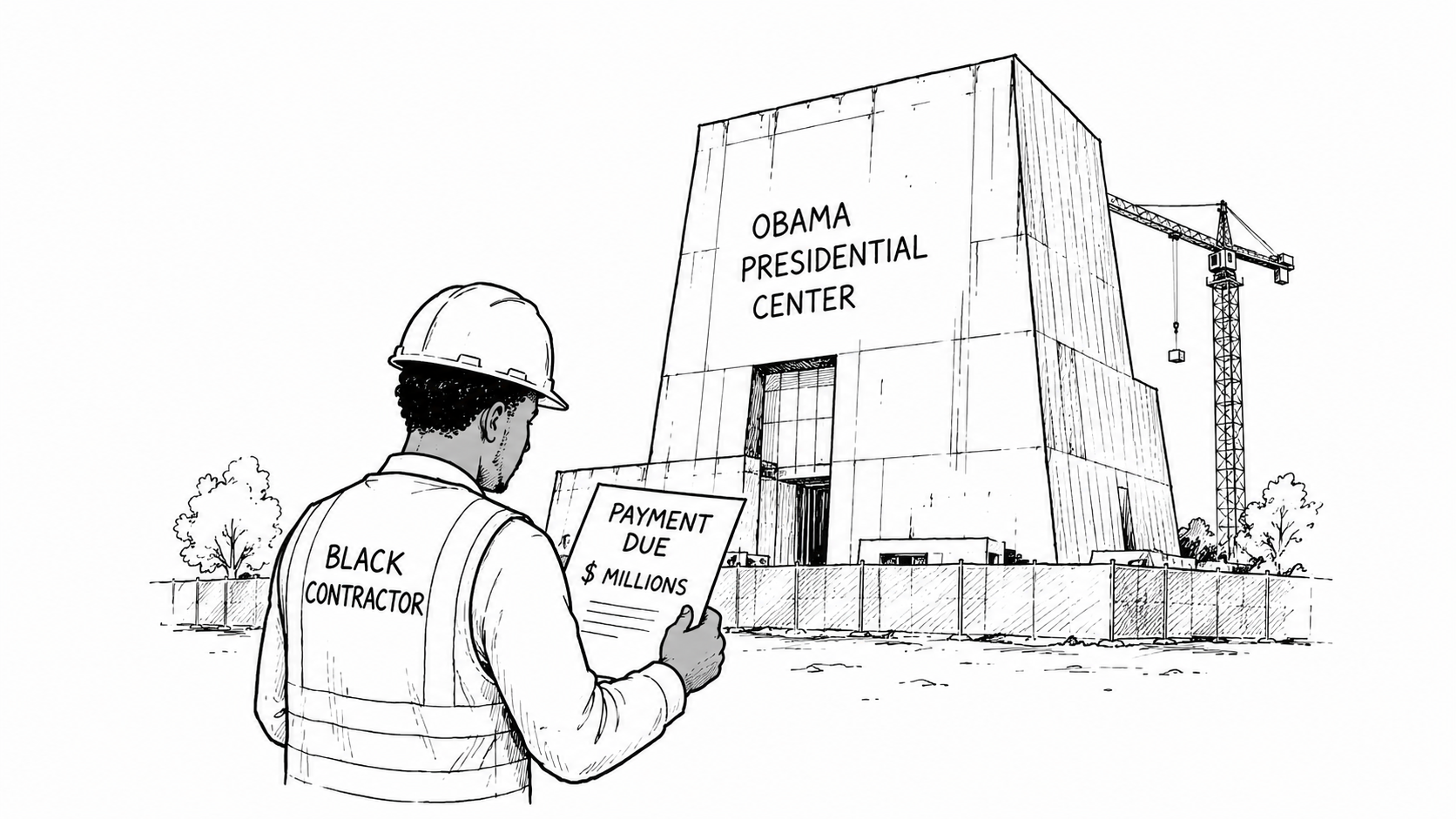
A Fox News Digital investigation syndicated by the New York Post in June reported that subcontractors tied to the Obama Presidential Center say they are owed millions of dollars for work on the Chicago project. The dispute includes a federal claim of more than $40 million by the Concrete Collective against structural engineering firm Thornton Tomasetti, Chapter 11 filings by at least two minority-owned subcontractors, and claims from Adamson Plumbing that repeated change orders left the firm millions of dollars short. Omar Shareef, president of the African American Contractors Association, told reporters that seven or more subcontractors have approached him with complaints, though many are constrained by nondisclosure agreements.
The Obama Foundation states that the project is fully funded and that it has no outstanding disputes with Lakeside Alliance, its construction manager. That is probably true, and it is also part of the structural problem. Once a project moves through a construction manager, prime contractors, engineers, subcontractors, and sub-subcontractors, the institution at the top of the chain gains legal distance from the firms at the bottom. The Foundation did not contract with Adamson Plumbing or Glass Management Services or Vision Painting and Decorating. Lakeside Alliance did. The Foundation can say, accurately, that those disputes are not its disputes.
But the Foundation made a public commitment. Fifty percent of subcontracting spend would go to diverse and minority-owned vendors. That commitment is what gave the project its civic meaning in the communities it was built to serve. Inclusion commitments made in percentages get tested in payroll, cash flow, and Chapter 11 filings. A smaller firm does not absorb delayed payment the way a large institution absorbs it. It borrows, stretches, misses payroll, and eventually reorganizes or closes. When Glass Management Services files for bankruptcy after working on a civic project that promised diversity, the failure is not only legal. It is the gap between the press release and the outcome.
Contract chains are designed to allocate risk. What they also do is distance accountability. The larger the project, the more layers between the public promise and the firm actually holding the hammer. Adamson Plumbing’s Mike Owen described 100 or more change-order requests that went unresolved. Change orders are how scope changes become cost disputes in construction. A small firm with limited bonding capacity and thin reserves cannot wait out a large institution’s dispute resolution process without absorbing damage in the meantime.
This matters beyond one Chicago development because public projects increasingly use diversity targets as evidence of equitable practice. A target that counts who gets into the contract chain but does not protect how and when payment flows through it can produce symbolic inclusion and practical harm at the same time. The firms invited into the project may be the same firms least equipped to survive the project’s delays.
The accountability gap will look the same on the next major civic development that leads with inclusion language. Until payment protection, dispute resolution timelines, and bonding support are built into public-interest project requirements, the contract chain will keep doing what it does: moving risk to the firms with the least leverage to absorb it.