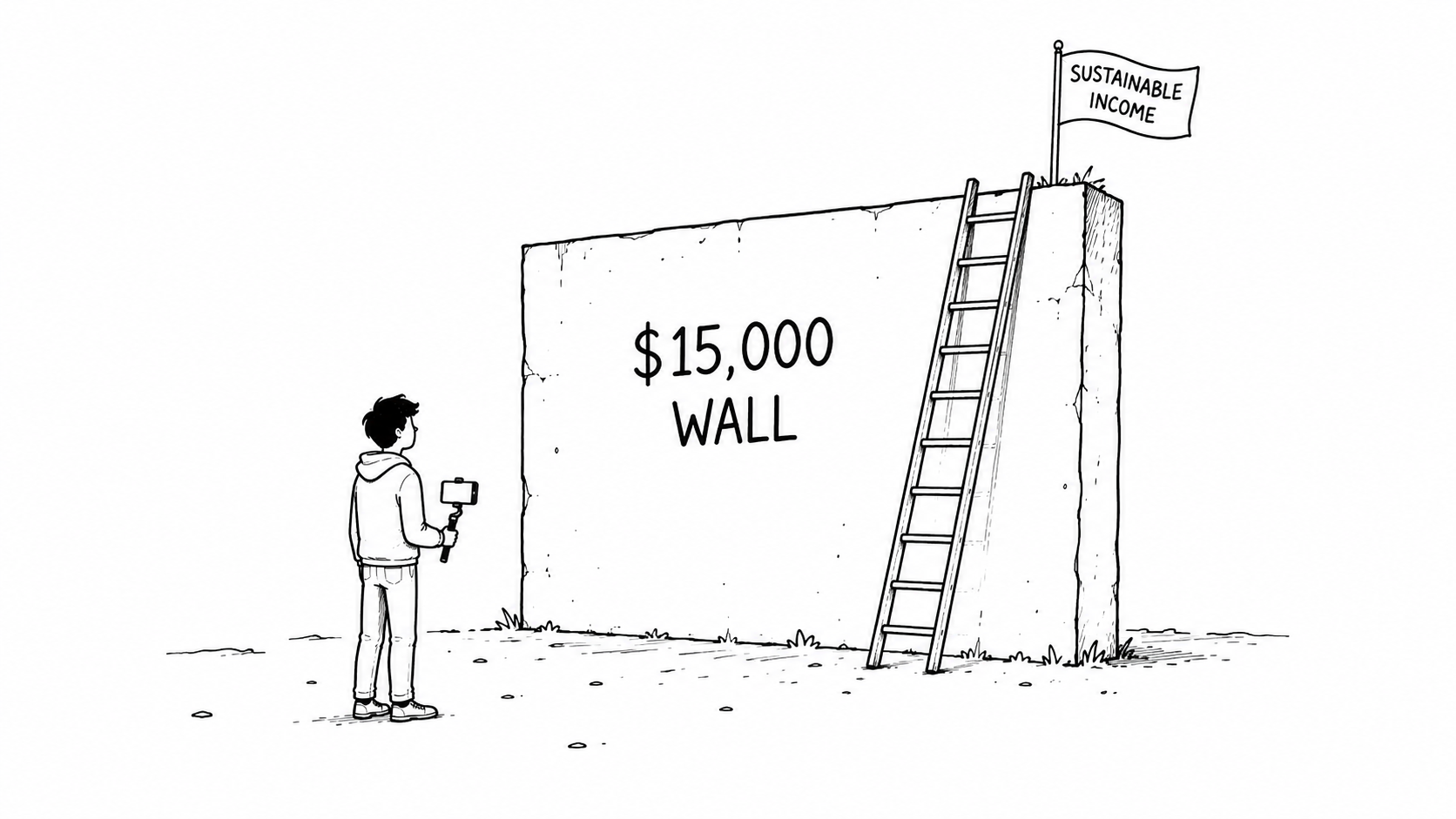
The $15,000 Wall: Why Half of All Creators Never Cross Into Sustainable Income
The creator economy is worth nearly $250 billion. Most of that value concentrates above a specific income threshold — and almost no one crosses it by accident.
The creator economy grew from $191.55 billion in 2025 to an estimated $234.65 billion in 2026, a 22.5 percent annual growth rate. Research identifies a critical threshold at approximately $15,000 in annual revenue that separates creators who struggle to monetize from those positioned to scale — income accelerates rapidly only after crossing that barrier.
The distribution on either side of that line is stark. Only 4 percent of global creators earn over $100,000 annually, while 50 percent earn less than $15,000 — revealing a massive undermonetized middle tier of creators producing quality content without the business infrastructure to scale.
The mechanism separating the two groups is not audience size. It is business infrastructure. Nearly 45 percent of successful creators own their own brands or businesses in addition to content creation, averaging close to $100,000 annually from brand ownership alone, and top earners maintain seven or more revenue streams compared to roughly two for low earners.
The barrier to starting has genuinely dropped — which makes the $15,000 wall more visible, not less. Today’s digital landscape has removed the traditional gatekeepers — media companies, labels, studios — that historically controlled access to creative industries. Someone can now film on a smartphone, edit with mobile apps, build an audience on TikTok, monetize through YouTube’s Partner Program, and raise funding through fan memberships, all without institutional permission.
But the runway to any income at all remains long. The average time for a creator to earn their first dollar is six and a half months. Even after that first dollar, the path to sustainable income stays unclear, with creators citing inconsistent brand deal flow, algorithm changes affecting reach, and the difficulty of converting followers into paying customers as the top ongoing challenges.
Fragmentation compounds the access problem rather than solving it. Creators are increasingly forced to stitch together tools across editing, analytics, monetization, accounting, legal, and tax compliance just to operate as a small business — infrastructure that platforms don’t provide and that costs money before a creator has reliable income to cover it.
Brands are increasingly aware of this threshold and are beginning to treat helping promising creators cross it as a partnership strategy rather than relying on one-off collaborations. But that is a brand-side strategy, not an access policy. The creator economy removed the gatekeepers who used to decide who got to participate. It has not removed the second gate — the business infrastructure required to convert participation into income — and for half of all creators, that gate is where access actually ends.