When Celebrities Crowdsource Care, the Internet Becomes the Waiting Room
Meek Mill asked Twitter for a doctor. The replies revealed something bigger than a punchline.
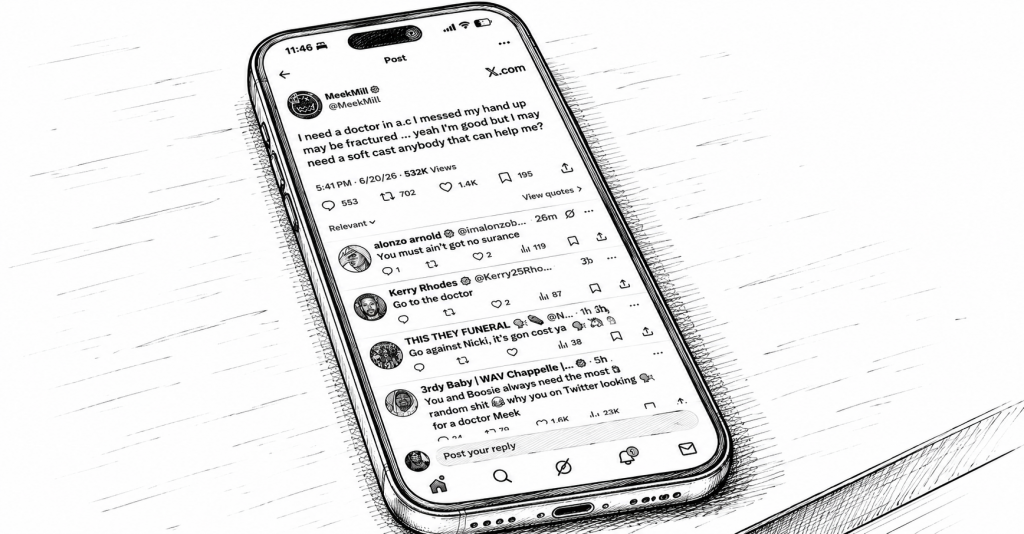
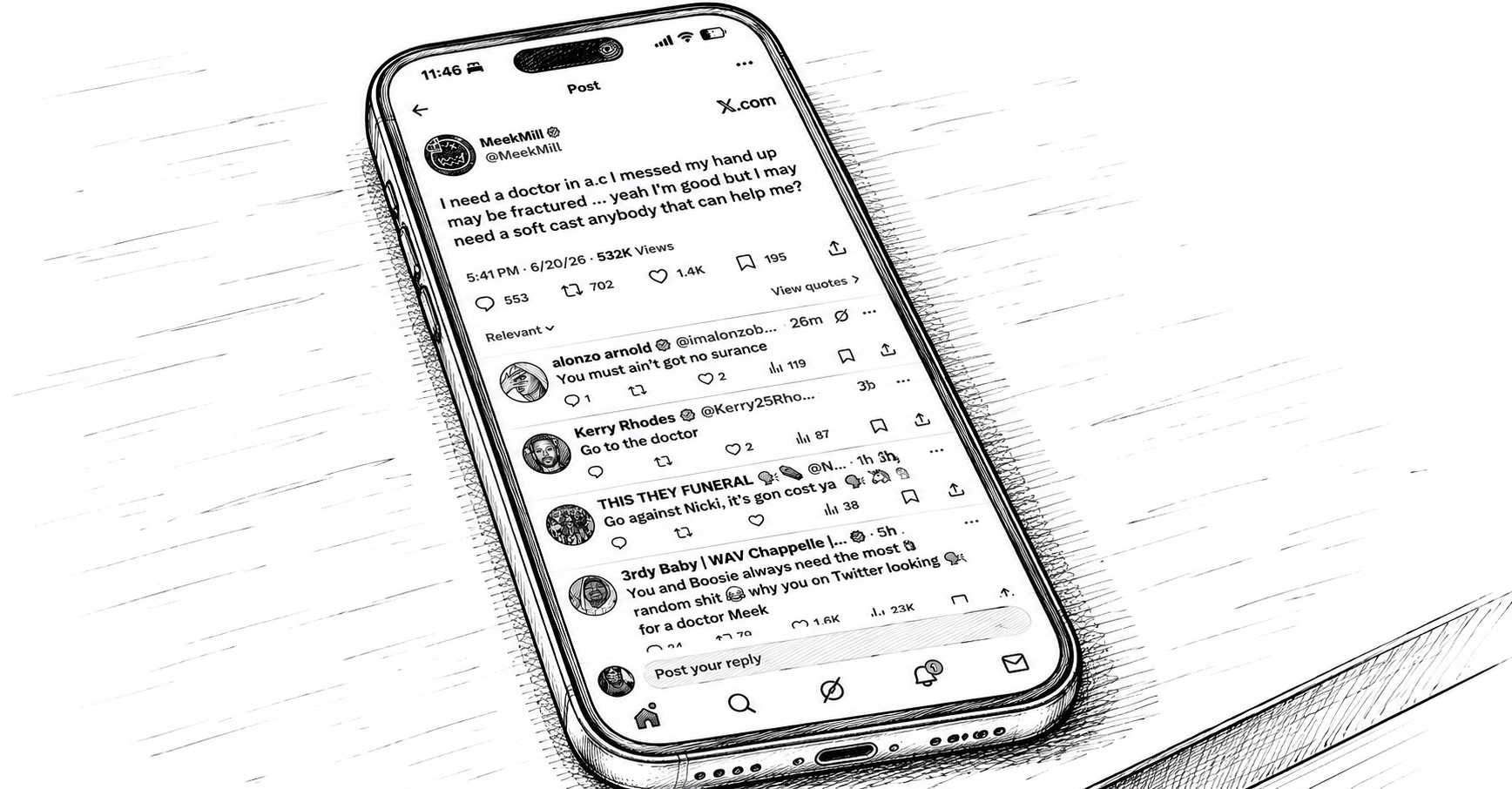
Meek Mill posted on X at 5:41 PM on June 20: “I need a doctor in a.c I messed my hand up may be fractured … yeah I’m good but I may need a soft cast anybody that can help me?” The post crossed 532,000 views within hours, drawing 553 replies, 702 reposts, and 1,400 likes. The replies split cleanly into three categories. Some users offered direct, practical advice — “Go to the doctor,” “Go to the damn emergency room instead of running to social media.” Others turned it into a bit, flooding the thread with AI-generated GIFs of pigeons and confused-looking men in white coats captioned “I know a guy!!” One user accused him of needing “the most random shit” right alongside Boosie, a recurring internet joke about both rappers’ unusual public requests. A smaller cluster expressed genuine confusion at the premise itself: “Bro is rich and be asking Random people for some help like he has nobody around him.”
That last reaction names the real tension in the thread, more than the jokes do. Meek Mill has the resources to access nearly any specialist in the country within hours. He posted on a public platform with 11 million followers instead, and the confusion in the replies wasn’t really about the medical need — it was about the channel. People expect wealth to translate directly into access: the right doctor, on call, reachable through a private number. What Mill’s post reveals, intentionally or not, is that fame and money don’t automatically produce that kind of frictionless personal network. Public figures often maintain enormous audiences while operating with surprisingly small circles of immediately available trusted contacts for a specific, narrow need — in this case, an orthopedic recommendation in Atlantic City, on a Saturday evening, for an injury that wasn’t severe enough to justify an ER visit but was bothering him enough to want a same-day soft cast.
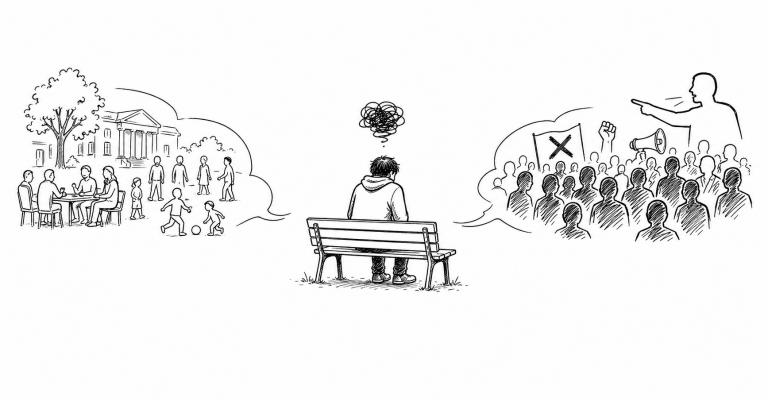
That’s not an isolated celebrity quirk. It’s a visible version of something that’s become structurally normal across social platforms. People routinely ask X and TikTok for medical recommendations, Reddit for legal interpretation, Facebook groups for contractor referrals, and LinkedIn for job leads — replacing the referral systems that used to run through neighbors, churches, extended family, and workplace networks with a single public post to a crowd of strangers and loose acquaintances. The mechanism is the same whether the person posting has 200 followers or 11 million: the platform has become a faster, broader substitute for the kind of dense personal network that used to make a same-day doctor recommendation possible without ever leaving a group chat. What’s different about a celebrity doing it is scale. When an ordinary person posts that request, a few dozen friends see it. When Meek Mill does it, the post becomes a public spectacle, generating real medical suggestions, AI meme content, and a referendum on what wealth is supposed to buy — all in the same thread, within the same hour.
SSC examined why Black Twitter functioned as real infrastructure before its collapse — a coherent space where context traveled alongside content, where you knew roughly who was in the room, and where collective attention could be coordinated fast enough to matter. What replaced it is more distributed, more personalized, and harder to coordinate. Mill’s thread is a live demonstration of what that fragmented replacement actually looks like in practice. There’s no single coherent room anymore where a need like his would reliably reach the right person fast. Instead, there’s a public post that reaches hundreds of thousands of people simultaneously, and the response that comes back is a chaotic mixture of real help, mockery, and memes, sorted by nothing more organized than who happened to be scrolling. The infrastructure didn’t disappear. It got noisier and less reliable, even as it got bigger.
The specific shape of the backlash is worth sitting with too. A meaningful share of the replies weren’t mocking the request for help itself — they were mocking the gap between expectation and reality. “Why are you tweeting??? you should be googling” and similar comments register the same complaint: that turning to a public platform for something this practical reads as either avoidable or revealing. But the fact that Mill chose a public post over, say, calling his team or a concierge medicine service is itself informative. It suggests that even with money, the fastest path to a usable answer — a real orthopedist, in the right city, available same-day — ran through a public crowd rather than a private rolodex. Social capital, unlike net worth, doesn’t scale the same way. Having the resources to pay for care isn’t the same as having immediate, on-demand knowledge of who the right specialist is in a city you don’t live in.
What the entire exchange demonstrates, jokes and genuine offers alike, is how thoroughly platforms have absorbed a function that used to belong to dense, local, often invisible human networks. The internet has effectively become a waiting room — a place where a need gets posted publicly and the response arrives as a chaotic but real mixture of mockery, memes, and occasionally useful information, sorted by whoever happens to be paying attention at that moment. Mill will likely find his doctor, soft cast and all, through some combination of the public thread and his own team working in parallel. But the structural lesson holds regardless of how this particular injury resolves: when even someone with Meek Mill’s resources defaults to a public crowd for a practical referral, it says less about his individual judgment and more about how unevenly distributed real personal networks have become — and how completely platforms have filled the gap left behind, however imperfectly.
— SSC Culture Desk | Social Storytellers Collective
Free, daily structural analysis like this lands in your inbox every weekday morning. Subscribe: https://246481934.hs-sites-na2.com/newsletter