Sweden’s Market Court Orders Google to Pay PriceRunner $1.5 Billion — and Changes How Tech Companies Calculate Risk

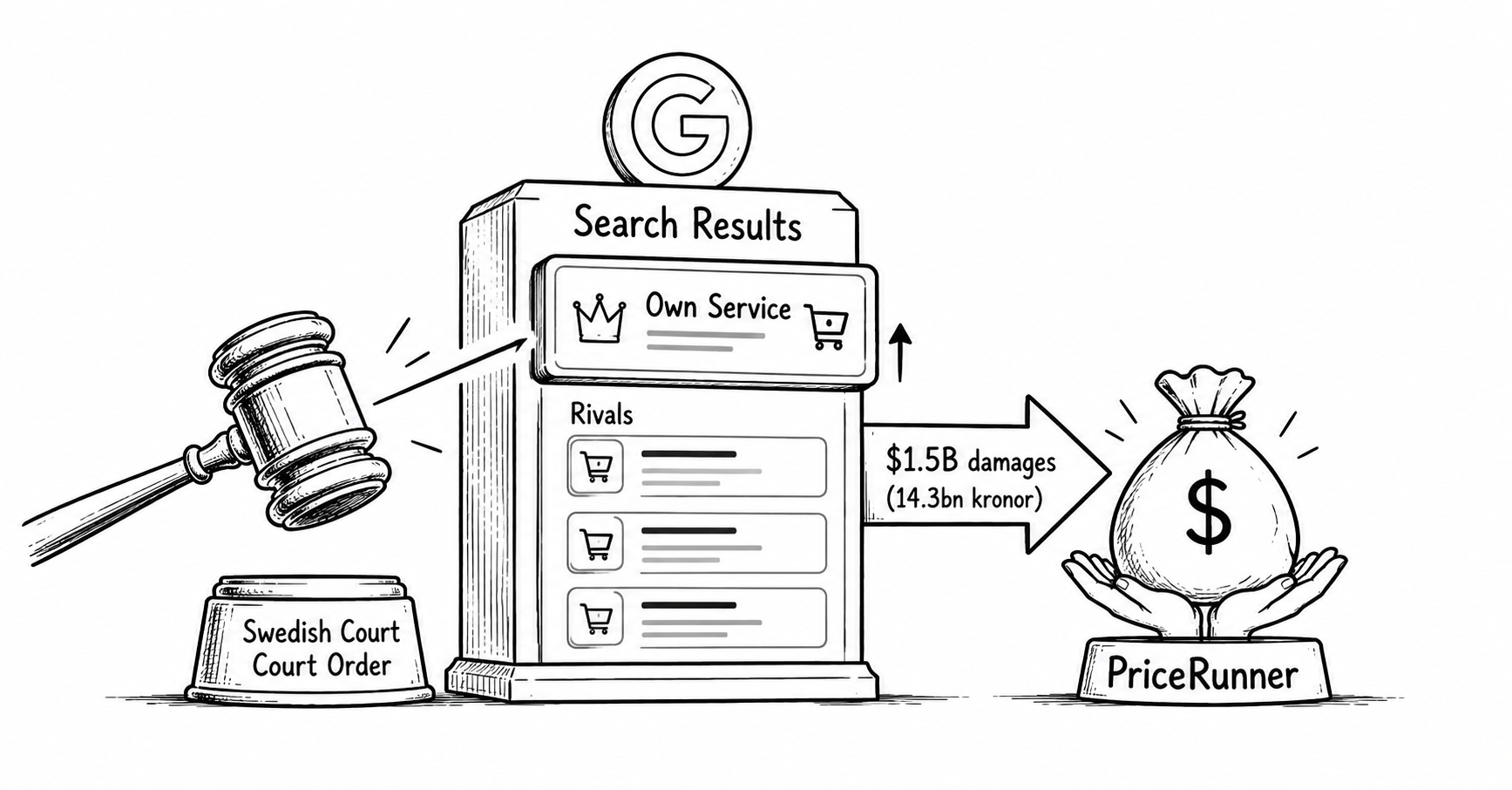
Sweden’s Market Court ordered Google to pay PriceRunner roughly 14.3 billion kronor, about 1.5 billion dollars, in what AFP via France 24 described as the country’s largest competition-related award, after ruling that Google unlawfully favored its own price comparison service over rivals in search results. The conduct at issue is familiar and has been litigated in Europe for more than a decade. What is new is the shape of the remedy, and the shape is what changes company behavior.
Fines vs. Damages: The Mechanism That Matters
Regulatory fines and private damages awards are both large sums leaving a company’s accounts. They function differently. A fine is paid to a government, calculated against turnover, capped by statute, and negotiated through an administrative process with appeal routes that can run for years. It registers as a cost of doing business, and firms with sufficient margin treat it as one. Nothing about paying a fine restores the position of the competitor that was harmed.
A damages award paid to that competitor does something else. It transfers money from the firm that benefited to the firm that lost, which means the injured party is made whole rather than the treasury being topped up. It has no statutory ceiling tied to turnover; it is tied to demonstrated harm, which in a market where a rival was foreclosed can exceed what a regulator would have imposed. And critically, it creates a template that any similarly situated competitor can follow, in any jurisdiction that permits the claim.
The Cascade Effect
One regulator issuing one fine is a discrete event a company can budget for. An established finding of unlawful self-preferencing, combined with a court willing to award substantial damages to a private plaintiff, is an open invitation to every price comparison service, every vertical search competitor, and every merchant that lost placement over the relevant years. The exposure stops being a line item and becomes a function of how many parties choose to sue.
European competition authorities established the underlying finding years ago. Regulatory enforcement against Google’s treatment of comparison shopping services has been running since the mid-2010s, and the pattern of self-preferencing in search results has been examined repeatedly across jurisdictions. The difficulty has never been proving the conduct. It has been that the remedies did not reach the harm. A firm can pay a fine, adjust presentation at the margins, and retain the market position the conduct produced, because the competitors that would have occupied that position no longer exist or no longer have the scale to contest it.
Damages litigation addresses that only partially and it addresses it in the currency that matters. PriceRunner is being compensated for a position it lost. Whether 1.5 billion dollars restores a viable competitor to a market Google has occupied for a decade is a separate question, and the honest answer is probably not. Money does not rebuild the user habits, merchant relationships, and data advantages that accrued to the incumbent during the years in question. The award is a transfer, not a restoration.
But it changes the arithmetic going forward, and that is where the effect will show. A company weighing whether to favor its own service in a ranked list has historically compared the commercial gain against an expected regulatory penalty discounted by the probability of detection and the years of appeal. Introducing uncapped private damages, available to every affected competitor, in every jurisdiction with a functioning competition court, changes that calculation more than raising the fine would.
Distributed Enforcement Changes Everything
The jurisdictional detail is worth attention. This came from Sweden’s Market Court, not from Brussels. National courts applying competition law to companies operating across the bloc produce a different enforcement pattern than centralized regulatory action does. It is less coordinated and less predictable, and for a defendant it is harder to manage, because there is no single authority to negotiate with and no single proceeding whose conclusion resolves the exposure.
That pattern parallels what is happening in American antitrust, where 12 state attorneys general obtained a restraining order against a 110 billion dollar media merger that federal enforcers did not challenge. In both cases, enforcement is migrating from a central authority to a distributed set of actors with their own standing to sue. The doctrine is not new in either instance. What changed is who is using it, and distributed enforcement is harder for a large firm to manage precisely because it cannot be settled in one room.
What Comes Next
The amount will be appealed and may be reduced. Awards of this size rarely survive review intact, and the final figure matters less than the finding that supports it. A court that has held self-preferencing unlawful and quantified the harm has produced a document other plaintiffs will file with their own complaints.
Expect a sequence of comparison-shopping and vertical search claims across European national courts over the next two years, each citing this ruling, each seeking damages rather than penalties. The regulatory phase of this dispute established what Google did. The litigation phase will establish what it cost, and that number will be assembled from many courts rather than announced by one.