Why Falling AI Costs Are Producing Bigger AI Bills
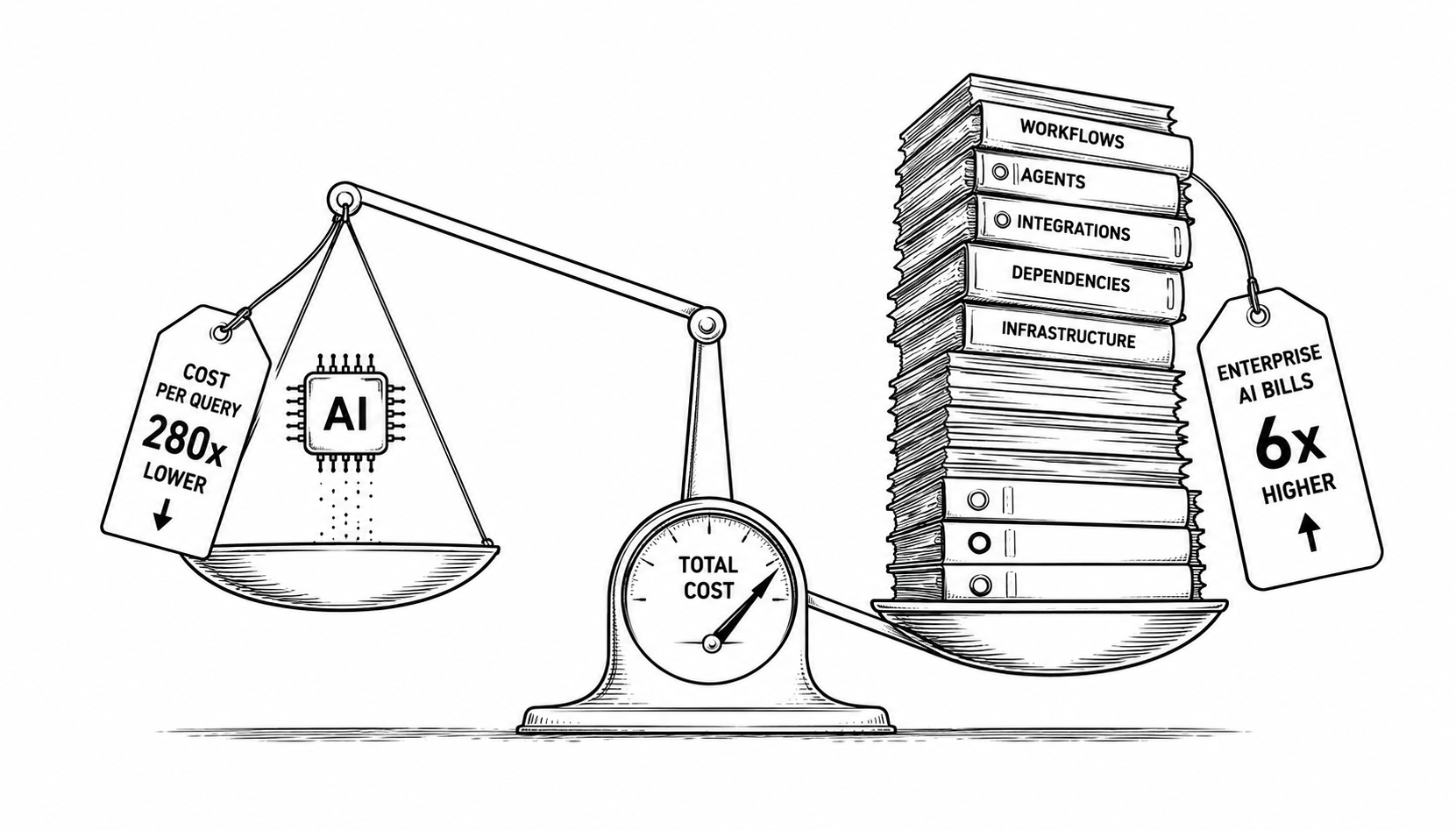
Token prices have dropped 280 times in two years. Enterprise AI budgets have grown nearly 6x in the same period. The math is not a contradiction — it is a mechanism.
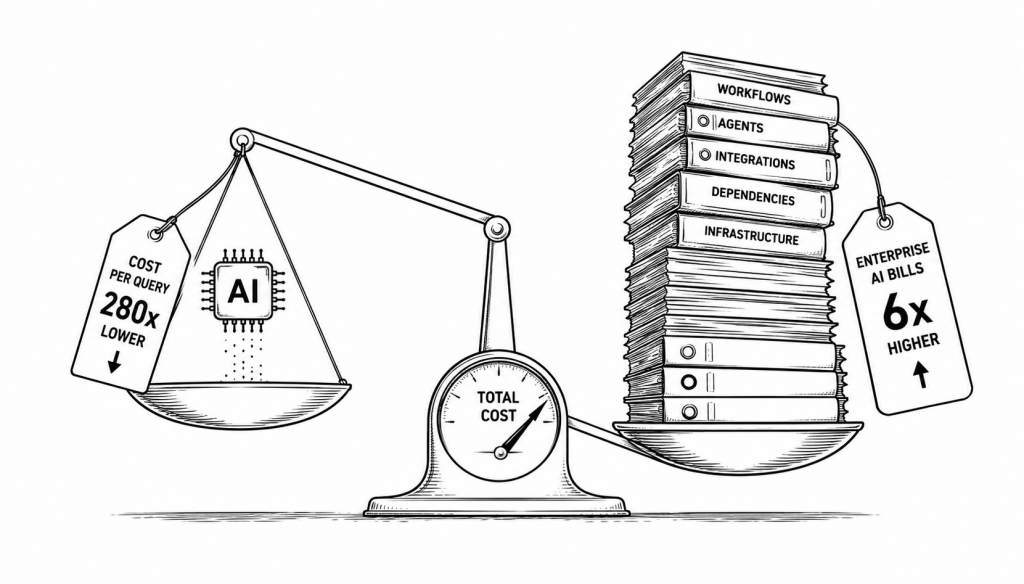
The cost of an AI query has fallen roughly 280 times over the past two years. The average enterprise AI budget has grown from $1.2 million annually in 2024 to $7 million in 2026. Both numbers are accurate. They are not a contradiction. They are a mechanism.
When a technology becomes cheaper, organizations use more of it. When they use more of it, they build workflows, products, and dependencies around it. When those dependencies exist, every marginal cost increase becomes a structural cost — not a discretionary spend that can be cut, but an operating line that can’t easily be removed without breaking something that now works. AI is doing this faster than most technologies have before it, because the price decline has been steep enough to make the technology feel free at the experimental stage, and because agentic workflows — systems in which AI models trigger other AI calls automatically — multiply token consumption in ways that don’t appear in pilot budgets.
The data on volume is specific: agentic AI workloads consume roughly 1,000 timesmore tokens than standard chat interactions for comparable tasks. Uber burned through its entire 2026 AI coding budget in four months. The FinOps Foundationfound that 73% of enterprises reported AI costs exceeded original projections. Goldman Sachs forecasts that agentic AI could drive a 24-fold increase in total token consumption by 2030. The budget shock is not coming from prices going up. It is coming from usage going up faster than anyone priced it, because the per-unit cost signal suggested the technology was nearly free.
Microsoft has been the clearest case study. Its GitHub Copilot deployments generate token costs that, in some enterprise configurations, now exceed the cost of the developers the tool was deployed to assist. The tool is still producing value — faster code, fewer errors, reduced time on routine tasks. But the economic case that AIcoding tools would reduce labor costs has been replaced by a more complicated question: are the productivity gains worth the token bill, and how do you measure that when the labor costs and the token costs appear in different budget lines under different owners?
The broader pattern is Jevons’ Paradox applied to compute. When a resource becomes cheaper, efficiency gains in that resource tend to increase total consumption rather than decrease it. The AI industry priced itself as a cost-reduction technology. What it is producing, at scale, is a new category of operating cost — one that grows with deployment rather than shrinking, and one that will require organizations to develop AI financial governance disciplines they have not needed before.
— SSC Economy Desk | Social Storytellers Collective