Intel Is Cutting the Division That’s Winning
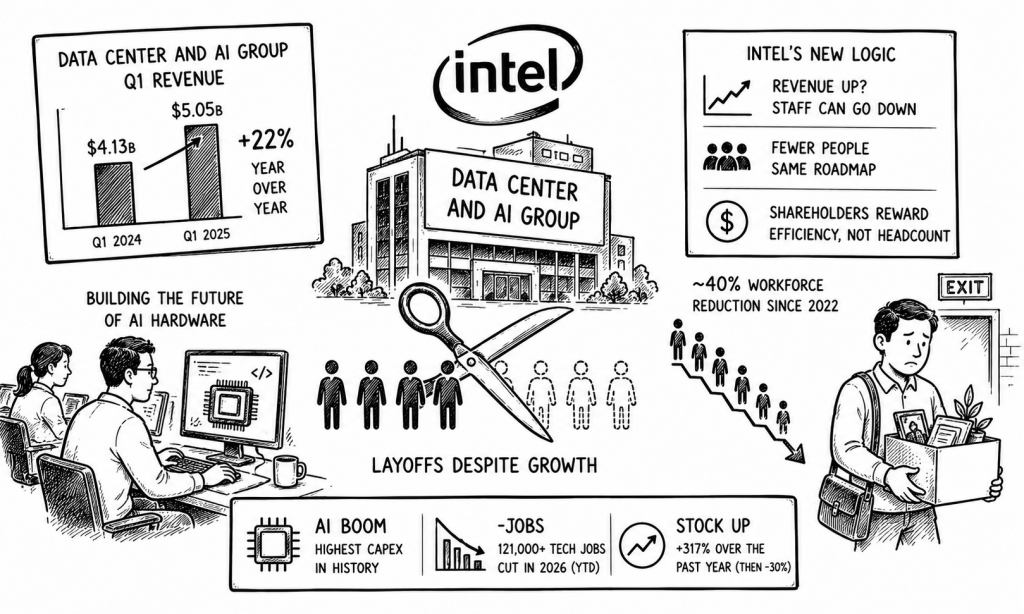
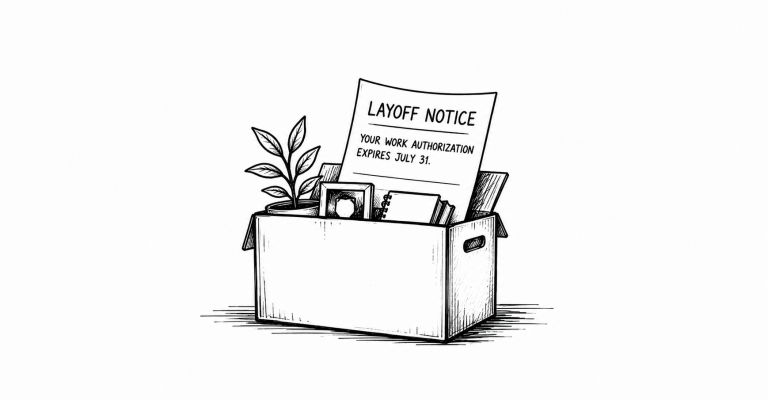
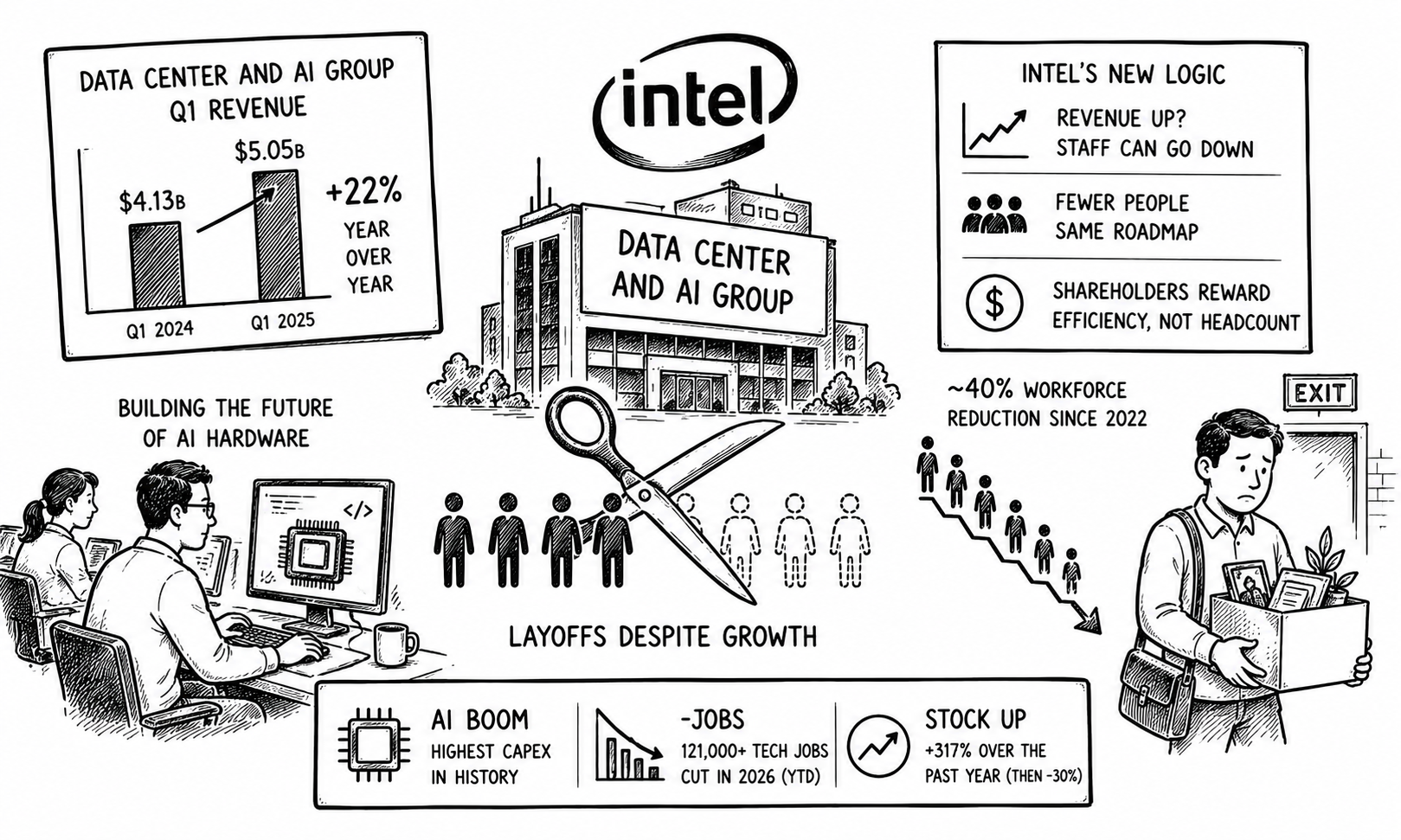
The Oregonian first reported on July 20 that Intel has told employees in its Data Center and AI Group to expect a fresh round of job cuts, a move the company confirmed to Business Insider as part of a broader effort to become a more focused and efficient company. The detail that makes this worth more than a routine layoff item is the one buried in the earnings file. That division posted first-quarter revenue of 5.05 billion dollars, up 22 percent year over year, according to reporting compiled by TrendForce. Intel is cutting the unit that is growing.
The usual explanations do not fit. A company reduces headcount in a business because demand fell, because a product failed, or because a market closed. None of those describe server CPUs and custom AI chips in 2026, which sit at the center of the largest capital expenditure wave in the industry’s history. Tom’s Hardware noted the awkwardness plainly, observing that the Data Center group is among Intel’s strongest performers and well positioned for the AI buildout, and that gutting it is a surprising choice.
So the question is what a cut means when it is not a response to weakness. The answer is that headcount has been decoupled from performance as a management variable, and Intel’s numbers show how far that has gone. TrendForce, citing The Oregonian, reported the company’s global workforce has fallen nearly 40 percent in four years, from roughly 132,000 in 2022 to about 81,000 now, through a combination of divestitures and tens of thousands of layoffs. Benzinga noted that CEO Lip-Bu Tan, who succeeded Pat Gelsinger in March 2025, announced plans to reduce the global workforce by about 15 percent, with more than 5,000 U.S. employees already cut, concentrated in California, Oregon, Arizona, and Texas.
Here is the mechanism. Under the older arrangement, a division that grew was a division that hired, because growth required people and people were how you captured it. Under the current one, growth is evidence that a division can be run leaner, because if revenue rose 22 percent without a corresponding increase in effort, the implication management draws is that the effort was never the binding constraint. The better a unit performs, the stronger the case that it is overstaffed. That logic is internally consistent and it inverts the incentive every worker in the division thought they were operating under.
The market has told Intel this logic works. Benzinga reported the restructuring has coincided with a share price rally of more than 317 percent over the past year. Tom’s Hardware cited OregonLive noting the stock climbed from a low of 23 dollars to more than 96. KRON4 reported shares had since slipped roughly 30 percent from record highs earlier in the month, which is its own kind of data point, but the direction over the year is unambiguous. Investors did not reward Intel for the data center division’s revenue growth alone. They rewarded the combination of revenue growth and a shrinking payroll, and that combination is now the product being sold.
What this does to the labor market is more specific than a headline count. Intel remains one of the Portland metro’s largest private employers, with roughly 20,000 people across its Washington County campuses according to The Oregonian. Cuts in a division like this one do not fall on marginal roles. They fall on server architects, chip designers, and the engineers who build the thing that is growing, which means the skills being released are the exact skills the industry says it cannot find enough of. An engineer laid off from a growing AI hardware unit is not a person whose skills went obsolete. She is a person whose employer concluded it could ship the roadmap without her.
Intel says it can. A person familiar with the changes told Business Insider the cuts would not affect the division’s product commitments or roadmaps. Take that at face value and it is a statement with consequences. If a company can hold its roadmap constant while removing the people who were building it, then the relationship between staffing and output in advanced semiconductor design is looser than the entire industry’s hiring rhetoric has implied for a decade.
The pattern is not confined to Intel. Reuters reviewed documents showing Samsung Electronics America is cutting 739 positions in Englewood Cliffs, New Jersey, tied to its headquarters relocation to Texas, alongside cuts across U.S. display, smartphone, and other consumer electronics operations. Benzinga cited Layoffs.fyi counting 121,326 tech jobs eliminated so far in 2026, nearly matching the 122,606 recorded across all of 2025 with five months still to run. The sector is on pace to exceed last year’s total in a period when its valuations and capital spending are both at records.
What makes Intel’s version instructive is that the company removed the ambiguity. When Microsoft cut 4,800 roles, its chief people officer said the positions were not being replaced by AI, and the disclaimer was necessary because the alternative reading was available. Intel does not need the disclaimer. It is cutting a division that makes AI hardware, during an AI hardware boom, while that division grows. There is no substitution story to tell. There is only a company that has learned its shareholders will pay more for the same revenue produced by fewer people.
Intel reported second-quarter earnings on July 23, and the company may disclose the number of affected employees there. That figure will get the coverage. The number worth tracking instead is the ratio the company reports next year between data center revenue and data center headcount, because that ratio is now the metric management is optimizing and the one investors are pricing.
Expect the practice to move upstream from cost centers into revenue centers across the sector over the next four quarters. Once a company demonstrates it can cut a growing division without a roadmap slip and the stock rises, the demonstration becomes the template, and the argument that a profitable unit has earned its staffing stops being available to anyone.