India’s Youth Protests Outlasted the Hunger Strike That Started Them
Indian activist Sonam Wangchuk ended a 26-day hunger strike on Friday, NPR reported, after a protest movement he helped galvanize became one of the largest youth-led mobilizations in India in recent years. Demonstrators said they would continue until the education minister resigns. That sentence contains the entire question about this movement, because a hunger strike ending without its demand being met is usually where a protest wave breaks, and this one did not.
The hunger strike is a specific political instrument with a specific weakness. It concentrates enormous attention on one body and one timeline. Every day is a news event, the stakes escalate visibly, and a government faces mounting pressure to respond before something irreversible happens. That is the strength. The weakness is that the movement’s momentum becomes tied to a single person’s physical condition, which means the government can wait, and when the strike ends the pressure it generated ends with it. Governments have learned to manage these by doing very little and letting the clock run.
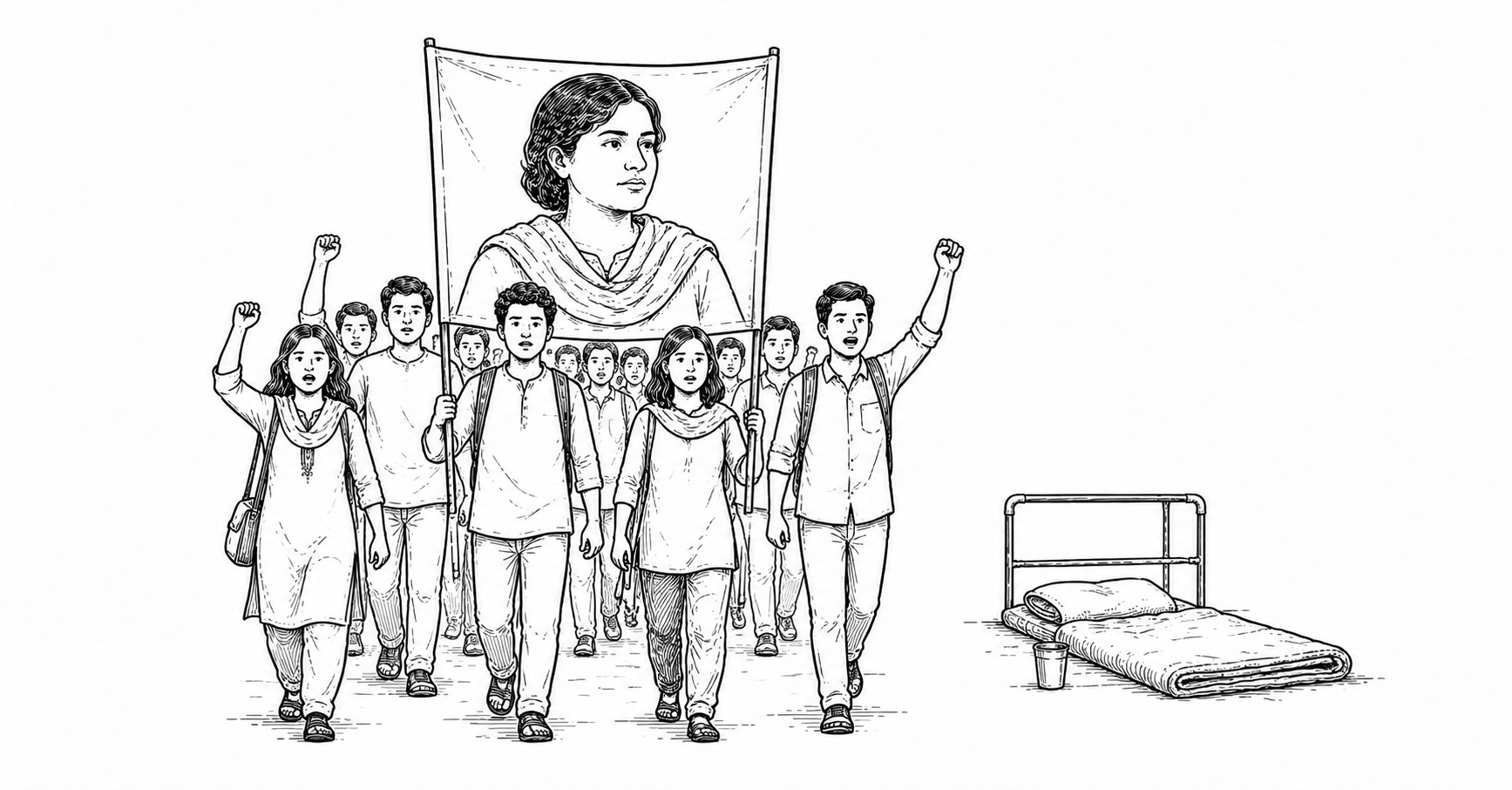
Wangchuk’s situation carried an additional layer. NPR’s coverage referenced a protester in New Delhi demonstrating with a banner bearing Wangchuk’s portrait after he was forcibly transferred to a hospital by police while striking. Removing a hunger striker to medical care is a maneuver that resolves the immediate danger and defuses the symbol at the same time. It is defensible as a welfare measure and it functions as a way to end a protest without appearing to suppress one.
That the demonstrations continued past both the hospitalization and the strike’s conclusion is the datum worth isolating. It indicates the mobilization had acquired a form independent of its most visible figure, which is the transition that separates movements with durability from those that dissipate when the founding individual steps back or is removed.
The demand itself tells you something about the movement’s character. Protesters want the education minister to resign. That is a narrow, concrete, and achievable target, which is a strategically sound choice and a limiting one. Narrow demands are winnable, and winning builds the confidence and organizational capacity that larger campaigns require. They are also containable. A government can remove a minister, ride out the news cycle, and leave every underlying condition in place, and the movement that defined victory as a resignation has to decide afterward whether it was actually about the minister.
Education ministries are a recurring flashpoint for youth movements globally, and the reason is built into what the institution represents. Education is where the state’s promise to young people is most explicit and most measurable. A government commits, implicitly, that credentials will convert into employment. When they do not, the ministry that issued the credential is the nearest institution to hold responsible, even when the failure sits in a labor market the ministry does not control. Youth movements that begin over examinations, fees, or curricula are often movements about the value of what a young person was told to spend six years acquiring.
That framing connects this to conditions well outside India. The relationship between credentials and employment is weakening across a number of economies at once, in part because the entry-level roles that converted degrees into careers are being eliminated. AI-attributed job cuts this year have concentrated in customer support, data entry, QA testing, and junior software engineering, which are the positions that functioned as first rungs. A generation encountering that closure will locate blame in whichever institution is closest, and the education system is closer than the firms doing the cutting.
The organizational vehicle here, described in the coverage as a movement led by the Cockroach Janta Party, is a detail worth understanding before drawing conclusions. Youth movements that operate through a named party structure behave differently from those organized through networks alone, because a party has an electoral incentive and a succession mechanism, and those change what the movement will accept as a settlement.
What happens over the next several weeks is the test. Sustained mobilization requires infrastructure that protest energy alone does not supply: legal support for arrested demonstrators, money, coordination across cities, and the ability to keep people engaged through a period when nothing dramatic is occurring. Most movements fail in the quiet stretch rather than under repression. The hunger strike solved the attention problem for 26 days. Nothing has yet demonstrated that this movement can hold attention without one.
The government’s likely approach is delay, because delay has worked before and costs little. Concede the minister if pressure becomes unmanageable, and otherwise wait for the academic calendar, the monsoon, or a competing news event to thin the crowds.
Expect the resignation demand to be met or nearly met, and expect that to be the point at which this either becomes a lasting formation or ends. A movement whose stated goal is achieved must immediately articulate a second one, and the second demand is always harder than the first because it cannot be satisfied by removing a single person. Whether anyone in this mobilization has drafted that demand yet is the thing that determines what it turns out to have been.