Private Colleges Are Telling Students They’re Already In. That’s Not Generosity. That’s Survival.
SSC News Desk
Hundreds of private universities are now admitting students who never applied. The access framing is real. So is the demographic cliff underneath it.
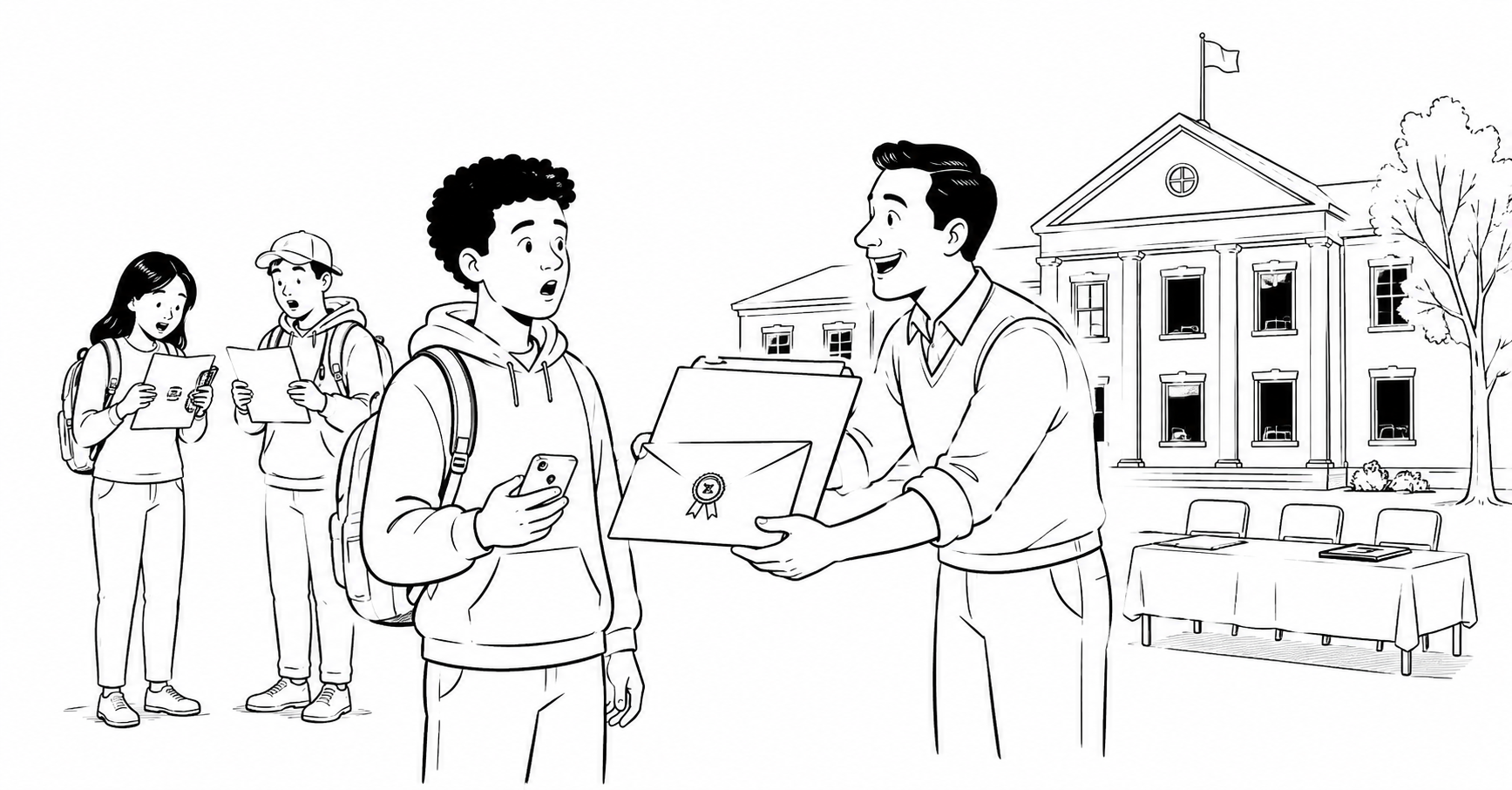
Wingate University, a private college of 2,600 undergraduates outside Charlotte, North Carolina, sent acceptance letters this year to 20,000 high school students who never applied. Each letter came with a $24,000 scholarship. No application required. Wingate expects to enroll 500 students through that process — more than 50 percent of its incoming freshman class, and eight times the number who accepted through the same approach in 2023, the first year the school tried it.
Wingate is not doing something unusual. It is doing something that more than 215 colleges and universities are now doing through the Common App’s direct admissions program alone, up from 70 schools in 2023–24. The platform Niche, a college search and enrollment site, has seen an 85 percent increase in schools participating in its own direct admissions tool since 2023. More than 60 institutions will begin making direct offers to students through Niche this week for the 2026–27 enrollment cycle.
The framing institutions use for this shift centers on access. Direct admissions, advocates say, reduces barriers for first-generation students and low- and middle-income applicants who may not know what financial aid is available or may find the application process itself prohibitive. The Common App’s direct admissions tool specifically targets those populations. At Nazareth University near Rochester, New York, which extends up to 40,000 direct admissions offers per year, the program is used to reach first-generation students through the Common App and expand into large markets in Texas, Florida, and California. Niche reports its direct admissions scholarships average $17,500 per year.
That framing is accurate and incomplete. The fuller explanation is demographic. The number of high school seniors in the United States is declining, and private colleges below the top tier of selectivity are competing for a shrinking pool of prospective students. Roughly 400 private, not-for-profit four-year institutions already have admissions rates of at least 80 percent, according to the National Center for Education Statistics. These are not institutions with the luxury of waiting for students to come to them. The average tuition discount rate for first-time students at private colleges reached 57 percent in 2026 — meaning the listed price and the price students actually pay are functionally different numbers at most institutions.
Rob Bielby, managing director at Huron, a consulting firm specializing in higher education, said direct admissions has “almost become a default requirement for institutions that are not at the highest tier of selectivity.” He noted that as these programs expand, students in specific geographies may receive admissions offers from “dozens, if not hundreds, of institutions” — most of which they did not seek out and may know nothing about.
That is the structural reality underneath the access language. The colleges most aggressively pursuing students who never applied are the ones most financially exposed to enrollment decline. Lycoming College in Pennsylvania, with listed tuition of roughly $52,000 a year, recorded an 18 percent jump in applications for the 2025–26 cycle after implementing direct admissions and is now investing in campus housing to attract students who visit. Wingate’s listed tuition is approximately $44,000 per year — the scholarship reduces that, but the school’s VP of enrollment acknowledged the school’s net tuition after aid is comparable to in-state public universities in North Carolina, which is both a selling point and an indication of how significant the discount is.
The schools not participating in direct admissions are the schools that do not need to. Harvard is not sending unsolicited acceptance letters. The institutions sending tens of thousands of pre-emptive offers are the ones whose survival depends on converting more of a smaller pool. That is not a criticism of the model — the scholarships are real, the access benefits are real, and removing application barriers can meaningfully change who considers attending. But the driver is institutional need, not institutional generosity, and those two things produce different policies when they come apart.
What changes as direct admissions scales: the signal value of selective admissions continues to erode at the schools where it was already weakest, the volume of college offers students receive increases to the point of noise, and the institutions best positioned to survive the demographic decline are not necessarily the ones offering the most to students — they are the ones with the resources to invest in what happens after students arrive.