
Paris Is Turning Heat Adaptation Into Public Swimming Access
Paris spent a month trying to keep people out of the water during a heatwave. Then the city admitted that approach was never going to work, and started letting people in instead.
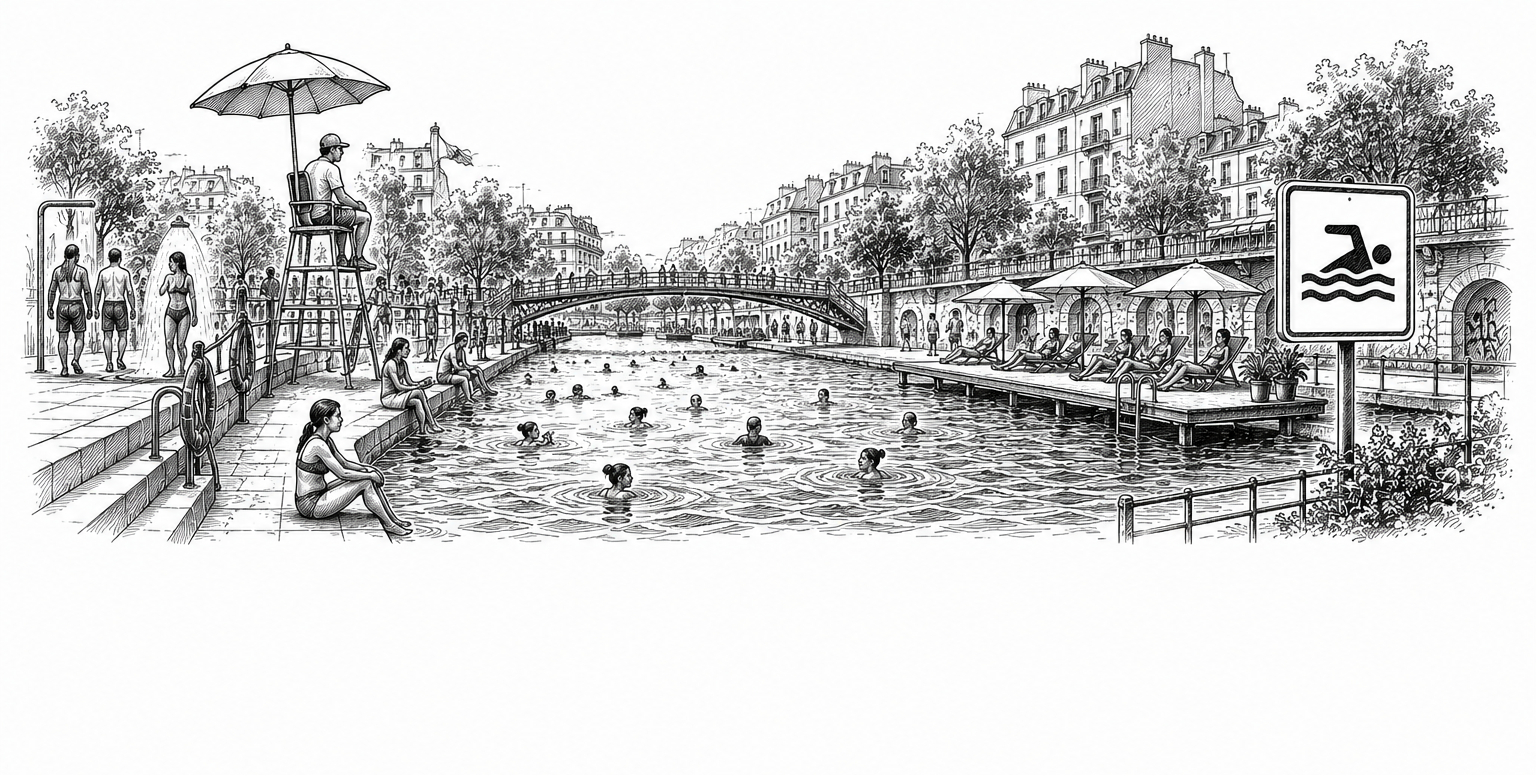
Paris City Hall opened a 100-meter stretch of the Canal Saint-Martin to swimmers on June 17, ahead of its planned July opening, as a new heatwave pushed temperatures toward 40°C. The early opening followed a public standoff a month earlier, when the city spent what Paris Mayor Emmanuel Grégoire described as “a huge amount of effort stopping young people from swimming” during an unauthorized heatwave dip in the same canal. Grégoire’s framing of what changed is unusually direct for a municipal government: “That way of thinking was really absurd. Rather than spending energy pulling them out of the water, I preferred to work on allowing them to swim safely.”
That’s a real reversal in enforcement logic, not just a scheduling adjustment. The old model treated unauthorized swimming as a compliance problem: post the prohibition, deploy personnel to enforce it, treat every heatwave as a new round of the same standoff between overheated residents and the rules meant to keep them out of the water. The new model treats it as a demand problem: people are going to try to cool off in the water regardless of what’s posted, so the more effective intervention is making that behavior safe rather than making it illegal. Alexandra Cordebard, mayor of the city’s 10th district, called the shift “a new way of tackling climate change and adapting the city.”
The infrastructure behind the reversal took over a decade and roughly €1.4 billion to build, most of it aimed at the Seine rather than the canal specifically. A 46,000-cubic-meter underground storage tank near Austerlitz, big enough to hold the volume of 20 Olympic pools, now intercepts sewage overflow that used to spill into the river during heavy rain, the mechanism that kept the Seine officially closed to swimmers for over a century after a 1923 ban. That investment was accelerated by the deadline pressure of hosting the 2024 Olympics, but its ongoing payoff is showing up specifically in how the city handles heat two years later: daily water-quality testing, lifeguards, showers, and sun decks at multiple free public sites along the Seine, plus the Bassin de la Villette and now the Canal Saint-Martin, with 2026 adding a new free site in Seine-Saint-Denis and extending the swimming season to bracket both June heatwaves and the traditional July-August window.
The safety protocols matter as much as the access itself, because they’re what makes “just let people swim” a defensible public-health policy rather than a liability risk the city is choosing to absorb. Swimmers must be at least 140 centimeters tall to enter the Seine directly; shorter swimmers and non-swimmers use a separate shallow pool. Jumping from footbridges is banned. Areas outside the designated, supervised zones remain off-limits. The regional health agency runs continuous water-quality monitoring. None of that removes risk entirely, officials have flagged strong currents, depths up to 3.5 meters, and boat traffic as ongoing hazards, but it converts an unmanaged, unauthorized cooling behavior that the city couldn’t actually stop into a managed one it can actually oversee.
The framing that ties it together is explicitly about capacity, not just comfort. Guidance for swimmers at the urban sites specifically appeals to “everyone’s sense of responsibility” to avoid risky behavior “so as not to overwhelm the region’s hospitals,” treating public swimming access as a release valve for emergency-service demand rather than an amenity layered on top of it. That’s the same logic infrastructure planners apply to cooling centers and shade corridors elsewhere, treating heat response as capacity management across an entire public system, not an isolated set of interventions at each individual site.
Former Paris mayor Anne Hidalgo, who championed the original Seine cleanup, put the long-term rationale plainly when the river first reopened: “Heatwaves are only going to increase.” Paris built its swimming infrastructure on an Olympic deadline for an Olympic reason, but what it’s revealing now, two summers later and in a smaller canal rather than the marquee river, is that the same infrastructure functions as climate adaptation whether or not anyone planned it that way from the start. The city that spent a decade and well over a billion euros cleaning a river for a two-week sporting event is now using that investment every time the temperature crosses 35°C, which is happening earlier in the year and more often than the original planning timeline accounted for.