
America 250 Is Being Rewritten by Heat, Politics, and Public Safety
The country’s semiquincentennial arrived on schedule. The conditions it was designed for did not.
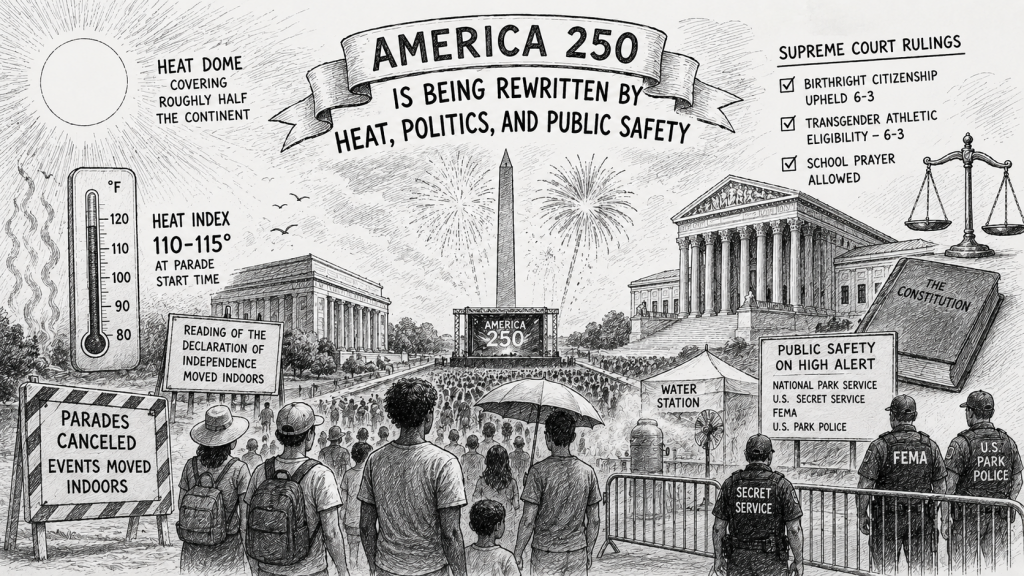
The United States marked its 250th birthday on July 4, 2026 under conditions that no planning document anticipated: a heat dome covering roughly half the continent, a Supreme Court term that ended with rulings on birthright citizenship, transgender athletic eligibility, and school prayer all landing in the same week, and a public safety apparatus that spent the day managing events it couldn’t fully open. The celebration is real. The National Mall fireworks will go forward. Donald Trump’s address will proceed. But the infrastructure surrounding those events — the parades, the outdoor gatherings, the reading of the Declaration of Independence at the National Archives — has been rerouted, delayed, moved indoors, or canceled entirely.
That reorganization is not incidental. It is the event. A country that chose to celebrate its 250th anniversary with the largest planned outdoor gathering in its history discovered, in the week before the celebration, that heat index values of 110 to 115 degrees at parade start time made the original schedule a public health liability. The Washington D.C.Independence Day Parade was canceled the night before. Philadelphia’s Salute to Independence Semiquincentennial Parade was canceled the morning of. The reading of the Declaration of Independence was moved from its traditional outdoor setting. The National Park Service, the U.S. Secret Service, FEMA, and the United States Park Policecoordinated misting stations, water distribution points, and revised crowd-flow plans for a celebration that had been years in the making.
What the logistics exposed is a mismatch that goes deeper than a single heat event. The America 250 planning assumed that the country’s summer infrastructure — its streets, its gathering capacity, its public event protocols — would hold for a multi-day national celebration in early July. Those assumptions were built for a climate that no longer reliably delivers the conditions they require. A 100-degree heat index in Washington D.C. in early July is not a freak outlier in 2026. It is a recurring risk that planners have to price into every major public event scheduled for summer.
The political dimension ran parallel. The week the country turned 250, its highest court was adjudicating who belongs to it. The Supreme Court upheld birthright citizenship 6–3, rejecting an executive order that would have narrowed the 14th Amendment’s reach. The 6–3 ruling on transgender athletic eligibility gave states more authority to define gender through public institutions. A country simultaneously celebrating 250 years of a founding document that declared all people created equal — while actively litigating who that declaration applies to — is not in contradiction with itself. It is doing what it has always done: arguing about the gap between the promise and the delivery, in every legal and political forum available, while the fireworks go up anyway.
What 2026 adds is a physical layer the founders could not have written into the ceremony. The heat dome does not respect the holiday schedule. It does not defer to the planning timeline or the symbolism of the date. It arrived the same week as the 250th, reshaped the events designed to mark it, and will return next year whether or not the grid and the gathering infrastructure are ready. A country that wants to keep celebrating in public will have to decide what it is willing to rebuild in order to do so.