Extreme Heat Is Becoming a Workplace Rights Issue
There is still no federal rule that says an employer has to stop working someone once the heat index crosses a specific number. That gap is what workers are living inside of this week.
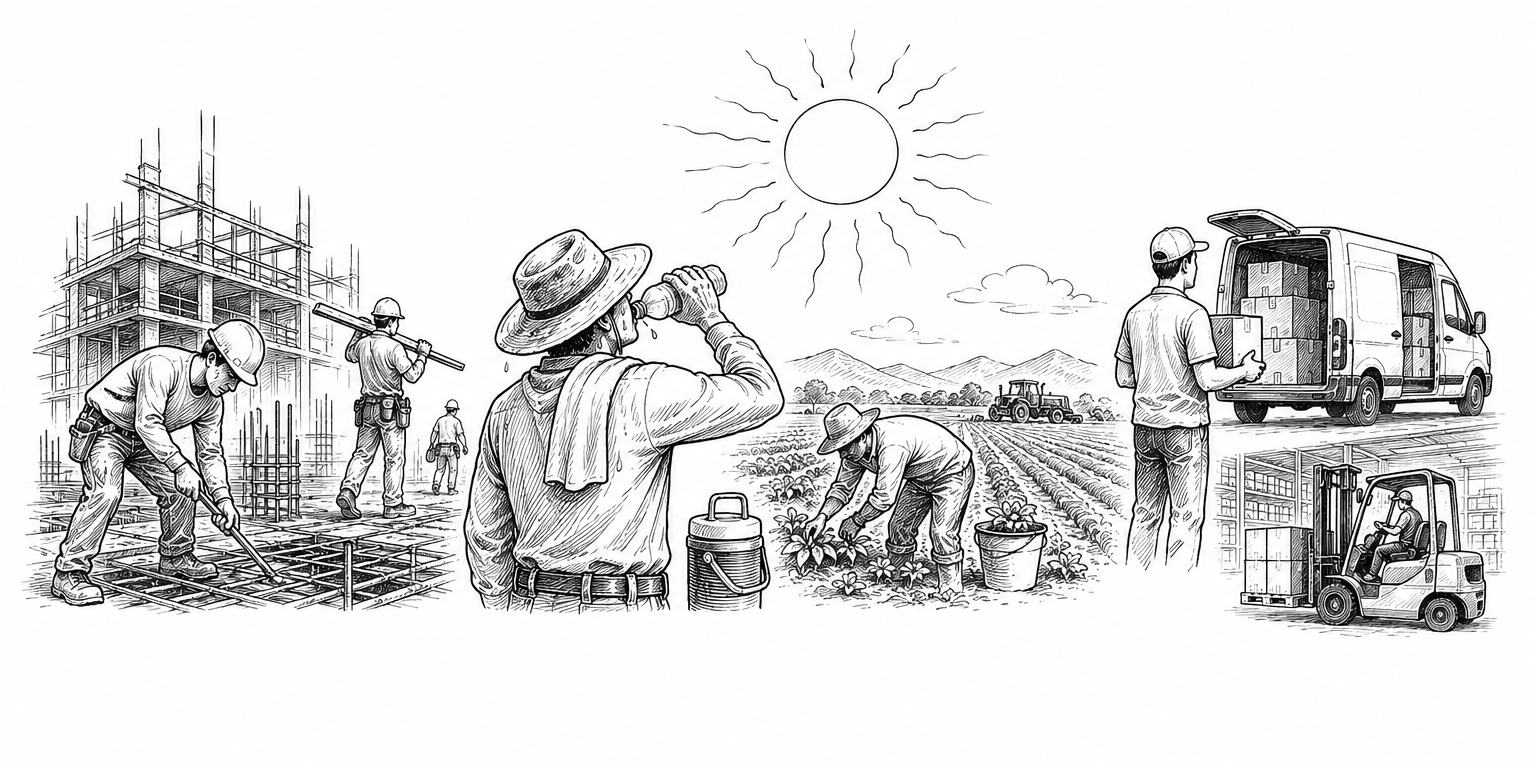
As a heat dome pushes dangerous temperatures across half the country this holiday weekend, millions of outdoor and indoor workers, construction crews, farmworkers, delivery drivers, warehouse staff, remain covered by no binding federal heat standard at all. OSHA published a proposed federal heat rule in August 2024 that would require water, shade, rest breaks, and acclimatization plans once temperatures cross 80°F and 90°F thresholds. It has been in the rulemaking process for nearly two years, through a public hearing that ran from June through July 2025 and a comment period that closed in October. It is still not law. In the meantime, OSHA enforces heat protections mainly through its General Duty Clause, a catch-all provision that requires employers to keep workplaces free of recognized hazards, and through a renewed National Emphasis Program that sends inspectors into workplaces, but only on days the National Weather Service issues a heat advisory, and only as an add-on to inspections already underway for other reasons.
While the federal rule sits in limbo, workers’ actual protections vary enormously depending on which state they happen to work in. Six states, California, Oregon, Washington, Nevada, Colorado, and Maryland, now have enforceable heat illness standards on the books, and every one of them exceeds what the stalled federal proposal would require. California’s outdoor standard mandates shade above 80°F, mandatory ten-minute cool-down breaks every two hours once temperatures hit 95°F, a 14-day acclimatization period for new workers, and a full quart of water per worker per hour. Oregon’s rule escalates rest-break requirements sharply as temperatures rise: 20 minutes of rest per hour at 95°F, 30 minutes at 100°F, 40 minutes at 105°F. Virginia’s governor signed legislation in April directing the state’s labor department to build its own rule. Most states have nothing.
That patchwork means a construction worker’s legal protection from heat exposure currently depends less on the temperature they’re working in than on which side of a state line they’re standing on. A worker in Sacramento has a mandated water ration, shade requirement, and acclimatization schedule written into law. A worker doing identical physical labor in a state without a heat standard has whatever protection their individual employer voluntarily chooses to provide, enforceable only after the fact, if OSHA can prove the employer violated the General Duty Clause’s general hazard-recognition standard, a far higher bar than a specific numeric trigger.
This is not a hypothetical gap. Heat is already the deadliest weather-related hazard in the country, and the risk concentrates specifically among workers who cannot remote-work their way out of exposure: agricultural laborers, roofers, delivery drivers, warehouse workers in unairconditioned facilities, landscapers, and outdoor utility crews. These are also disproportionately lower-wage jobs with less individual bargaining power to refuse unsafe conditions, less job security to fall back on if they do, and less access to paid time off if a heat illness sidelines them for a day. The workers most exposed to the hazard are frequently the workers with the least leverage to demand protection from it.
The stalled federal rulemaking illustrates why the standard has been this hard to finalize. Testimony at OSHA’s public hearing split along predictable lines: labor advocates pushing for mandatory 15-minute breaks every two hours, employer groups calling that schedule “disruptive” to operations. OSHA has signaled it’s still weighing evidence on basic questions, like whether fans in break areas actually help or make heat stress worse by blowing hot air. Two years into the process, the agency has said only that it intends to develop a final rule that is “feasible for employers” as well as protective of workers, language that leaves enormous room for a rule to end up considerably weaker than the 2024 proposal once finalized.
What makes this gap matter now, specifically, is timing. Climate models point toward summers arriving earlier and lasting longer, meaning the season during which heat is a live occupational hazard is expanding on both ends of the calendar even as the regulatory apparatus meant to protect workers during it remains stuck in comment periods and hearing transcripts. A heat dome large enough to disrupt a national holiday and force emergency grid orders is also, for millions of workers without a state-level heat standard, a week in which their legal protection from heat exposure amounts to whatever their employer decides to voluntarily provide. The infrastructure question, whether the grid can handle the heat, has gotten emergency federal attention. The labor question, whether the workers outside in it have an enforceable right to water, shade, and rest, is still sitting in a regulatory queue with no finalized answer.