San Francisco Has Been Miscounting Its Homeless Population for Years. Now It Wants to Prioritize Residents Who Have Been There Longest.
A counting error and a residency-first proposal reveal the same thing: the city’s safety net is being redesigned around who deserves access to it, not who needs it most.
San Francisco changed how it counts its homeless population in early 2026 after years of HUD-reported figures the SF Standard identified as systematically inaccurate — undercounting the number of people living without shelter in the city. The revised methodology brought the city’s count closer to what street-level surveys and shelter data had been suggesting for years: the number of unhoused residents is substantially larger than official figures acknowledged. Simultaneously, the city began exploring a proposal to ask unhoused people how long they have lived in San Francisco before determining their eligibility priority for housing resources.
These two developments belong to the same policy argument, even though they are being covered separately. The counting revision acknowledges that San Francisco did not know accurately who was experiencing homelessness within its limits. The residency-first proposal is the city’s answer to that problem — not to house more people, but to house people who have been there longer first.
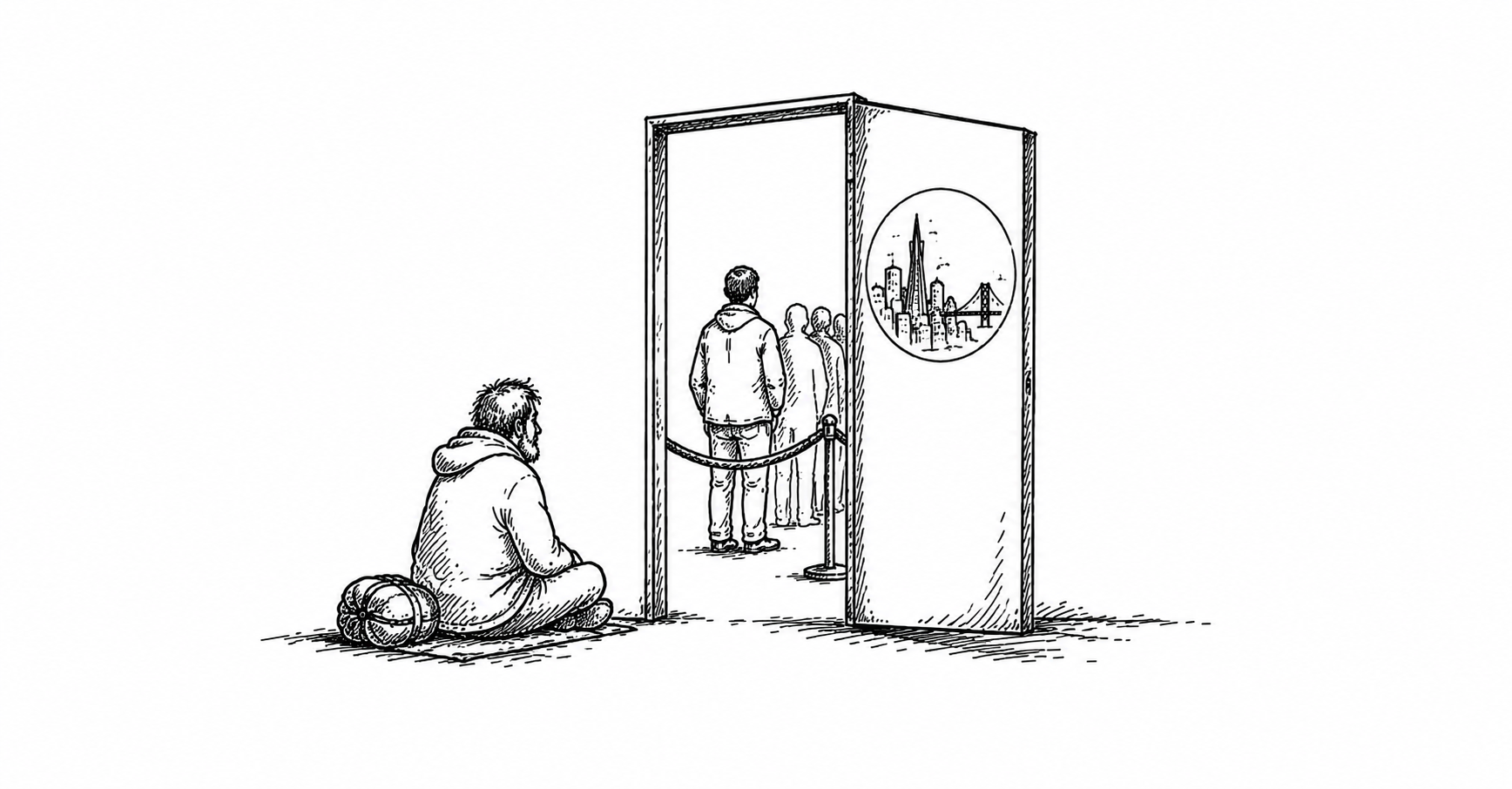
The mechanism the residency-first framework introduces is a filter. Unhoused individuals who moved to San Francisco recently — including people displaced from other parts of the Bay Area by rising rents, people who arrived seeking services, and people who came specifically because San Francisco’s shelter system is more accessible than neighboring counties’ — would receive lower priority than people who can document longer tenure in the city. The city frames this as serving its own residents. The structural effect is that people displaced by the Bay Area’s housing market, who often arrive in San Francisco because it is the most accessible service node in a metro-wide affordability crisis, are deprioritized for the services that exist precisely to address what the market produced.
The HUD counting error is relevant here not just as a bureaucratic correction but as a window into how official numbers shape political will. When the count was lower, the political pressure to expand resources was lower. The accurate number creates accountability — and accountability creates pressure on the city to either expand capacity or manage access more tightly. The residency-first proposal is a form of the latter. It does not increase shelter beds or expand the affordable housing stock. It determines who gets to the front of the line for what already exists.
No city in the United States has unlimited homeless services capacity. Prioritization decisions are inevitable. The question is what principle governs them. Medical need, vulnerability, and time spent unhoused are the criteria most commonly used in evidence-based allocation frameworks. Residency tenure is a different criterion — one that measures how long a person has lived in the city, not how much they need help or how acute their situation is. The distinction matters because the population most likely to be filtered out by a residency requirement is also, in many cases, the population most recently displaced by the same housing market conditions San Francisco’s policies helped produce.
The counting correction and the residency proposal together describe a city recalibrating its relationship to its homeless population — becoming more accurate about who is there and simultaneously more restrictive about who qualifies for resources. The accurate count is progress. The residency filter is a policy choice about who the city’s safety net is designed to serve. Those are not the same thing, and covering them as administrative updates obscures the political decision embedded in the second one.