New England’s Tech Boom Masks Regional Economic Decline
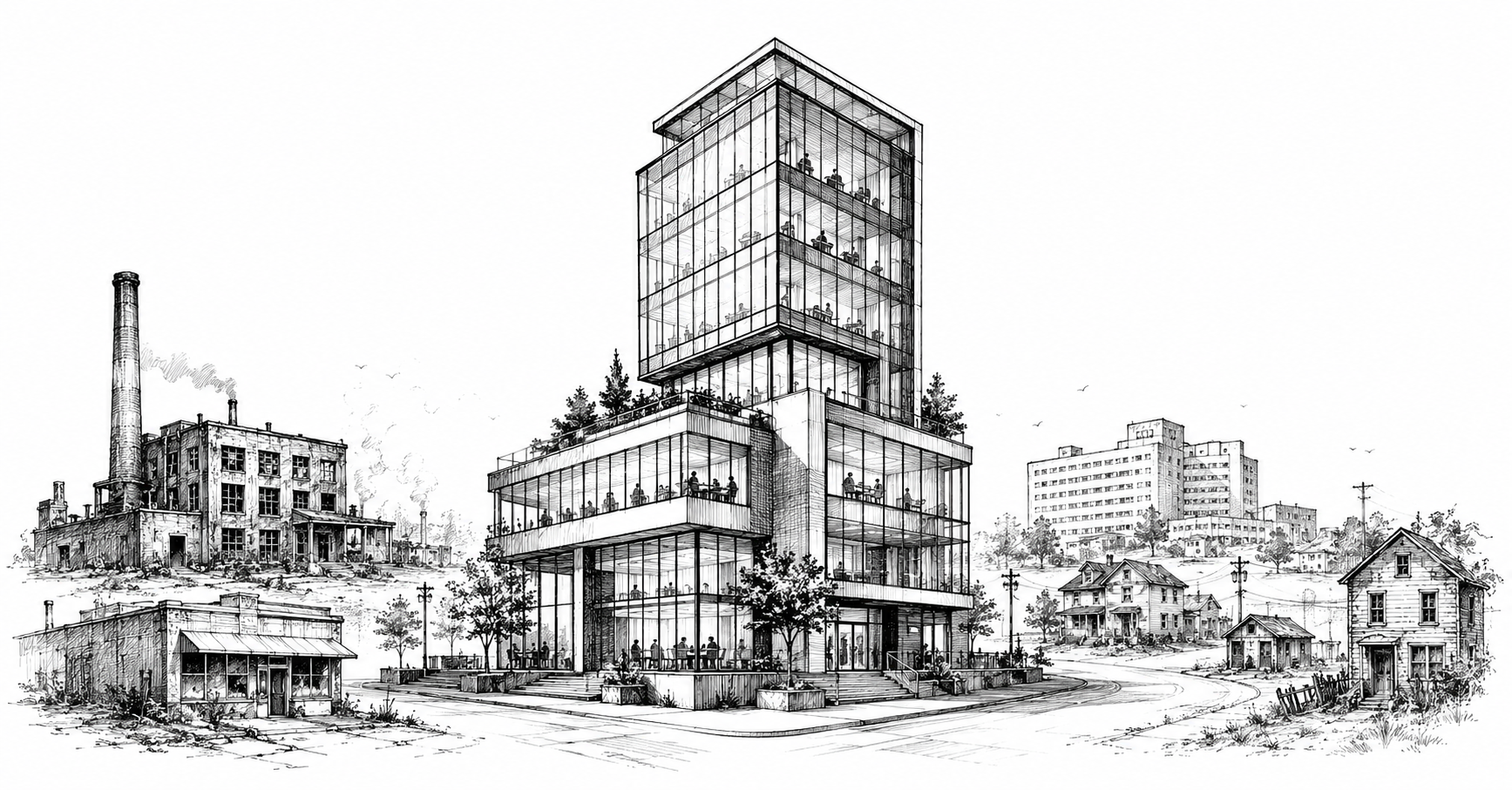
New England entered 2026 on soft footing. Economic growth is expected to decelerate modestly to 1.9 percent in 2026 from previous forecasts. Financial services activity, defense manufacturing, and healthcare are the bright spots, limiting downside from federal research funding cuts and trade uncertainty. Boston’s tech scene is booming. Venture capital is flowing. Startups are being founded. Exits are happening. The city is attracting tech talent and startup attention. By most metrics, Boston’s tech economy is strong. Yet New England’s broader economy is slowing. This contradiction is not random. It exposes the difference between local tech growth and regional economic health.
The Geography of Tech Wealth
Boston’s tech scene concentrates wealth in specific neighborhoods and companies. The epicenter is in Cambridge and Back Bay, where venture capital firms, tech headquarters, and startup incubators cluster within walking distance. The money flows to founders, early employees, and venture capitalists. Most of the value is captured in tech company equity, which is held by a narrow group of people. A venture capitalist invests $2 million into a startup in 2023. By 2026, the company is acquired for $400 million. The venture capitalist’s fund returns $80 million on the initial $2 million investment. That capital is distributed to limited partners—university endowments, pension funds, family offices—most of which are based outside New England. When a startup exits and founders become wealthy, that wealth mostly stays with the founders. It does not automatically distribute to the broader Boston economy. A founder who sells their company for $50 million might buy a brownstone in Back Bay for $4 million, hire a small staff for their next venture, and deploy the remaining capital into a diversified portfolio managed by wealth advisors in New York or San Francisco. The venture capitalists return capital to their funds, which invest it globally, not necessarily in New England.
The Hollowing Out of Traditional Sectors
Meanwhile, New England’s broader economy is driven by manufacturing, healthcare, and financial services. Those sectors are facing pressure. Manufacturing in New England—historically centered around machine tools, precision instruments, and industrial equipment—is automating and relocating to lower-cost regions or overseas. A manufacturing facility in Connecticut that employed 300 workers in 2010 employed 150 in 2020 and 80 by 2026. The remaining workers operate more sophisticated machinery but earn similar wages adjusted for inflation. Healthcare costs are rising but reimbursement is flat. Hospital systems are consolidating. Rural hospitals are closing. Community health centers are struggling with funding. Financial services is consolidating. Regional banks are being absorbed into larger institutions. Insurance companies are relocating back-office operations to cheaper labor markets. The wealth management business is concentrating among the largest firms. None of those trends are good for regional economic growth.
The Replacement Economy
Boston’s tech boom is not lifting traditional sectors. It is replacing them. As the economy becomes more tech-driven, it becomes more extractive. Wealth is concentrated, not distributed. Growth is nominal, not organic. Consider the actual employment picture: Boston’s tech sector employed approximately 150,000 people in 2026, up from 100,000 in 2015. That growth sounds impressive until you consider that New England lost approximately 200,000 manufacturing jobs between 2000 and 2020, with the pace of decline continuing through 2026. Financial services employment in the region has been flat or declining. Healthcare employment has grown but at wages that have not kept pace with cost of living increases. The regional wage growth in tech far exceeds wage growth in other sectors, but the number of tech jobs cannot replace the jobs lost in traditional industries.
This gap creates a labor market split. High-skill tech workers earn $150,000-$300,000 in compensation. Mid-skill workers in healthcare and administrative roles earn $45,000-$70,000. Low-skill service workers earn $28,000-$40,000. The tech sector does not employ the displaced manufacturing worker. It does not employ the workers displaced by financial services consolidation. It creates new inequality within the regional economy.
Housing and Real Estate
The concentration of tech wealth has another visible effect: housing prices. Boston’s median home price exceeded $650,000 in 2026, up from $380,000 in 2015. Rental prices have increased proportionally. A one-bedroom apartment in downtown Boston rents for $2,200-$2,800 per month. These prices are driven by demand from tech workers and venture capitalists, not by broader regional economic growth. A healthcare worker earning $55,000 per year cannot afford a home in neighborhoods near their job. They commute from further out, spending 90 minutes each way on congested highways or deteriorating public transit. A teacher earning $60,000 per year cannot buy a home in the region without a substantial down payment or family assistance. This creates a secondary economy: service workers who support the tech economy but are economically separated from it. They work in the restaurants, retail stores, and cleaning services that serve the tech industry. But they cannot afford to live near their jobs.
The Pattern Repeats Across America
This is the story of every major city in 2026: a thriving tech scene layered on top of a struggling regional economy. San Francisco has a booming tech scene and a homelessness crisis. New York has a vibrant startup ecosystem and declining manufacturing employment. Seattle has Amazon and has lost aerospace manufacturing jobs. Austin has exploded with tech growth and is facing housing affordability crises that are displacing longtime residents. Los Angeles has a growing entertainment tech sector and declining aerospace and manufacturing employment.
The tech scene attracts capital and attention but does not actually solve the underlying economic problem. It makes it worse by redirecting talent and capital away from traditional sectors that provided middle-class jobs. A talented engineer in 2006 might have gone to work at a precision manufacturing company, earning a solid middle-class salary with benefits and job security. By 2026, that same engineer goes to work for a startup, earning significantly more in salary and equity, but with no job security and the expectation of 60-hour work weeks. The startup economy is not creating a broader middle class—it is creating a narrow high-income class and leaving everyone else behind.
The Visibility Problem
The result is a city that looks prosperous if you follow tech news and ignores the broader economic decline if you look at actual employment data. Business journals celebrate unicorn startups and successful exits. Real estate developers announce new tech office parks. Venture capital firms announce new fund closings. But underneath this narrative is a regional economy that is structurally weakening. Unemployment in specific communities is rising. Wage growth in non-tech sectors is stagnant. Middle-class jobs are disappearing faster than they are being created. Public services are under pressure as property tax bases fail to keep pace with demand. Schools are struggling with funding. Public transit is deteriorating.
The tech economy creates an optical illusion of regional prosperity. The concentration of wealth and attention in the tech sector makes it difficult to see the broader economic reality. When you live in a city where venture capitalists are closing $50 million funding rounds and startups are raising Series B financing, it is easy to believe the entire economy is healthy. But the data tells a different story: nominal growth, concentrated wealth, and a hollowing out of traditional sectors that once provided stable middle-class employment.
This is not sustainable. A regional economy cannot prosper long-term on the foundation of a single sector, particularly one that concentrates wealth rather than distributes it. At some point, the contradiction between local tech growth and regional economic health becomes impossible to ignore.