The Geography of Abandonment: Baltimore’s Population Crisis

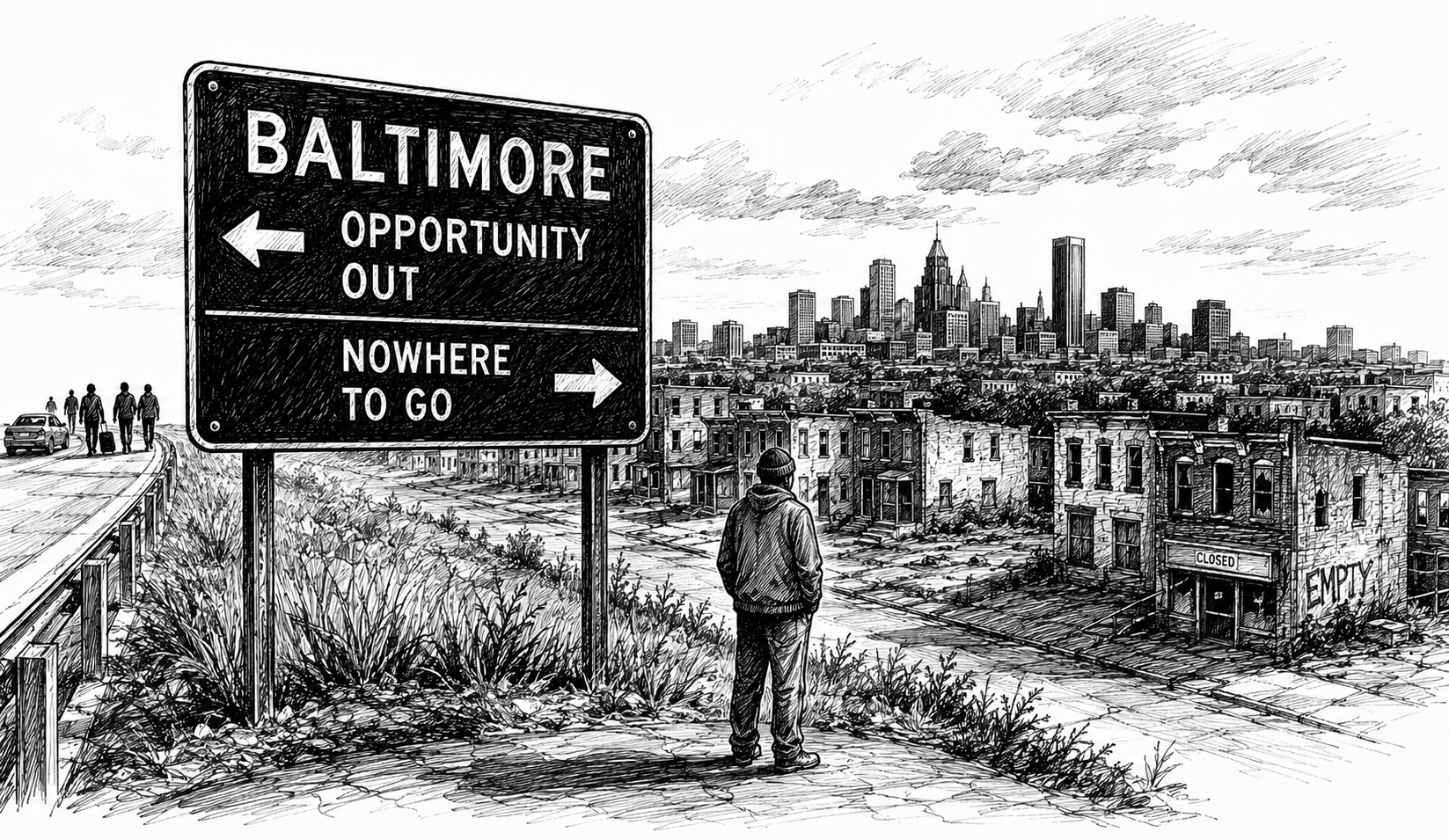
Baltimore’s population has been declining for decades. In 2026, the decline accelerated. People are leaving the city. Census data shows the exodus is not random. It is concentrated among people with options. Young professionals are moving to DC. Families are relocating to suburbs. Working-class residents who cannot afford to leave are staying. What remains is a city increasingly composed of people without the resources to live anywhere else. This is what city decline actually looks like: not economic collapse, but sorting by ability to leave. The people who can go are going. The people who cannot stay. The city becomes poorer, not because of what happens in it, but because of who is leaving it.
The Numbers Tell a Story
Baltimore’s population peaked at 950,000 in 1950. By 2000, it had declined to 650,000. By 2020, it was 585,000. By 2026, census estimates placed it at 565,000—a loss of 20,000 residents in just six years. The overall number masks the composition of who is leaving. Young adults aged 25-34 with college degrees have been leaving Baltimore at higher rates than any other demographic group. College-educated women are leaving at even higher rates than college-educated men. Households earning over $75,000 per year are leaving. Families with school-age children are leaving. These are the people with options. They have job skills that are in demand elsewhere. They have savings or family resources to finance a move. They have educational credentials that make them attractive to employers in other cities. When they leave Baltimore, they take tax revenue, consumer spending, and economic dynamism with them.
The people staying behind are disproportionately older, less educated, and lower-income. People over 55 make up an increasing share of the population. People without college degrees make up an increasing share. People in the bottom income quartile make up an increasing share. This is not because people are becoming less educated or older in place—it is because the younger, more educated, higher-income people are leaving. The composition of the city is changing through selective exodus, not through demographic change. Baltimore is not aging in place; it is being left behind by people who could afford to go.
The Vicious Cycle
This sorting creates a feedback loop that accelerates decline. As higher-income and better-educated residents leave, the tax base shrinks. The city collects less property tax revenue, less wage tax revenue, and less business tax revenue. Public services deteriorate in response. Schools become underfunded. Neighborhoods lack adequate police presence. Parks and public spaces fall into disrepair. Infrastructure maintenance is deferred. Potholes remain unfilled. Streetlights go dark. The quality of life in the city declines. This decline triggers another wave of departures. Families who had been considering leaving now leave because schools are clearly inadequate. Young professionals who thought they might stay now move because the neighborhood is deteriorating. Small businesses that had been struggling now close because customer bases are shrinking. Each departure makes the city less attractive to those who remain, prompting more departures.
The people who cannot leave—who lack the education, job skills, or financial resources to relocate—experience this decline acutely. A single mother earning $32,000 per year cannot afford to move to the suburbs. A retiree on Social Security cannot afford higher rent elsewhere. An older worker with limited job prospects in other markets cannot relocate. These people are stuck in a city that is declining around them. Their neighborhoods are emptying out. Their schools are under-resourced. Their local businesses are closing. They have no choice but to endure the decline.
Neighborhood Collapse
The sorting plays out differently across Baltimore’s neighborhoods. In Canton and Fells Point—affluent waterfront neighborhoods with renovated townhouses and young professional residents—population held relatively stable from 2020 to 2026. These neighborhoods are attractive to the people who have options. They have good housing stock, access to employment, proximity to restaurants and cultural amenities. They are neighborhoods where young professionals can afford to live if they have decent incomes and some family help with down payments. But even in these neighborhoods, there is churn—people move in, stay for a few years, then relocate to DC or the suburbs as they advance in their careers or start families.
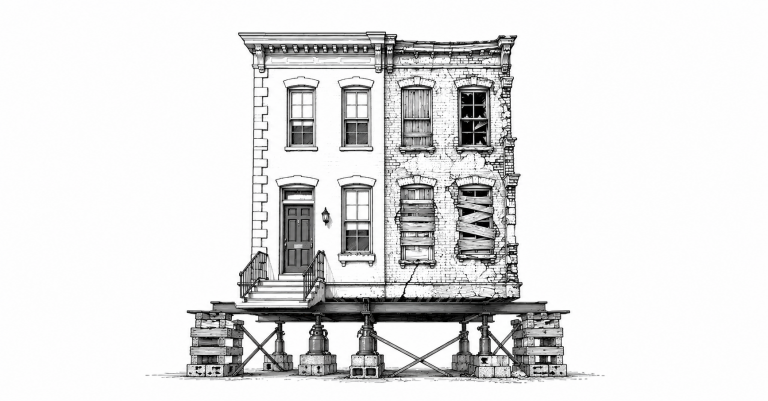
In neighborhoods like Sandtown-Winchester, Gwynn Oak, and Pimlico—working-class African American neighborhoods that were stable middle-class communities in the 1980s—population has collapsed. Sandtown-Winchester lost 30 percent of its population between 2000 and 2026. Blocks that once housed multi-generational families now have abandoned rowhouses interspersed with occupied homes. Corner stores have closed. Schools have consolidated or closed entirely. The people who could leave—people with college degrees, professional jobs, and savings—left. Those who remained are older residents who built their lives in these neighborhoods and people who lack the resources to go anywhere else. The neighborhood itself becomes less viable as a place to live as more people depart. Young people growing up in these neighborhoods see their peers leave and follow them. The neighborhoods empty out, not because they are inherently bad places, but because the people with options are gone.
The Human Cost
What this means in practice is that Baltimore is increasingly a city of last resort rather than a city of choice. For young people with ambition and credentials, Baltimore is a place you might spend your mid-twenties before moving to a better opportunity. For families, it is a place you left behind when you could afford to. For older people and working-class residents without options, it is home by necessity, not choice. This creates a particular kind of social fragmentation. People are not building long-term community investments. They are in transit. The teachers are not expecting to stay; they are working in Baltimore while looking for jobs elsewhere. The doctors and lawyers moved out years ago; Baltimore is now served by less experienced practitioners who could not find positions in higher-paying markets. Small business owners who might have built businesses over decades have left; what remains are marginal businesses that survive on thin margins and minimal investment.
Tax Base Collapse
The fiscal consequences are severe. Baltimore’s city government has been cutting services for years because revenue has not kept pace with demand. Police and fire departments are understaffed. Neighborhoods are assigned to precincts that cannot respond quickly. Fire response times have increased. The city’s school system has been chronically underfunded. School buildings are aging. Teachers leave for suburban districts with better pay and resources. Special education services are inadequate. The city has tried to compensate by raising tax rates on property owners, but higher taxes trigger more departures among people with options. Renters face rising rents as the remaining rental stock deteriorates and landlords have little incentive to invest in maintenance. The result is a deteriorating fiscal position: shrinking revenue from a declining tax base, rising demand for services from the people who remain, and inability to provide adequate services at affordable prices.
What Revival Would Actually Require
The conventional response to city decline is to focus on “revitalization”—waterfront development, cultural districts, tech hubs. Baltimore has pursued this strategy for decades. Inner Harbor development brought some economic activity to the downtown core. Federal Hill gentrified. Canton developed. But these pockets of activity do not reverse the underlying pattern. They create islands of prosperity in a declining city. Young professionals move to Canton because it is nice, but most leave within five years when they advance to the next opportunity. The development of a neighborhood benefits property owners and attracts new residents, but it does not stop people with options from leaving the city. And it does not help the people without options, who are pushed out when gentrification happens or left behind when development focuses on a few neighborhoods.
What would actually reverse Baltimore’s decline would require addressing the conditions that make people want to leave: quality schools, safe neighborhoods, job opportunities, affordable housing, functional public services, and a sense that the city is investing in its future. This would require sustained investment at a scale that the city cannot afford given its shrinking tax base. It would require attracting and retaining the people with options, the young professionals and families, the educated workers who can choose where to live. Without them, the city cannot rebuild a sustainable tax base. With them leaving, every day the city becomes harder to save.
The Fate of Declining Cities
Baltimore’s story is becoming common among post-industrial American cities. Detroit, Cleveland, Pittsburgh, St. Louis—all have experienced similar patterns of selective exodus and population loss concentrated among people with options. Some cities have managed to stabilize through strategic investment and attracting new economic sectors. Most have not. The cities that decline do so not because of sudden economic shocks, but through the slow sorting of people by ability to leave. The people who can go do. The people who cannot stay and endure the consequences of living in a city that nobody with options wants to live in anymore.