Markets Are Trading the Interpretation More Than the Economy
When language about an economic decision moves markets more than the decision itself, price discovery has migrated from the economy to the institution watching it.
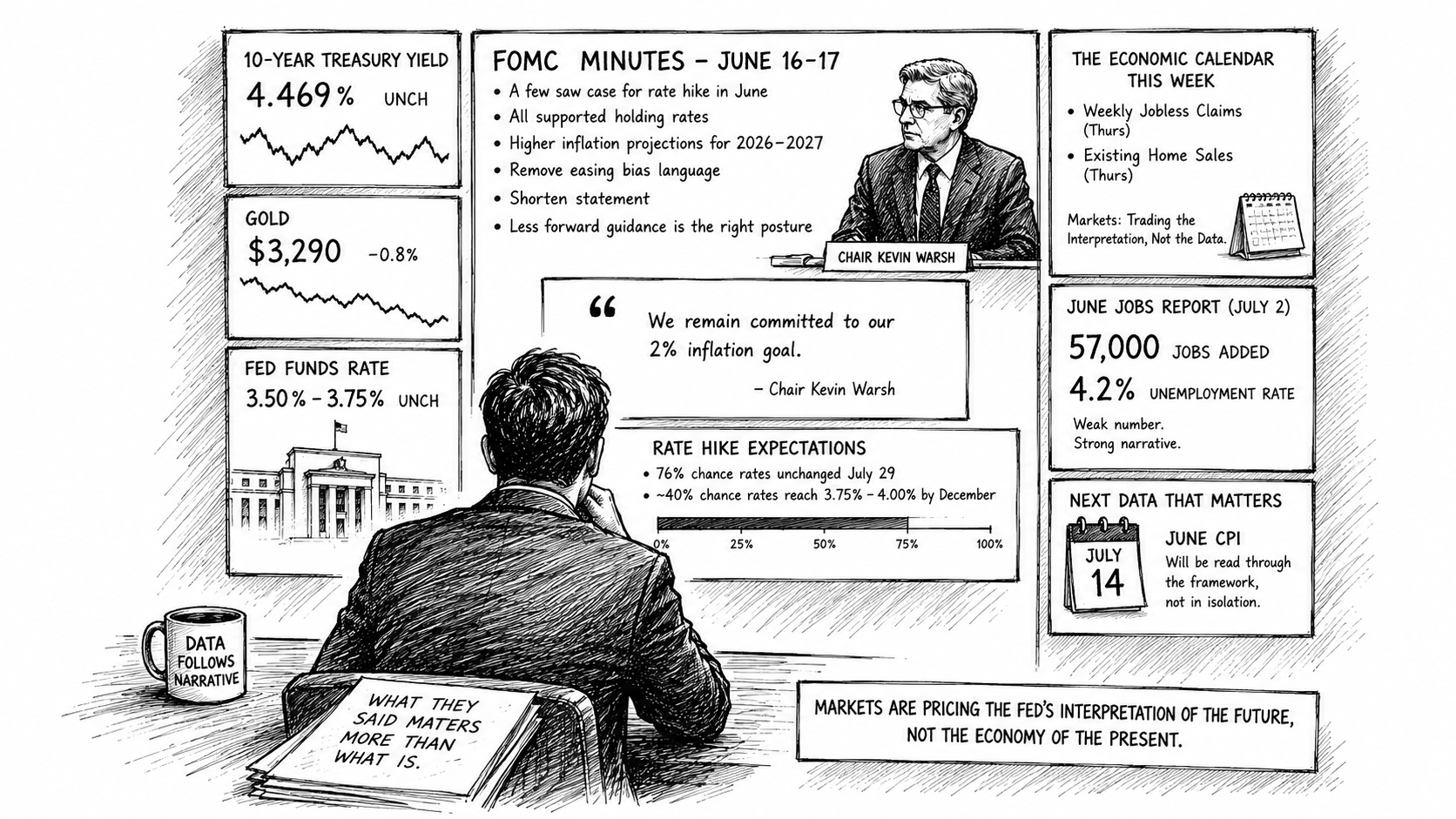
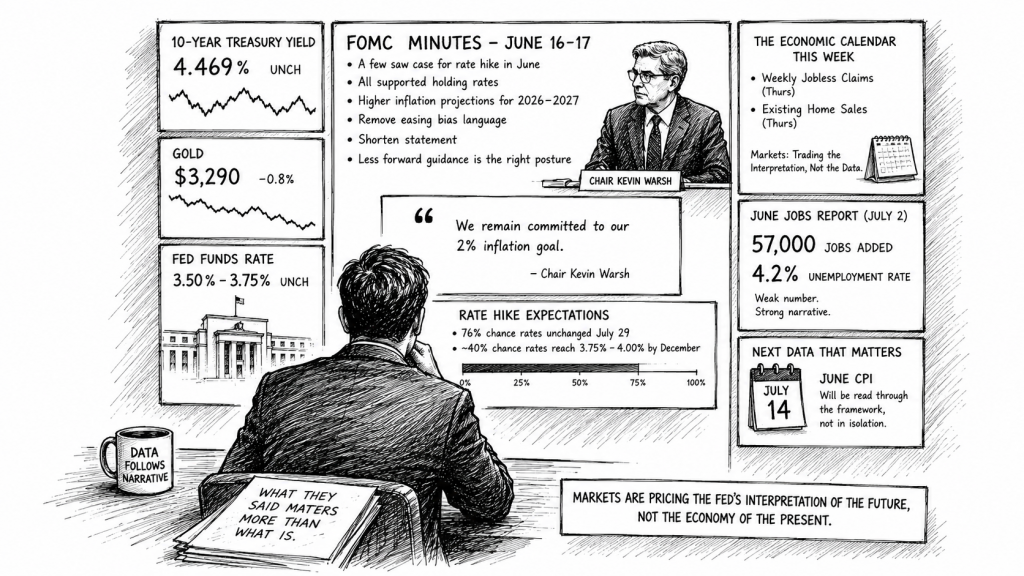
Bloomberg reported on July 8 that the Federal Reserve released the minutes from its June 16-17 FOMC meeting, confirming a hawkish tone under new Chair Kevin Warsh. A few officials indicated they saw a case for raising interest rates at the June meeting, though all ultimately supported leaving the federal funds rate unchanged at 3.50% to 3.75%. Staff projections were revised to show higher inflation in both 2026 and 2027 than previously expected. Most participants favored removing language that had suggested an easing bias. A majority favored shortening the post-meeting statement, arguing that less forward guidance — not more — is the appropriate posture for the current environment. Markets moved on all of it. The 10-year Treasury yield held at 4.469%. Gold, which opened July near $4,100 after falling from a January peak of $5,500, remained under pressure as rate hike expectations held firm. The CME FedWatch Tool showed a 76% probability that rates remain unchanged at the July 29 meeting, with roughly a 40% chance that rates reach 3.75% to 4.00% by December. None of that is from economic data released this week. The only meaningful calendar items are weekly jobless claims and the existing home sales report, due Thursday. Markets are trading on what officials said about what the data might mean, not on the data.
The June jobs report, released July 2, should have been the story. The Bureau of Labor Statistics reported only 57,000 payrolls added in June, well below expectations, with the unemployment rate at 4.2%. That number, under normal circumstances, would have moved rate expectations meaningfully toward easier policy. It did not hold that signal. By the time the FOMC minutes landed Wednesday, the market’s read on the jobs report had already been compressed by the Fed’s communication framework. The minutes confirmed that officials viewed the June slowdown as consistent with a labor market that has eased from overheating, not one approaching stress — which means the weak payroll number was absorbed into the Fed’s existing narrative rather than challenging it. The language in the minutes did not respond to the jobs data. It set the terms for how the jobs data would be read.
This is the specific dynamic worth naming. Kevin Warsh’s first meeting as Federal Reserve Chair created a communication variable that the market had no prior data to price. Warsh has been explicit that the Fed will remain committed to a 2% inflation target regardless of market expectations for easier policy. That stance, combined with the dot plot showing 9 of 19 policymakers expecting at least one more rate hike before year-end, means the distribution of outcomes now hinges less on individual data releases than on how officials describe their interpretation of those releases. The minutes revealed that participants flagged AI-related investment, tariffs, and Middle East tensions as upside inflation risks — not one of which is measured directly by any scheduled data release this week. Markets are not trading the economic numbers. They are trading a probabilistic model of how a new Fed Chair, whose communication preferences are not yet fully mapped, will synthesize ambiguous data into a policy decision at a meeting three weeks from now.
The next event that matters is not on this week’s calendar. The June Consumer Price Index releases July 14. That number will be interpreted almost entirely through the framework the June minutes established — if inflation reads hotter than expected, the minutes’ hawkish framing will be treated as having been correct, and the probability of a December hike will move accordingly. If it reads cooler, the debate about whether the minutes’ language overstated the committee’s resolve will begin in analyst notes and in futures markets simultaneously. Either way, the CPI will be read as a signal about the Fed’s next communication, not as a standalone measurement of price conditions. That is a different kind of market than one trading on economic fundamentals. It is a market trading on a model of an institution’s intentions, filtered through language, updated three weeks at a time.
Price discovery, in theory, is the mechanism by which markets aggregate dispersed information about the real economy and convert it into prices that tell producers, borrowers, and investors where to put their capital. When the most market-moving information in a given week is a document describing a meeting that ended three weeks ago, that mechanism is operating primarily at the level of institutional interpretation, not economic reality. The underlying conditions — a weakening labor market, elevated inflation, AI investment distorting demand signals — still exist. But the price signal being sent to anyone watching markets this week reflects how the Fed read those conditions in mid-June, not what those conditions are now. The gap between the two is where risk lives, and where it compounds quietly until the next data release closes it or widens it further.