Nobody Actually Knows How Many People Lost Their Jobs This Year
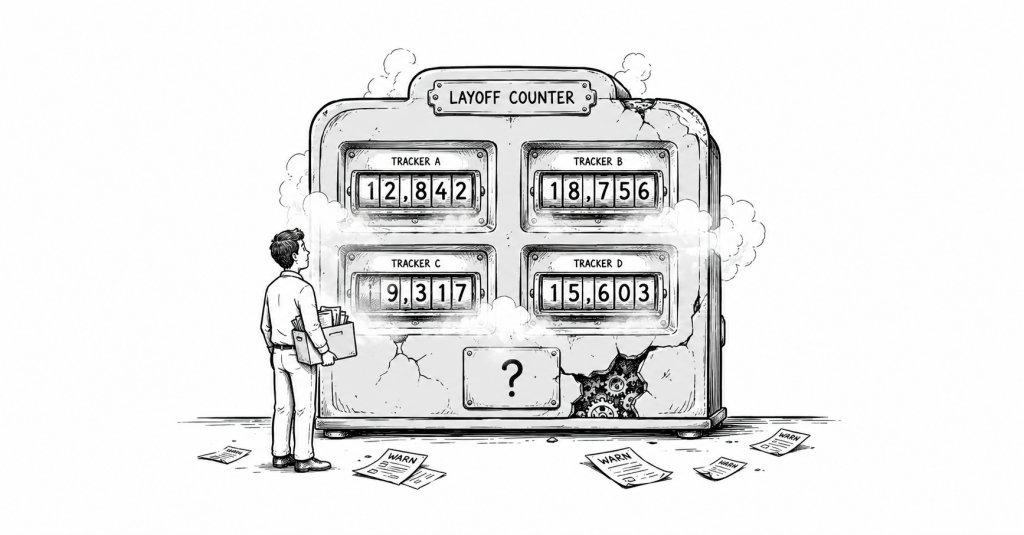
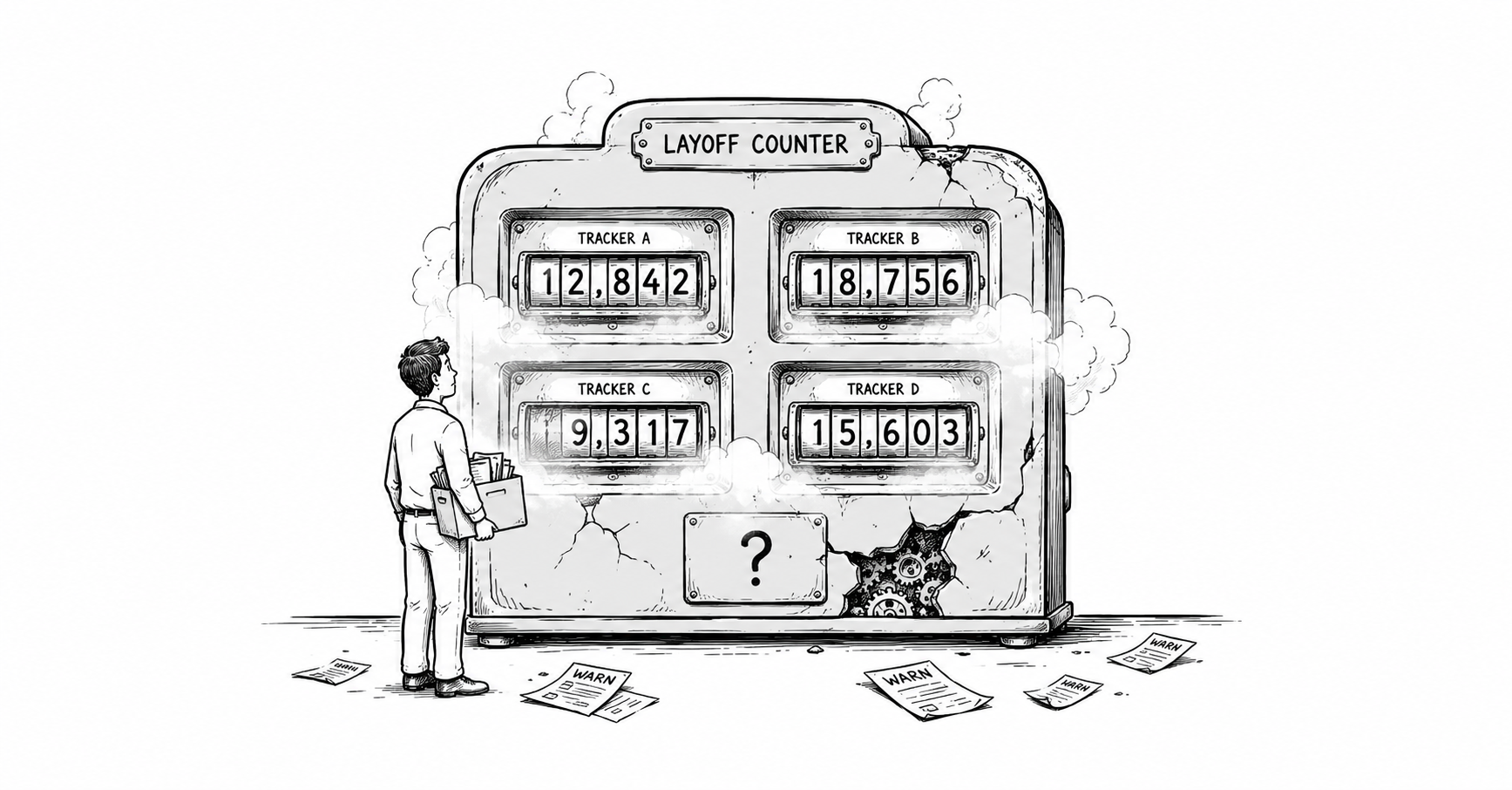
LayoffAlert.org reported that through July 2026, employers filed 2,954 WARN Act notices across 44 states affecting 270,641 employees. Skillsyncer’s tracker, counting the same year, logged 322 layoff events affecting 205,832 workers. Layoffhedge counted 25 companies and 13,532 jobs for July alone, while Layoffs.fyi put tech sector eliminations at 121,326. Four counts, four methods, four numbers that cannot be reconciled. The discrepancy is not sloppiness. It is what happens when a country decides not to measure something directly and lets private trackers approximate it from whatever public records exist.
The federal instrument is the Worker Adjustment and Retraining Notification Act, and its design explains the gap. Newsweek described the mechanics: employers with 100 or more workers must give advance notice, typically 60 days, before mass layoffs or plant closures. Every threshold in that sentence is an exclusion. A company with 99 employees files nothing. A company with 5,000 that cuts 40 people files nothing. A reduction executed in rolling waves that each fall below the trigger files nothing. Attrition without replacement files nothing, and a hiring freeze that eliminates a hundred positions that were going to exist files nothing, because no one was employed in them yet.
LayoffAlert states the limitation directly, noting WARN figures represent a subset of total layoffs since only larger reductions trigger the requirement. That candor is appropriate and it means the most official-looking number in circulation is a floor whose distance from the actual total nobody can specify. The trackers built to fill the gap use different inputs. Skillsyncer aggregates news reports, company announcements, and SEC filings. Layoffhedge counts announced layoff events by company. These methods capture things WARN misses and miss things WARN captures, and none of them can count what was never announced.
That last category is the one that matters most and appears nowhere. A company that reduces headcount by not backfilling 300 departures over eight months has removed 300 jobs from the economy with no filing, no announcement, and no tracker entry. The positions are gone. The people who would have filled them are somewhere else. From the outside this is invisible, and from the inside it is the preferred method precisely because it is invisible.
Who benefits from the fog is not evenly distributed. A company reporting quarterly results controls the narrative when the only external check is a filing regime it can plan around. A worker trying to judge whether her function is contracting has no reliable series to consult. A state legislator deciding whether to fund retraining is working from a number known to be low by an unknown margin. A journalist writing about the labor market picks a tracker, and the tracker picked determines the size of the story.
The timing rules add a second layer. WARN notices are filed in advance of the effective date, so a July filing may describe October separations. Newsweek noted July filings covering cuts with July effective dates, while Patch reported New Jersey reductions at Samsung, Novartis, Mars Wrigley, and Verizon totaling about 1,650 positions to be cut by mid-October. A tracker keyed to filing dates and one keyed to effective dates will report different months for the same event, which is enough to produce contradictory trend stories about whether layoffs accelerated or slowed.
The year-over-year comparisons inherit all of this. LayoffAlert noted that at the same point in 2025 it had tracked 3,700 notices affecting 329,525 employees for the full year, and cautioned that the 2026 pace would only become clear as more months accumulate. That caution is warranted and routinely dropped. A comparison of partial-year data against full-year data, drawn from a filing system that captures an unknown fraction, is not a trend. It is two numbers next to each other.
Meanwhile the interpretive claims layered on top have gotten confident. Skillsyncer’s analysis found 54 percent of 2026 layoff events explicitly citing AI, automation, or machine learning, covering 170,945 workers across 173 companies. A ResumeBuilder survey found 58 percent of companies planning layoffs in 2026. These are useful figures and they are measurements of what companies say, not of what companies do. Attribution is a communications decision. It tells you how firms want a cut understood, which is worth knowing, and it is a different variable from the cut itself.
The practical consequence is that the labor market’s most consequential number is the one with the least reliable instrument. Employment levels are surveyed monthly by the Bureau of Labor Statistics with established methodology. Job separations are captured in JOLTS. But the specific thing people mean when they ask how bad layoffs are this year, meaning how many workers were involuntarily removed from payrolls by employer decision, has no direct federal count, and the proxy that exists was designed in 1988 to give notice, not to produce statistics.
What would fix it is not complicated. Lowering the WARN employee threshold, closing the rolling-reduction gap, and requiring disclosure of position eliminations alongside separations would produce a series that could be trusted. None of that is on any legislative agenda, and the reason is straightforward: the current arrangement produces a number that is defensible, official, and lower than the truth, which suits everyone who has to answer for it.
Expect the trackers to keep diverging and the divergence to widen as more reductions run through attrition and relocation rather than announced events. When the recession that eventually arrives gets dated, the argument over when it started will hinge on which of these incompatible counts a given economist chose, and the answer will be unavailable in the data because nobody built the instrument to find it.