
France’s Third Heatwave Is Not a Crisis. It Is a Calendar.
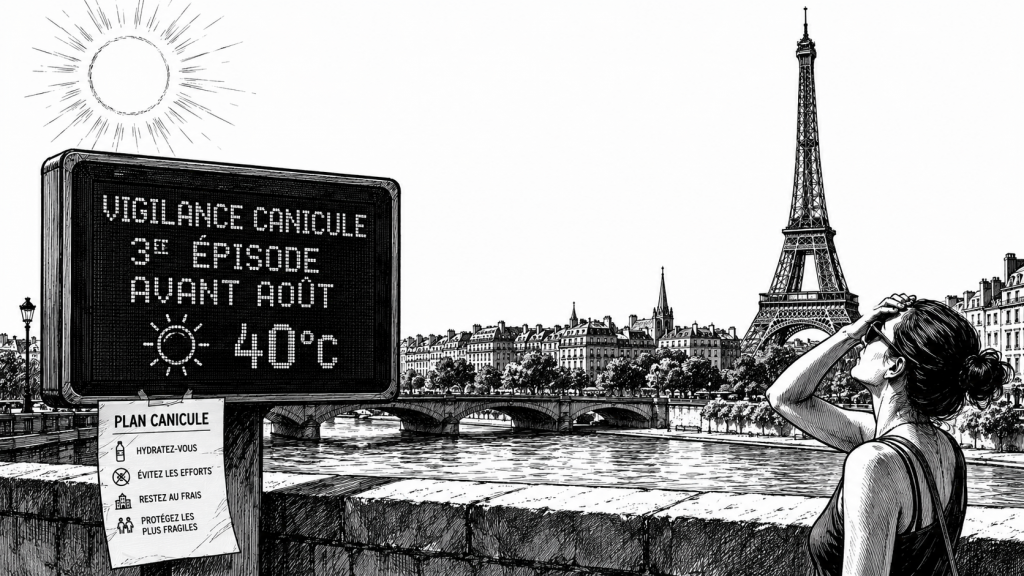
France’s third major heatwave of 2026 is arriving before the calendar reaches August. The Connexion France reported on June 25 that Minister for ecological transition Monique Barbut told FranceInter that there is a strong probability that, starting the week after July 6, France will return to extreme heat until July 14 — the country’s national holiday. La Chaîne Météo described the mechanism: an anticyclone near Portugal and the British Isles is repositioning over Western Europe, pulling a sub-Saharan air mass north and producing the heat dome effect that amplified May’s and June’s temperature records. Météo France confirmed that June 24 was the hottest day ever recorded in France, with Paris breaching 40°C — a threshold crossed only five times since 1947. France24 reported on July 3 that the June heatwave produced 2,025 excess deaths in France alone. Scientists at Indiana University have estimated that the broader 2026 European heatwave may have caused between 17,000 and 25,000 excess deaths continent-wide. Three major heatwaves before August is not a pattern waiting to be confirmed. It is a pattern confirming itself in real time.
Each heatwave triggers the same emergency infrastructure: hospital surge protocols, public cooling centers, vigilance alerts, guidance for vulnerable populations. Each time, the response is calibrated to the emergency as if it will not happen again. The third heatwave arriving before Bastille Day means France is now running its emergency protocols in rotation. That is not crisis management. It is a seasonal operating condition being administered through emergency framing, which is a more expensive and less effective way to manage a recurring problem. The sectors absorbing — carrying — the operational cost are not hidden. France’s agricultural system is entering the third heatwave with a soil drought already worsening, with no meaningful rainfall expected for at least two more weeks according to Météo France forecasts. Transport networks in the Netherlands ran reduced train service during the June heatwave to prevent track damage, deployed water spraying to keep drawbridges functional as steel expansion threatened their operation, and sent out road crews to prevent asphalt from buckling in the heat. France’s own metro and RER networks in Île-de-France reported heat-related disruptions. Wildfires burned concurrently across France, Spain, and Portugal during the June event, compressing emergency response capacity across borders. Labor productivity for outdoor and agricultural workers declines with each successive heatwave day — the efficiency loss compounds across a twelve-day event in a way that no individual workday count captures. Insurance markets have not yet priced three-heatwave summers as a normal annual exposure. They are still treating each event as tail risk, which means premiums, underwriting models, and reserve calculations are all running behind the actual risk cycle.
The French Prime Minister convened an interministerial crisis cell on June 29 to anticipate the next heatwaves. That sentence deserves a second read. The crisis cell was not assembled to respond to a heatwave that had already begun. It was assembled to prepare for one that had not yet arrived. That is the real signal embedded in the government’s response: France is now planning forward for heat the way governments plan for hurricane seasons or annual flood cycles. The emergency framing still dominates the public communication — warnings, alerts, hotlines, cooling center hours. But the operational logic underneath it, treat recurring extreme heat as a system condition rather than a weather event, is what an interministerial crisis cell preparing in advance actually represents. The gap between those two framings is where the policy failure lives. Emergency protocols protect people during the event. They do not retrofit hospitals to handle surge capacity permanently. They do not redesign rail infrastructure for higher ambient temperatures. They do not restructure agricultural subsidies around drought-resistant crops or shift outdoor labor schedules across an entire economy. Every system that responded in emergency mode during May and June will respond in emergency mode again in July. The third heatwave will cost more than the second, and the second cost more than the first, because nothing was rebuilt between them to absorb — to handle — a higher baseline. That is not a prediction. That is what the data from May and June already shows.