AI Didn’t Eliminate the Job at Klarna. It Downgraded Who’s Allowed to Have It.
The company didn’t restore the 700 jobs it cut. It built a flexible labor pool to patch what the AI still can’t handle — and that’s the more durable story.
Klarna spent 2023 and 2024 as the clearest public case for AI replacing white-collar work outright. The company eliminated roughly 700 customer service positions, partnered with OpenAI on a chatbot that handled up to three-quarters of support interactions, and let headcount fall from 5,500 to 3,400 largely through attrition. CEO Sebastian Siemiatkowski said the AI was performing at human-equivalent quality, and the story circulated as proof that AI displacement of knowledge work had moved from theory to deployment.
By mid-2025, Klarna reversed course. Siemiatkowski has said it is important that customers always have a clear path to a human — a marked shift from his earlier framing. He has acknowledged that the company’s aggressive push to replace jobs with AI led to diminished service quality, telling reporters the company “went too far” and that the focus on efficiency and cost ultimately eroded customer trust.
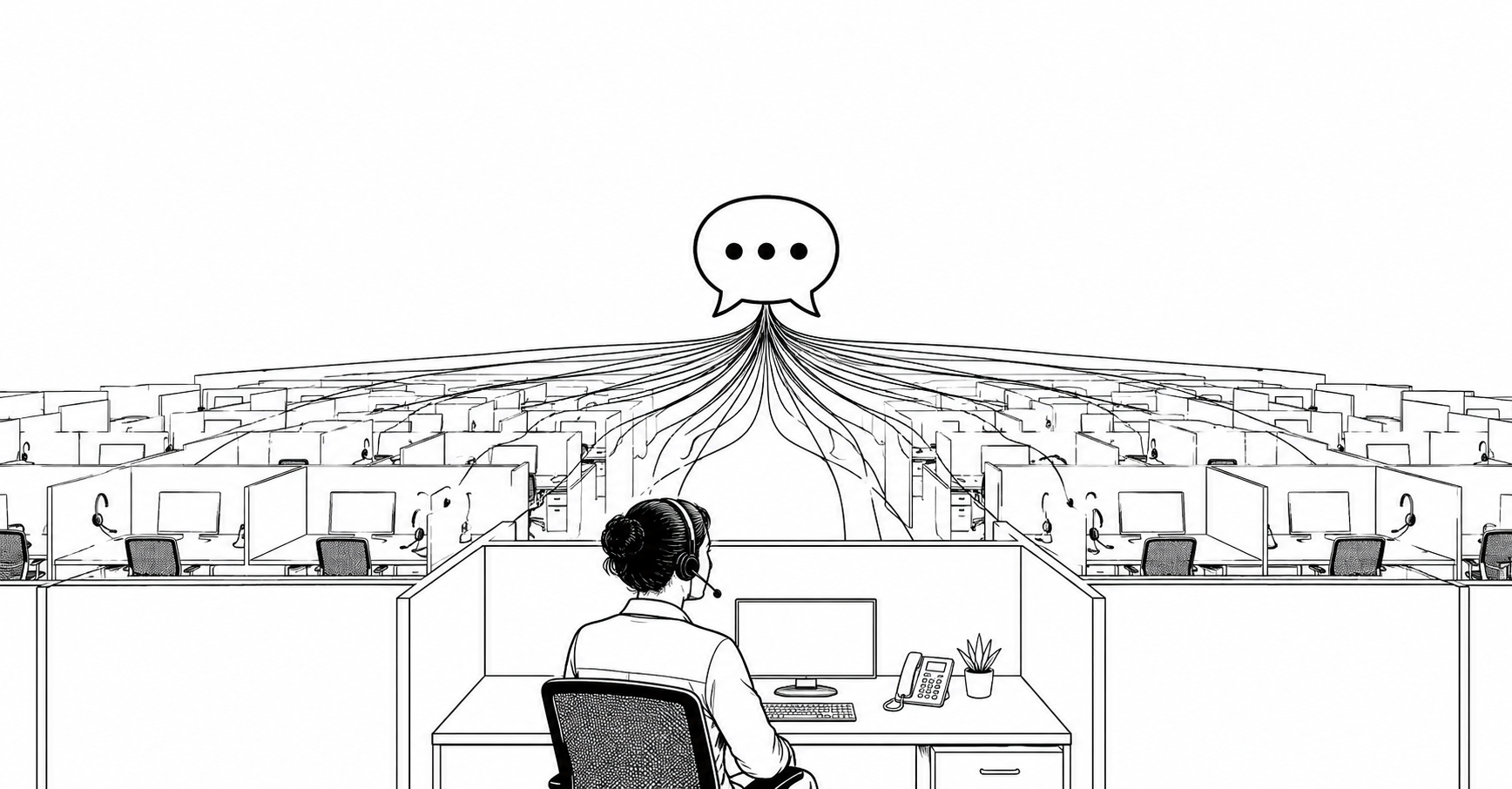
What replaced the AI-only model is the part that matters structurally. Klarna did not restore the 700 jobs it eliminated. It began hiring remote agents on flexible schedules, targeting students, parents, and rural workers — an approach industry coverage has described as an “Uber-style” workforce model. The company shifted to a hybrid structure where AI now handles routine, high-volume queries while human agents are reserved for escalations, complex disputes, and cases requiring judgment.
That distinction — automation versus fragmentation — is the structural story Klarna’s reversal actually tells. Automation removes the need for a worker. Fragmentation keeps the worker but relocates them to the edge of the system: present only for the cases the cheaper process couldn’t resolve, available on flexible terms rather than through stable employment. A full-time role carries wages, benefits, training infrastructure, and some institutional commitment. A flexible remote labor pool carries none of those by default. Reversing the original layoffs required recruiting, onboarding, and training new staff — a cost companies rarely model into their AI replacement business cases, and one that made the unwind more expensive than the original savings projected.
Industry analysts now treat Klarna’s reversal as the reference case for 2026 enterprise AI strategy, with companies evaluating their own AI workforce plans increasingly asked to explain how they avoid the same outcome. The lesson being drawn, though, tends to stop at the operational level — hybrid models outperform full automation on cost and satisfaction metrics. The labor question underneath that conclusion is the one that doesn’t get asked in the same breath: when the humans come back, what do they come back as.
The Klarna case punctures the cleanest version of the AI displacement narrative — the idea that software entering a system makes human labor obsolete. It doesn’t. Customer service at Klarna still requires people for the cases that are emotionally complex, ambiguous, or high-stakes enough that a model can’t be trusted with them. What changed is the terms under which those people are present. The next labor fight in this sector isn’t whether AI eliminates jobs. It’s whether the people doing the work the AI still can’t do get treated as employees with standing, or as flexible coverage brought in to patch what the system couldn’t finish.
— SSC Business Desk | Social Storytellers Collective