The 340B Medicare Drug Rule Turns Hospital Discounts Into a Fight Over Who Keeps the Savings
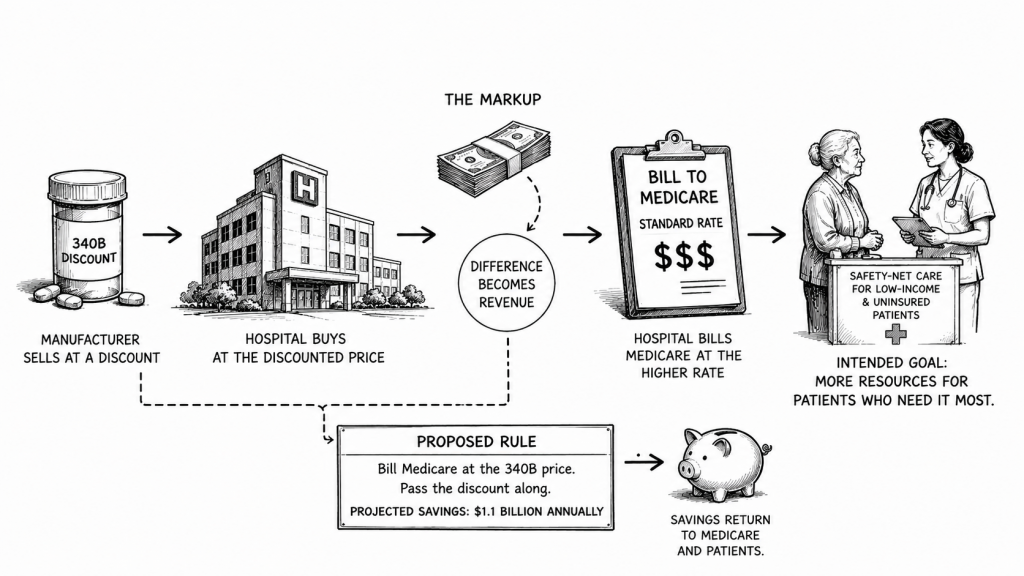
The 340B Drug Pricing Program has operated since 1992 on a straightforward premise: pharmaceutical manufacturers must sell drugs at steep discounts to hospitals and clinics that serve disproportionate shares of low-income and uninsured patients, and those savings are meant to help those facilities extend their financial capacity to serve people who would otherwise go without care. The Trump administration proposed a rule this week, reported by the Associated Press, that would prevent hospitals from applying markups on those discounted drugs when billing Medicare patients. Projected consumer savings: $1.1 billion annually. The American Hospital Association’s response was immediate — the rule would strain hospitals already operating under financial pressure.
Both positions are accurate as far as they go. The dispute between them reveals what the 340B program has become: a system in which the same drug discount travels through enough hands that a significant portion of its value is captured before it reaches a patient.
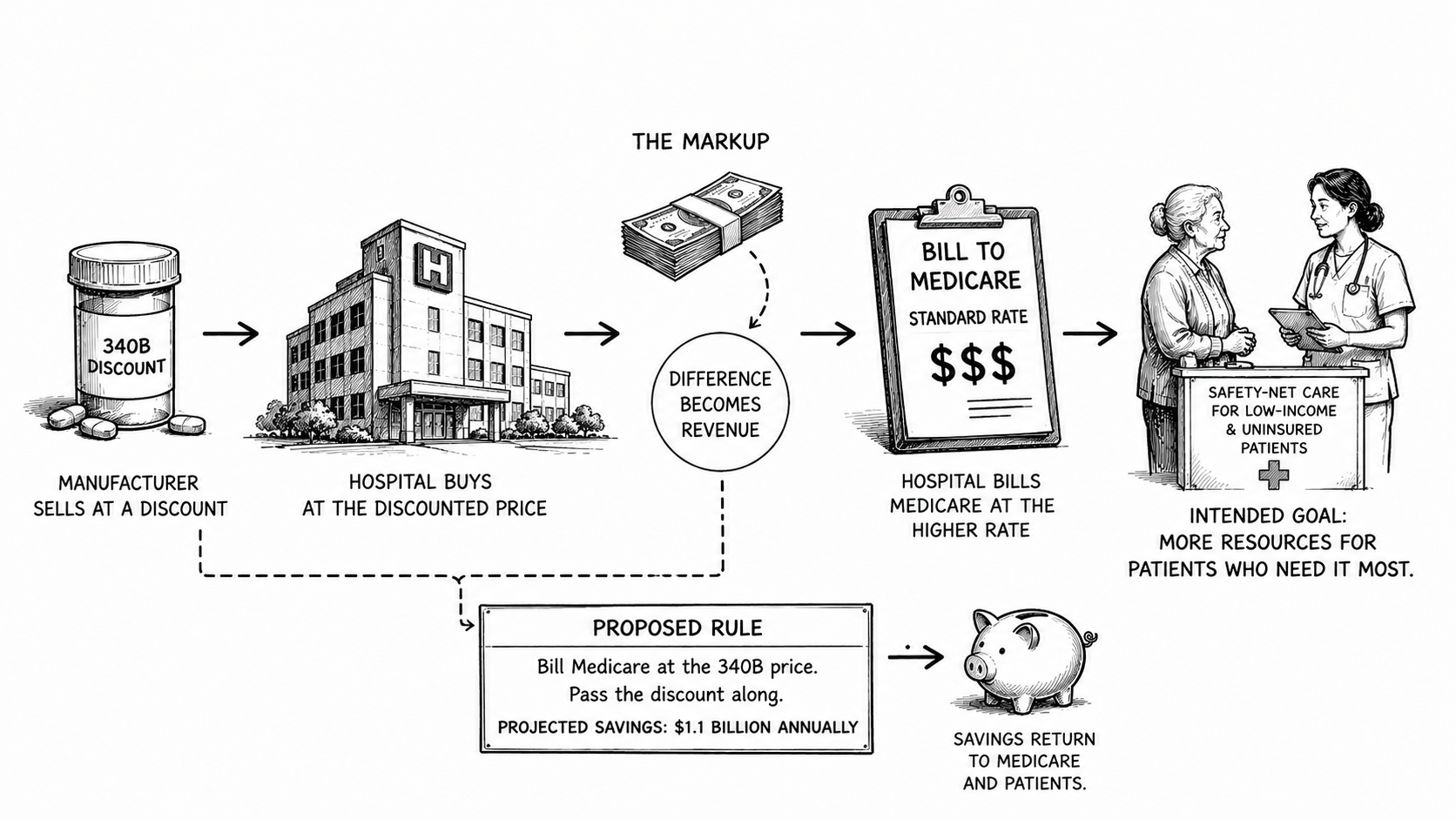
The mechanism is the markup. When a 340B-eligible hospital purchases a drug at the discounted price the program requires manufacturers to provide, it bills Medicare at the standard rate — the rate that reflects the drug’s undiscounted cost. The difference between what the hospital paid and what Medicare reimburses is revenue to the hospital. The proposed rule would require hospitals to pass the discount along: bill Medicare at a rate that reflects the 340B acquisition price rather than the market rate. The $1.1 billion in projected savings is the aggregate of that markup across the Medicare-covered patients in the 340B system.
The hospital association’s argument is that those revenues cross-subsidize care for the uninsured and low-income patients the program was designed to serve. Under that argument, the markup is not profit extraction — it is the mechanism by which safety-net hospitals fund their safety-net function. There is real truth in this for certain categories of 340B participants: federally qualified health centers, critical access hospitals, and rural referral centers where the margin between the discounted acquisition price and the Medicare reimbursement rate is what makes the economics of serving uninsured patients possible.
The problem is that 340B eligibility has expanded significantly since 1992. Large hospital systems that are not primarily safety-net institutions now participate in the program. The Government Accountability Office and the Health Resources and Services Administration have both documented that a growing share of 340B revenue is captured by hospitals with substantial non-charity care operations. The program now covers roughly 40% of all hospital drug purchasing by some estimates — a scale that is difficult to reconcile with a program originally designed for a narrow category of high-need providers.
The rule does not resolve that structural tension. It addresses the Medicare billing piece while leaving in place the broader architecture of 340B participation that has allowed the program’s scope to expand beyond its original purpose. Hospitals that depend on the markup to fund genuine safety-net services will face a real reduction in revenue. Hospitals that have been using the markup as a revenue line on routine commercial operations will face pressure to justify their 340B participation in terms the program’s original logic supports.
The $1.1 billion in projected savings has to come from somewhere. The rule proposes that it come from hospital revenue rather than patient copayments. Whether that outcome actually reaches patients depends on how hospitals absorb the change — and on a downstream enforcement question the proposed rule has not yet answered.