Shenzhen’s Robotaxis Are Arriving Before Drivers Have a New Bargain
Automation is entering a saturated ride-hailing market before the people it threatens have leverage over the transition.
William Langley reported for the Financial Times on June 28 that Shenzhen is moving to legalize robotaxis beginning July 1, opening the door for autonomous ride services in a city with nearly 400,000 taxi and ride-hailing drivers. Pilot programs from companies including Pony.ai and Baidu are already operating in districts such as Nanshan.
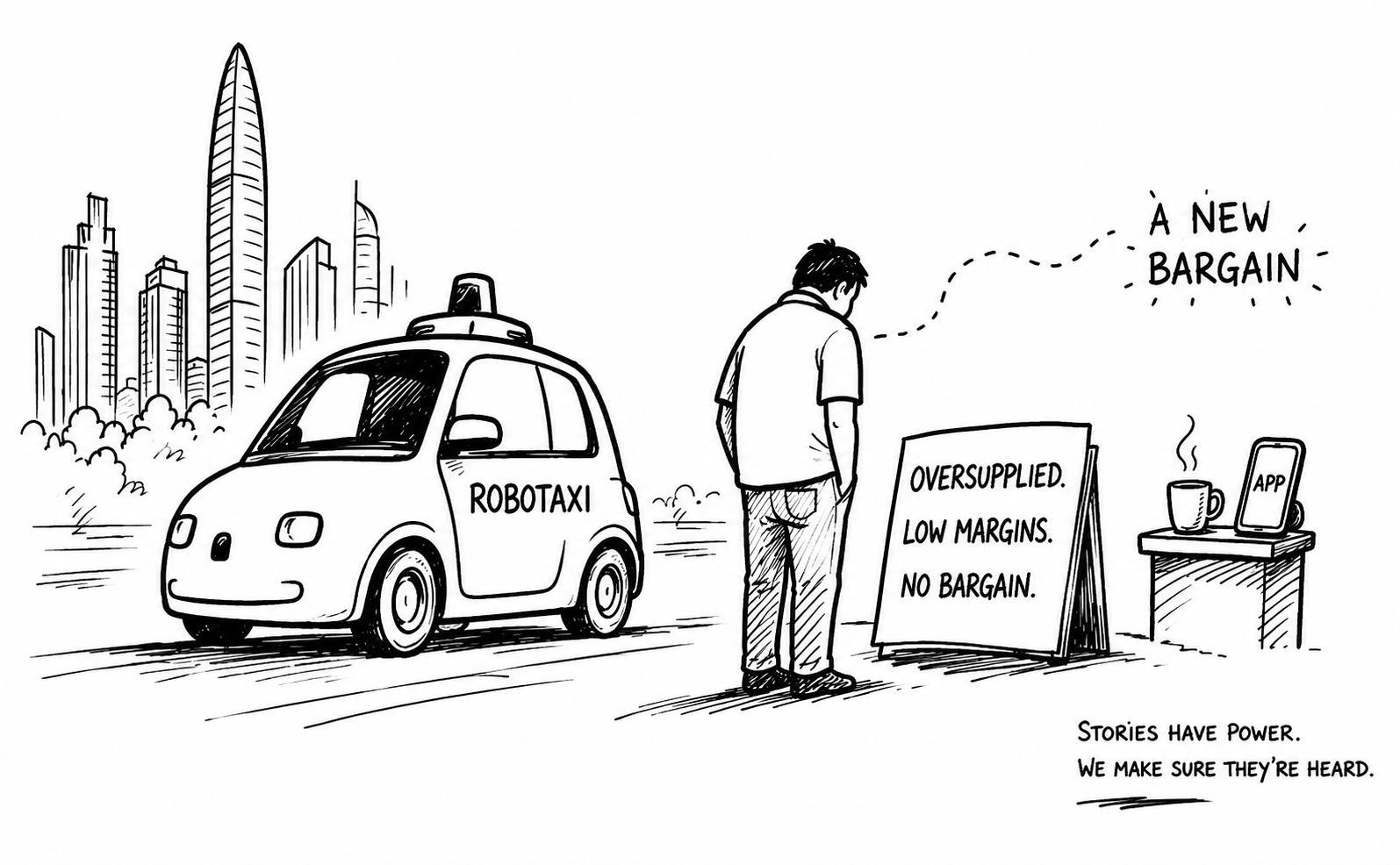
Automation changes labor markets most sharply when it enters after workers have already lost bargaining power. Shenzhen’s ride-hailing market is not a healthy one being disrupted from above. It is an oversupplied, low-margin market being entered by machines from below. The human worker was already made replaceable by the app. The robotaxi makes the app’s premise literal.
That sequence matters. The first stage of platform ride-hailing weakened drivers by converting transport work into algorithmic dispatch. Apps expanded supply, lowered switching costs, pushed drivers to compete on availability and rating, and captured the relationship with the passenger. Individual drivers lost the ability to set prices, choose routes, or build repeat customers. The platform became the employer without the obligations. The second stage replaces the driver entirely. The same system that made labor flexible now makes labor optional.
City legalization accelerates the timeline. When Shenzhen authorizes robotaxis on July 1, it is not only approving a technology. It is deciding whose claims count in the transition. Autonomous vehicle companies gain a regulatory runway. Investors gain a signal that the market is open. City officials gain a showcase. Drivers absorb competition from machines in a market where they already hold little pricing power and no formal protections.
The official framing promises complementarity: robotaxis will serve underserved corridors, reduce accidents, or fill gaps the human supply cannot cover. That argument may apply in limited settings. Workers do not experience automation as a gap-filling service. They experience it as reduced peak-hour demand, lower incentive rates, and a growing sense that the economics of the job are being decided without them at the table.
Shenzhen’s move also shows why the automation debate cannot be separated from urban governance. A city that legalizes robotaxis without a parallel policy on driver transition, income protection, or retraining has made a labor policy inside a technology announcement. That choice will be visible in driver earnings data, insurance claims, informal work growth, and social stability long before it appears in any official labor report.
Cities are taking the technology question seriously. The driver bargain is still waiting for the same seriousness.