
The Howard Stern Show Isn’t Ending. It’s Being Restructured. The Staff Is Finding Out What That Means.

A dozen staffers gone. Light severance. One live broadcast a week. The show that built satellite radio is now running the same playbook as every other media company cutting from the top.
Part of Culture in Motion — examining who defines culture, how it moves, and what it reveals about the moment.
NEWS DESK | SOCIAL STORYTELLERS COLLECTIVE
Rahsaan Rogers spent 16 years at The Howard Stern Show. He joined in 2010 as a producer and editor, built toward on-air work, hosted The Wrap-Up Show and Sternthology Live, emceed multiple seasons of Summer School, and produced specials drawn from 40 years of Stern Show archives. Last week he confirmed his departure on LinkedIn, writing: “After 16 incredible years with The Howard Stern Show and the Howard Stern Channels, I’m opening a new chapter.” He was warm about it. He didn’t have to be.
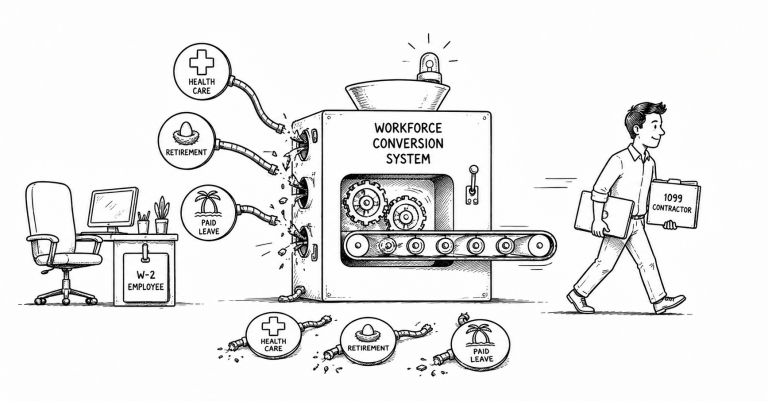
Rogers is one of roughly a dozen staffers let go from the Stern organization this month, following the announcement that Howard Stern will scale back to a single live broadcast per week. The cuts have moved through the on-air layer of the show — the producers, hosts, and editors who built the daily infrastructure of one of the most successful franchises in radio history. Severance packages were reportedly one week of pay for each year worked. Multiple staffers rejected those offers and are negotiating for more. Subscribers have been canceling since the reduced schedule was announced. Robin Quivers, Stern’s co-host since 1981, has also exited. The show that defined what satellite radio could be is now running a restructuring playbook that would be familiar to anyone who has followed the 2026 layoff cycle across any other media company.
A reduced output schedule requires fewer people to produce it. The people who built the institution absorb the displacement. The framing around the transition focuses on the format change rather than on the human cost of executing it. SSC documented this pattern across the corporate sector in AI Didn’t Replace Those Workers. It Just Made Eliminating Them Sound Like a Strategy. and The Middle Manager Is Becoming Software — the decision gets named as an operational one, and the workforce reduction that follows gets treated as a byproduct rather than the point. Stern scaling back to one live broadcast is a programming decision. It is also a workforce reduction decision. Both things are true, and only one of them is in the press release.
What makes the Stern situation specific is the institutional weight of what is being restructured. This is not a mid-tier podcast operation or a digital media startup managing its burn rate. The Howard Stern Show is the franchise that justified the existence of SiriusXM — that convinced listeners to pay for radio when broadcast radio was free, that built the subscriber base the platform still depends on, and that proved the model of uncensored long-form audio entertainment that every podcast that followed owes a debt to. The people being let go are not peripheral to that history. They are the producers who understood how the show actually worked — the preparation, the instinct, the institutional knowledge of what the audience wants before the audience knows it. Rogers named those things explicitly in his LinkedIn post. He credited the show with teaching him “how great shows actually get made.” That knowledge is now available to whoever hires him next. It is no longer available to the organization that developed it.
Subscriber cancellations are worth watching closely. SiriusXM’s business depends on retention, and the Stern show has historically been its most powerful reason for people to stay. One live broadcast per week is a significantly different product from five, and the listeners canceling are making a straightforward calculation about what they are paying for. Whether the restructured format can hold enough of the subscriber base to justify the reduced cost structure is a question SiriusXM will be answering over the next several quarters. The staffers who built the show that justified those subscriptions are answering a different question right now — about one week of severance per year of service, and whether that is what 16 years is worth.
Why This Matters
The Howard Stern Show restructuring is a media story and a labor story simultaneously, and most coverage is treating it as only the first one. The format change is real. So is the displacement of the people who built the format — with light severance, rejected offers, and the particular indignity of finding out that the institution you spent sixteen years building has decided your departure is a line item rather than a loss. That experience is not specific to radio. It is the experience of every worker who built something durable inside an organization that is now restructuring around a leaner version of the thing they built. The show may survive in its new form. The people who made it what it was are already opening new chapters, whether they were ready to or not.