India Is Training Workers for AI Jobs It Hasn’t Actually Measured
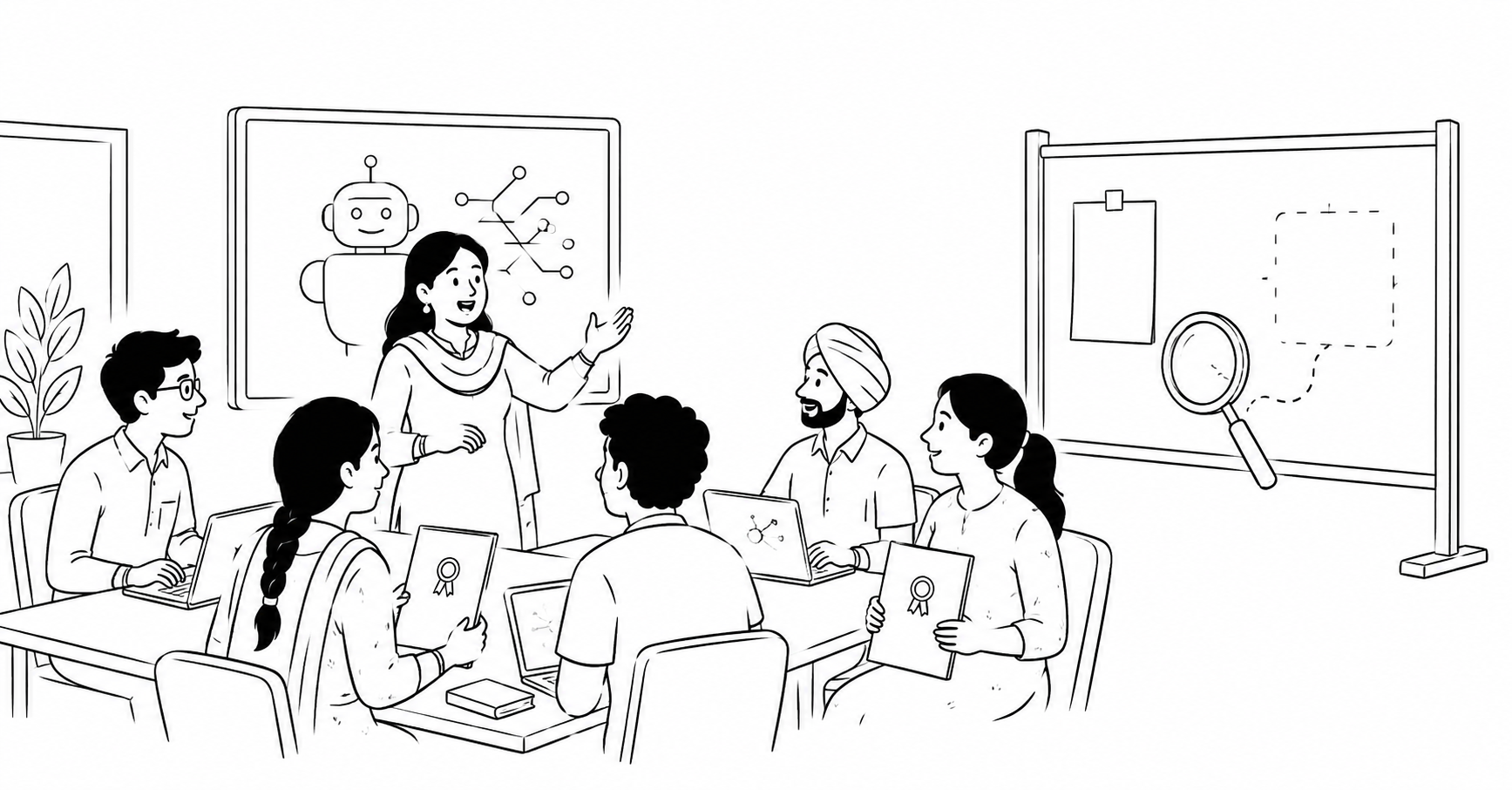
India has enrolled 53,449 people in artificial intelligence job training through one of its flagship skills programs. The government has also acknowledged something more significant: it has not conducted a specific assessment of how much demand exists for those AI skills, or how large the country’s shortage of trained workers actually is.
The disclosure came in a written response to India’s Lok Sabha from Minister of State for Skill Development and Entrepreneurship Jayant Chaudhary. As of June 30, 39,104 participants enrolled in AI-related roles under the Pradhan Mantri Kaushal Vikas Yojana 4.0 had been trained, 28,345 had been assessed, and 25,466 had received certification. That means fewer than half of everyone who enrolled had reached certification — a completion-rate question that would ordinarily drive the conversation. The government’s admission about demand measurement creates a larger one.
India is building a public pipeline intended to produce workers for an AI economy without having first established the size or composition of the labor-market demand that pipeline is supposed to satisfy.
PMKVY 4.0 was explicitly designed to make India’s skills system more responsive to emerging industries, with AI offerings spanning at least 20 roles alongside robotics, mechatronics, the Internet of Things, and drones. AI Data Quality Analyst attracted the most enrollment at 15,469 candidates, followed by Machine Learning Engineer at 8,986 and Database Administrator at 7,059. Certification rates vary sharply: just 31.9% for Data Quality Analysts compared with 71.9% for AI DevOps Engineers — a gap that suggests either the curriculum, the assessment, or the candidate pool differs significantly between roles.
There is nothing inherently unusual about governments trying to anticipate workforce demand. Training systems have always had to prepare people for jobs that are still forming. AI makes the equation harder because employers themselves are still deciding which tasks they will automate, which roles they will redesign, and which new capabilities they will need. Separate research reported by Business Standard found employers increasingly emphasizing AI fluency, adaptability, and human-centered skills as AI reshapes entry-level work — signals of what employers want, but not a measurement of how many workers they need or which specific credentials they will accept.
That creates a potential mismatch on both sides. Workers are being told that AI credentials are the path into the future economy at the same moment AI is reducing or restructuring some of the entry-level positions through which people traditionally entered that economy. Training more people is only a solution if the credential, the curriculum, and the eventual job continue to line up. Without knowing what employers are actually hiring for — and at what scale — there is no way to verify that alignment exists.
India does involve industry and Sector Skill Councils in developing job roles, and the country has already established 116 AI- and machine-learning-related qualifications, occupational standards, and microcredentials through its vocational regulator. The training infrastructure is substantial. What the parliamentary disclosure identified as missing is an empirical map connecting that infrastructure to actual workforce demand.
That missing map deserves attention well beyond India. “Train workers for AI” has become one of the default policy responses to technological disruption — it sounds simultaneously optimistic and practical, promising that displacement can be met with reskilling and that economies can prepare people for whatever comes next. But skills policy works only when the destination is visible. A government can successfully train thousands of people, issue thousands of credentials, and still discover that employers were hiring for something else entirely. India’s disclosure names a problem that most governments running similar programs have not publicly acknowledged. You cannot close a skills gap you have never actually measured.