China’s Factory Profits Show an Economy Splitting Between AI Winners and Downstream Losers
AI-linked factories are carrying the headline recovery while weaker consumer-facing sectors absorb the margin pressure.
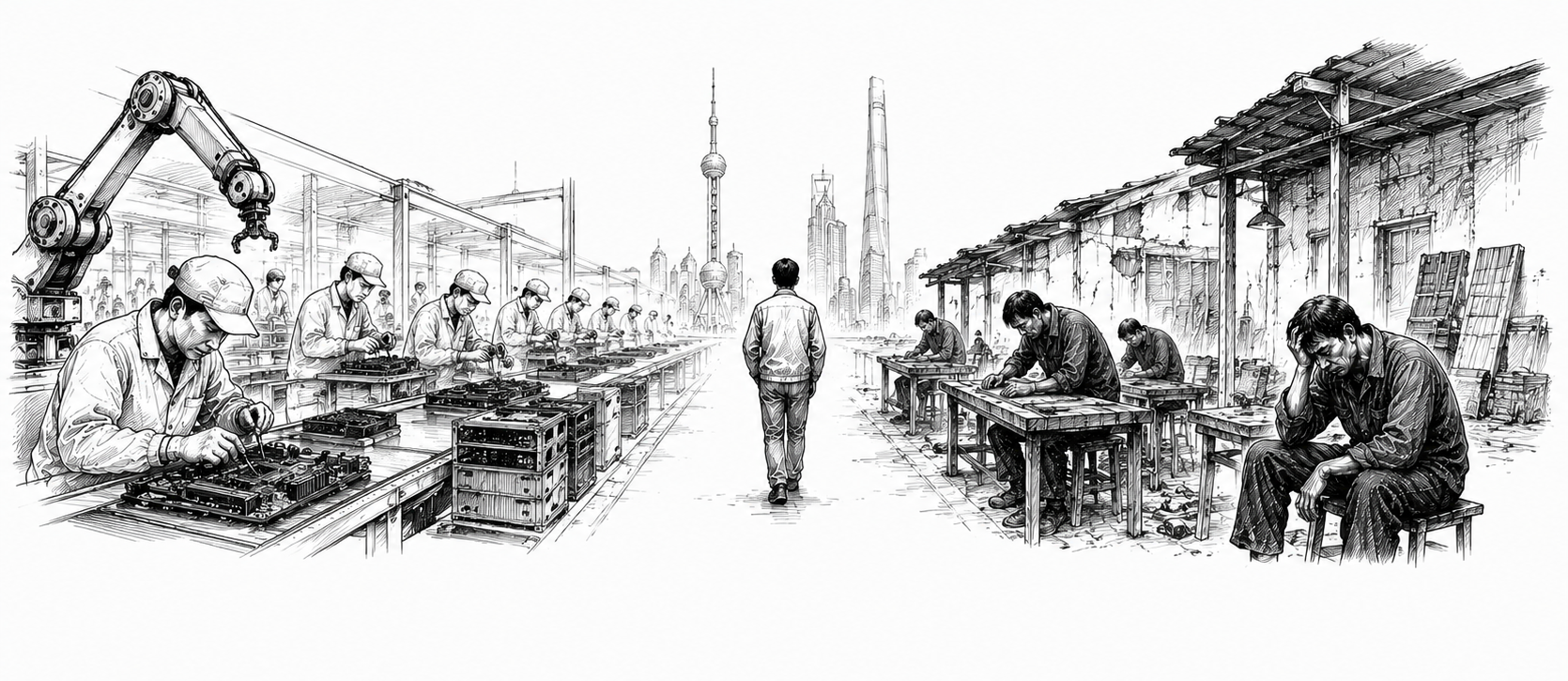
Reuters reporters Qiaoyi Li, Ellen Zhang, Shuyan Wang, and Ryan Woo reported on June 27 that China’s industrial profits rose 21.1% year over year in May. The same report showed the split inside that number: computer, communications, and electronics profits rose 103.9%, while automaker profits fell 19.8% and furniture manufacturing profits fell 58.4%.
Aggregate industrial data can produce a strong national headline while individual sectors experience a downturn. China’s May numbers are doing exactly that. Electronics and export-linked manufacturing are pulling the total high enough to read as recovery. Automakers losing nearly 20% in profits and furniture manufacturers losing more than half of theirs are experiencing a different economy inside the same country in the same month.
The electronics surge is traceable. AI-linked demand — data center components, semiconductors, server hardware, communications equipment — has pulled orders, margins, and capital toward the manufacturers connected to that supply chain. That concentration is real and large enough to move national totals. What it does not do is repair sectors whose demand comes from domestic consumers who remain cautious about spending, from housing markets still under pressure, or from an auto industry fighting price wars and overcapacity at the same time.
Furniture is the hardest number to ignore. A 58.4% profit decline in a sector tied to housing, household formation, and discretionary spending is not a rounding error. It names where domestic consumer confidence actually sits — well below what the headline industrial number suggests. Households buying less furniture are households that feel less settled, less confident, or less able to absorb the cost of household investment even as the country’s industrial exporters post triple-digit gains.
That gap creates a policy tension Beijing has not resolved. Export and AI-linked manufacturing strength stabilizes macro numbers and foreign reserve positions. But domestic consumer weakness limits how far that strength can travel into the parts of the economy that ordinary people experience. A furniture factory in Guangdong feels a different economic reality than a semiconductor fab in Shenzhen, and neither the headline profit figure nor the government’s growth targets bridge that gap for the worker or the owner inside the weaker sector.
The firms and workers inside electronics and AI-linked supply chains are absorbing the gains from the current demand cycle. The firms and workers in overcapacity, consumer-facing, or housing-adjacent industries are absorbing the cost of structural weakness. The national profit figure will keep looking strong for as long as electronics demand holds. The domestic economy will keep feeling uneven for as long as that gain stays concentrated in one corner of the factory floor.