America’s Diplomatic Isolation Is No Longer a Warning. It’s Becoming Policy.
When your oldest allies start comparing you to North Korea in official communications, the soft power era is over.
Part of Structural Reality — examining the systems that shape access, opportunity, and everyday life for Black and Brown communities.
NEWS DESK | SOCIAL STORYTELLERS COLLECTIVE
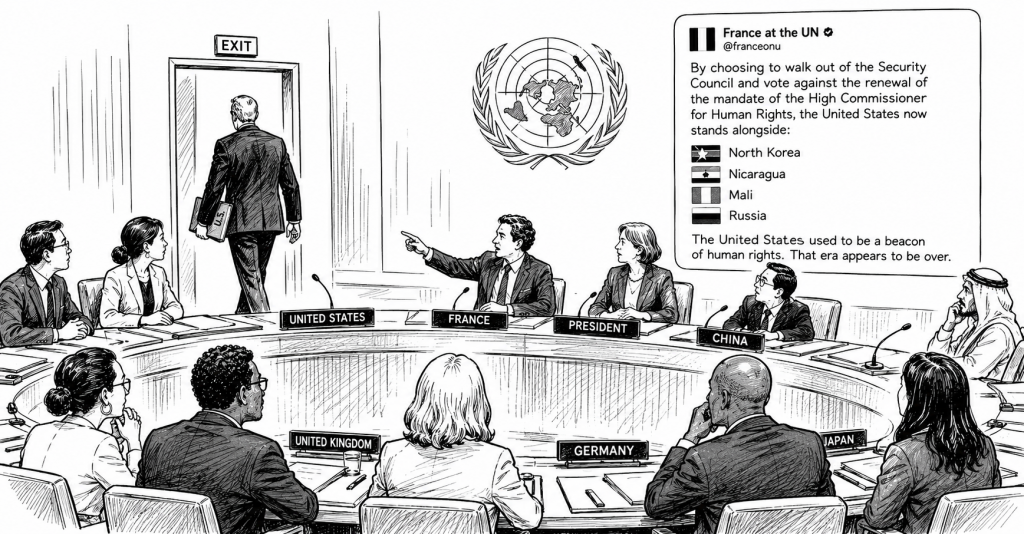
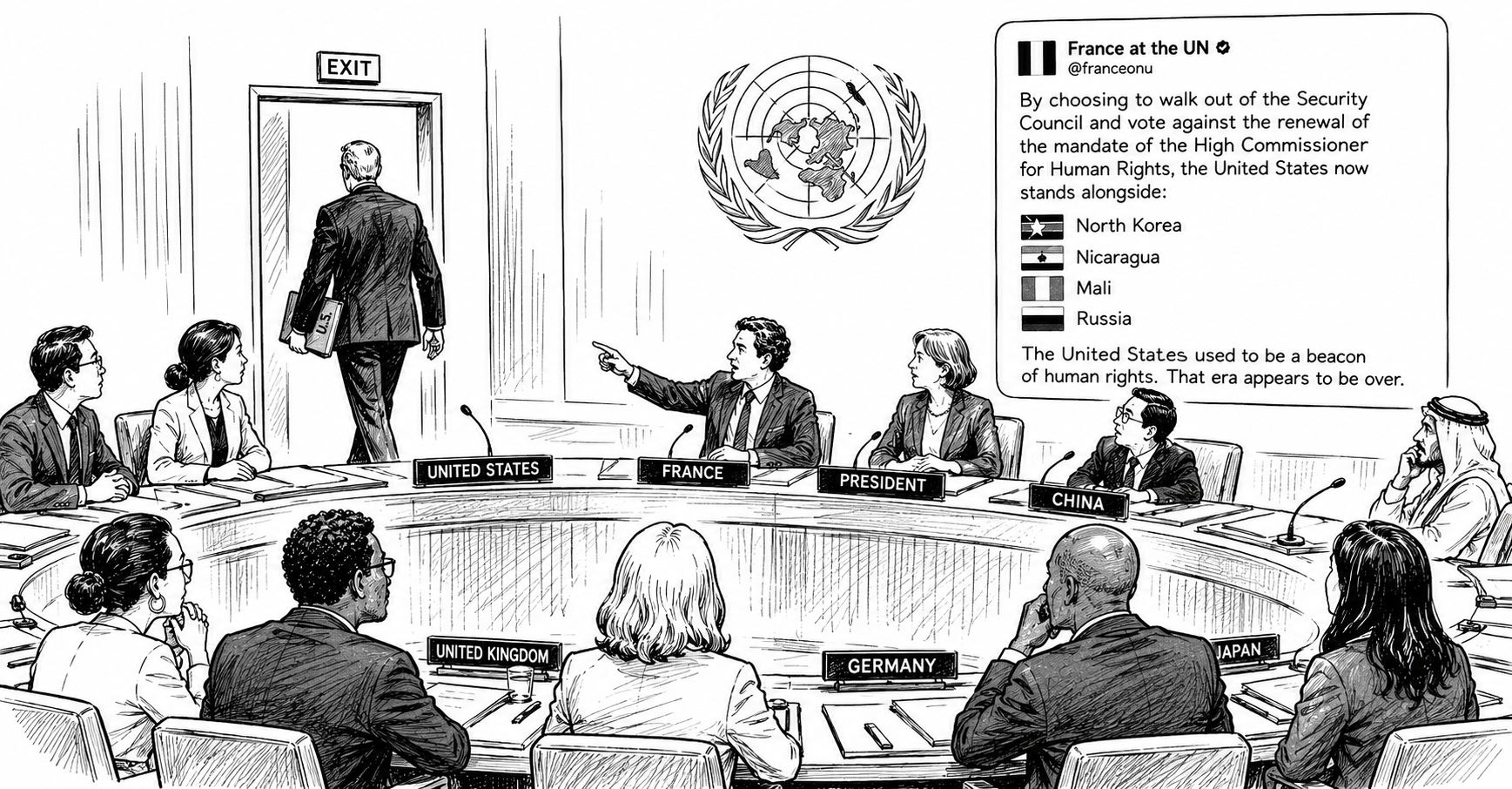
The United States has spent decades positioning itself as the world’s foremost defender of human rights. This week at the United Nations, one of America’s oldest allies said that era is over — not in private, not through back channels, but on social media, in an official statement, with a list of the countries it now believes stand alongside Washington on human rights: North Korea, Nicaragua, Mali, and Russia.
The immediate trigger was a U.S. walkout during a Security Council meeting while France’s ambassador criticized Washington’s decision to oppose extending Volker Türk’s term as U.N. High Commissioner for Human Rights. France’s U.N. mission posted the comparison publicly afterward. The statement was extraordinary not simply because it was blunt, but because it came from France — a country that has historically aligned closely with the United States on questions of democratic governance and international institutions. Allies rarely compare one another to geopolitical adversaries in official communications. When they do, it signals more than disagreement over a single vote.
The immediate story is diplomatic friction. The more important story is what it reveals about the mechanism through which American influence actually operates — and what happens when that mechanism starts to break down. For decades, the United States exercised influence through more than military and economic power. It also benefited from what political scientists call normative power — the ability to shape international behavior because other governments accepted American leadership on human rights, civil liberties, and democratic governance. That influence depended less on perfection than on credibility. Allies were willing to tolerate inconsistencies because they believed the United States fundamentally intended to strengthen the institutions it helped build after World War II. That assumption is becoming harder to sustain, and France’s statement is the clearest signal yet that allies are no longer keeping that assessment private.
Walking out of a Security Council session while an ally delivers criticism sends a specific message: disagreement will be managed through disengagement rather than negotiation. Voting against the continuation of the world’s top human rights official compounds that signal. Together, those actions create space for competitors — China, Russia, and the emerging bloc of governments that have chafed under American normative leadership — to argue that Washington is voluntarily stepping away from the institutions it once championed. That argument is now being made not by adversaries but by France, and it is being made in public. Previous administrations sought to shape multilateral institutions from within, even when they viewed those institutions as flawed or captured by interests misaligned with American priorities. The current approach appears more willing to challenge, bypass, or withdraw from those organizations entirely. Supporters argue this restores national sovereignty. Critics argue it reduces American influence by leaving institutional leadership to others. History suggests both can be true simultaneously — countries can preserve greater autonomy while surrendering the soft power that makes their autonomy matter to anyone else.
What makes this moment distinct is who is speaking. Public criticism from adversaries is expected and largely discounted. Public criticism from allies carries different diplomatic weight because it reveals fractures within the relationships that have traditionally formed the foundation of Western cooperation. France is not a peripheral voice. It is a permanent Security Council member, a NATO ally, and a country whose own history of colonial power and postwar rebuilding is inseparable from the American-led international order it is now publicly questioning. When France says the United States “used to be a beacon of human rights,” it is not offering a critique from outside the system. It is a founding architect of that system telling the room that the lead contractor has walked off the job.
Whether this episode becomes an isolated dispute or the beginning of a deeper realignment depends on what follows in NATO, the G7, and the other multilateral institutions where American normative leadership has historically been the organizing assumption. If similar confrontations accumulate, they will point to something larger than a disagreement over one U.N. appointment. They will signal that the United States is redefining not just its foreign policy priorities, but the very mechanisms through which it exercises global influence — and that its allies have begun making their own arrangements in response.
Why This Matters
Institutions are built on legitimacy as much as power. Military strength can compel action. Economic strength can incentivize cooperation. But legitimacy determines who others choose to follow — and it is not rebuilt the same way it is lost. It erodes through accumulation: a walkout here, a vote there, a comparison to North Korea from an ally that used to hold the line in private. Once that erosion becomes visible enough for France to name it publicly, the question is no longer whether American soft power is declining. It is how fast, and who moves into the space it leaves behind.