A Historic Heat Dome Is Straining the Power Grid Across Half the Continent
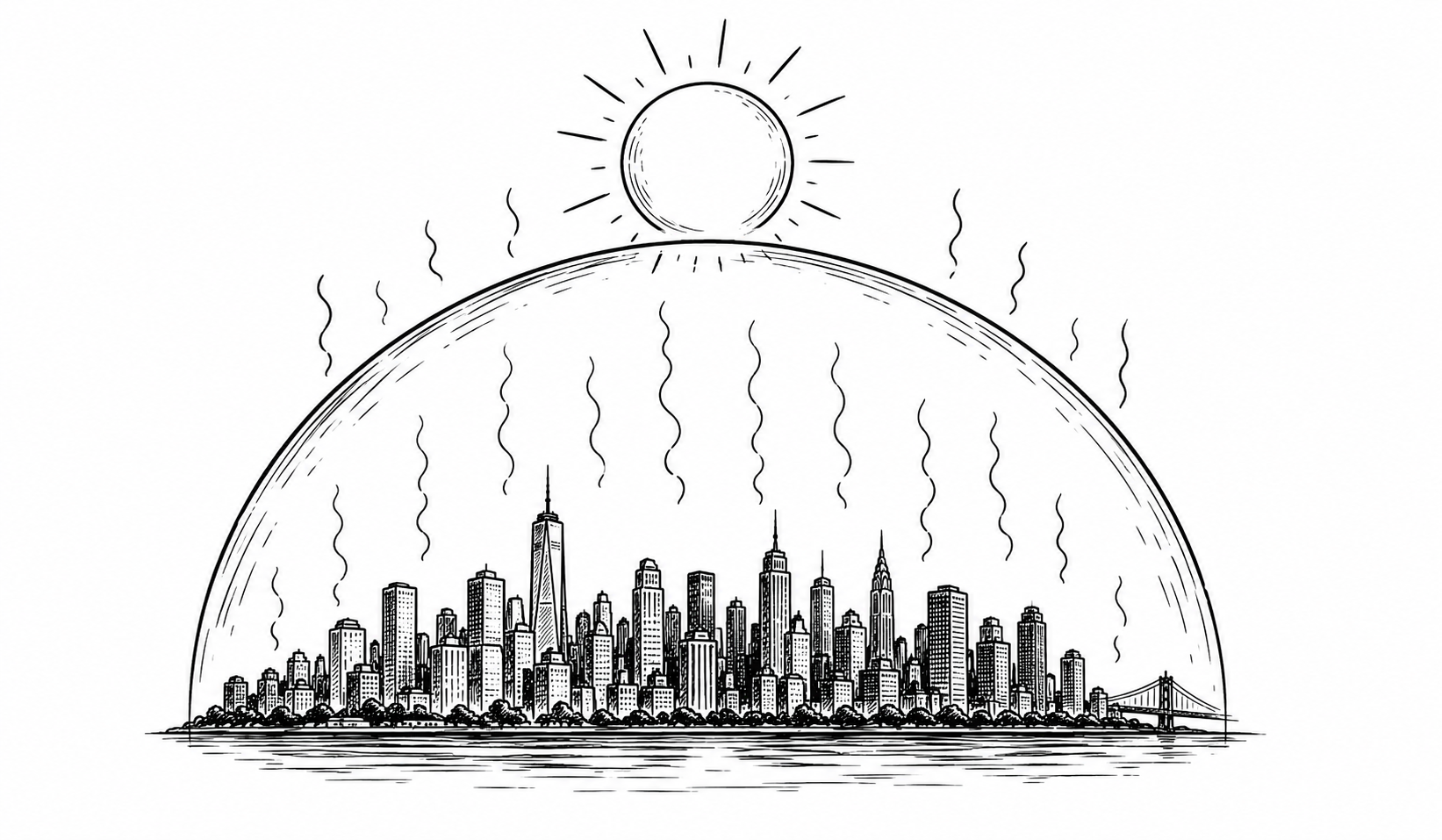
A heat dome now covers roughly half the United States, with about 180 million people under major or extreme heat risk from the National Weather Service. New York’s Central Park hit 100 degrees for the first time in 14 years, tying a record set in 1966. Heat indices topped 110 degrees from Washington, D.C., to Boston, and at least 20 locations broke or tied daily record highs on Thursday alone. The Department of Energy issued emergency orders to boost electricity generation within the PJM Interconnection, the grid serving much of the Mid-Atlantic, as officials warned of strain on the power supply heading into the holiday weekend.
The heat is not confined to one country or one coastline. Chicago is under warning with a heat index near 102 degrees. Ontario and Quebec are simultaneously under heat warnings, with temperatures expected to reach nearly 99 degrees in parts of Canada. This is a continental event, not a regional one, and it is arriving at the same time as the FIFA World Cup, the July 4th holiday travel period, and a federal grid system that is responding with emergency orders rather than pre-built capacity.
That sequencing is the story. Grid operators only issue emergency generation orders when the system is already close to its limit. A one-off heat wave stresses a grid built for average conditions. A grid that requires emergency federal intervention every time a heat dome forms is a grid whose baseline capacity was never sized for the climate it now operates in. Utilities and regulators have spent years treating each heat wave as an isolated weather event requiring a reactive response, cooling centers, conservation requests, mobile medical vans, rather than as a recurring stress test that argues for permanent capacity investment.
The response so far reflects that reactive posture. New York City opened hundreds of cooling centers and deployed mobile medical vans. More than 2,200 LinkNYC kiosks are displaying directions to the nearest cooling center. Washington, D.C., activated an extreme heat alert through July 5. These are real and necessary measures, but they treat the heat as an emergency to be managed rather than a condition to be built for. Norristown, Pennsylvania, and Haddon Township, New Jersey, have canceled their Fourth of July parades. The public rehearsal for PBS’s A Capitol Fourth concert on the National Mall was canceled due to the heat, with organizers deciding by Friday morning whether the concert itself would proceed.
The deeper risk is in the nights, not the days. Nights are warming faster than days as the climate changes, and warm, humid nights are giving the body little chance to recover before the next day of dangerous heat. Temperatures in many locations are only falling into the 70s overnight, struggling to drop below 80 in urban areas. Extreme heat is already the deadliest weather-related hazard in the United States: at least 13,000 Americans have died from heat since 2018, more than from hurricanes, tornadoes, or floods. In eastern Virginia, forecasters say this could be the region’s most significant heat event since a 2012 heat wave that caused more than 30 deaths across four states.
What this event tests is not just how hot it gets, but whether infrastructure built for a different climate can absorb a recurring stress that is arriving earlier, lasting longer, and overlapping with more of the calendar than it used to. A heat dome large enough to force emergency federal action, cancel a national broadcast event, and span two countries at once is not an anomaly anymore. It is a preview of what an ordinary summer now requires of a power grid that was not built for it.