Meta Wants to Turn Prediction Into Another Engagement Product
If prediction markets move inside social platforms, public life becomes something users are trained to wager on, even before money enters the app.

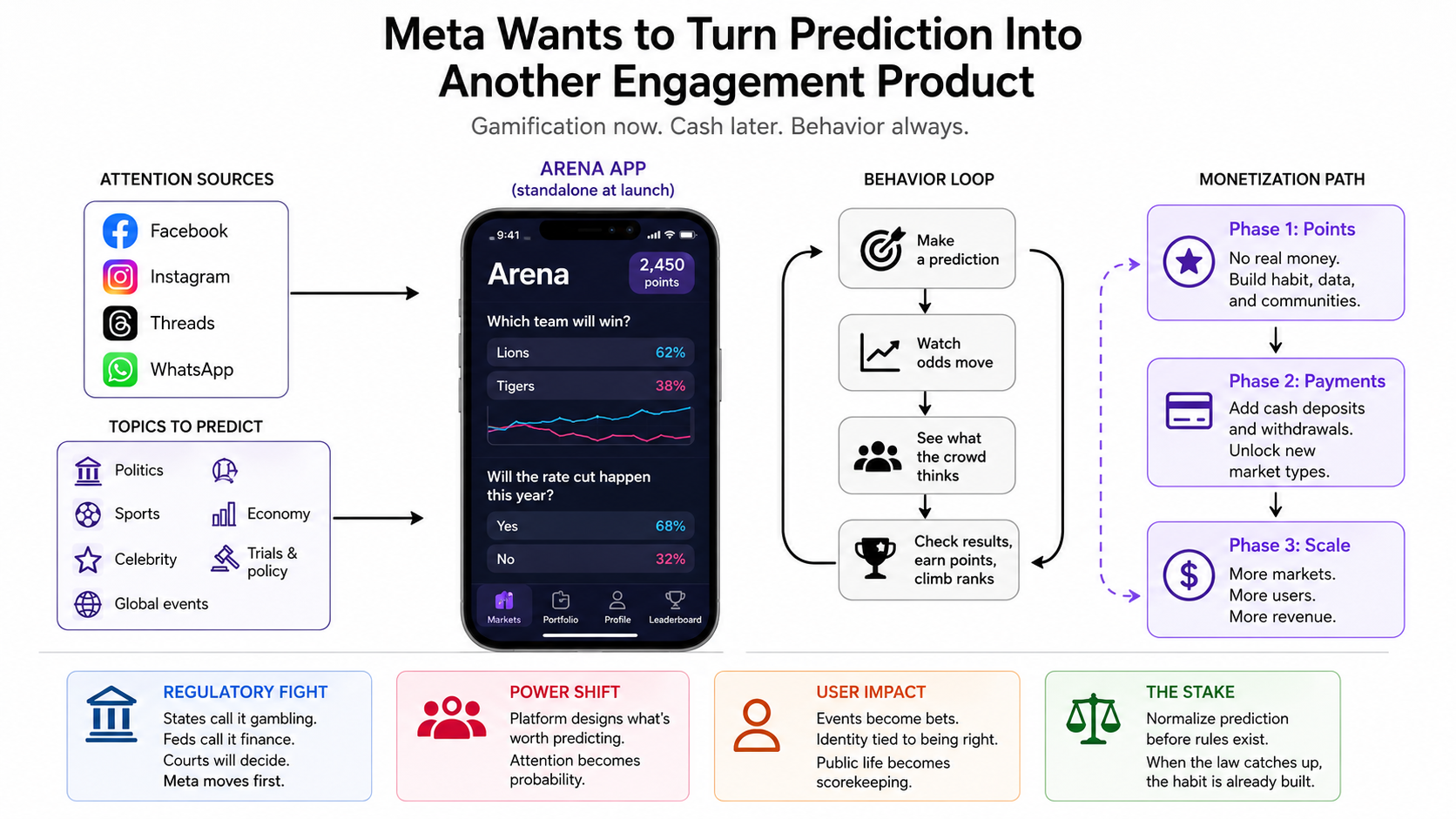
Lucas Ropek reported for TechCrunch on June 23 that Mark Zuckerberg wants Meta to build a prediction-market app modeled on platforms such as Polymarket and Kalshi. The app, internally called Arena, would reportedly start as a standalone smartphone product where users earn points for making correct predictions rather than betting real money. TechCrunch, citing the New York Times, reported that cash could be added later.
The mechanism is gamification before monetization. Meta does not need to launch real-money betting on day one for the product to matter. A points-based prediction app can still train users to treat politics, sports, celebrity news, public policy, elections, trials, economic data and global conflict as events to forecast, rank and revisit. The wager may be symbolic at first. The behavioral loop is not.
That loop is familiar. Social platforms already know how to turn attention into habit. They reward return visits, visible status, speed, reaction and competition. A prediction market gives that system a cleaner structure: make a call, watch the odds move, check whether the crowd agrees, come back for the result. The product does not just ask users what they think. It asks them to attach identity and scorekeeping to being right.
That is why Meta’s entry would change the scale of the prediction-market debate. Polymarket and Kalshi are already powerful enough to attract regulators, lawsuits and traders looking for an edge. Meta brings a different asset: distribution. A standalone Arena app could still be fed by Facebook, Instagram, Threads and WhatsApp-adjacent attention flows. Even without direct integration, Meta knows how to push users toward new behaviors when it decides a format is strategically important.
The regulatory fight is already messy. State attorneys general have argued that some prediction-market contracts look too much like gambling, especially when tied to sports. In April, New York Attorney General Letitia James joined a bipartisan coalition defending states’ authority to apply gambling laws to prediction markets. The federal government has moved in the other direction, suing several states over attempts to regulate prediction-market operators under state law.
That conflict matters because Meta is not entering a settled category. Prediction markets are being described as finance, forecasting, entertainment, gambling, civic intelligence and speculative trading, depending on who benefits from the label. The label determines the regulator. The regulator determines the guardrails. The guardrails determine whether a platform can scale first and answer hard questions later.
Meta’s reported points-based design gives the company a softer opening. It can frame Arena as a game, not gambling. It can test engagement without immediately triggering the same legal exposure as cash trading. It can learn which topics pull users back, which communities form around prediction, which events drive intensity and where the product might support future monetization. The absence of money at launch does not mean the absence of stakes.
The stakes sit inside the social behavior the product creates. If prediction becomes another feed-native habit, public events become raw material for competition. Users are not only consuming information. They are sorting it by payoff, probability and personal scoreboard. That can sharpen attention, but it can also reward cynicism. A user trained to predict outcomes may begin to treat every public crisis as a market signal before treating it as a human event.
Power moves from public interpretation to platform-designed probability. News organizations, regulators, campaigns, leagues and public institutions already struggle to shape context inside social feeds. A Meta-owned prediction product would add another layer: not just what people see, but what they are incentivized to forecast. The platform would not need to decide what is true to influence behavior. It would only need to decide what is worth predicting.
The next version of the attention economy may not look like scrolling. It may look like placing a stake, even a fake one, on what happens next. If Meta normalizes prediction as social behavior before regulators decide what prediction markets are, the company will have done what large platforms often do best: turn an unsettled legal category into a user habit, then force the law to catch up.