
Zillow Grew Revenue 18%, Doubled Profit, and Just Cut 500 Jobs Anyway
The company’s own numbers contradict the reason usually given for layoffs like this one. That contradiction is the actual story.

Zillow laid off more than 500 employees on Tuesday, about 7 percent of its global workforce, in what CEO Jeremy Wacksman called the company’s largest round of cuts this year, according to a company blog post and reporting from GeekWire’s Todd Bishop. The layoffs land a day before Zillow reports second-quarter earnings, and they arrive attached to financial results that don’t fit the standard layoff narrative. Q1 2026 revenue rose 18 percent year over year to $708 million, in a residential real estate industry that grew just 2 percent over the same period, according to National Association of Realtors data. Net income climbed to $46 million, up from $8 million a year earlier.
That’s not the profile of a company cutting costs to survive. It’s a company outperforming its entire industry, more than tripling profit, and still deciding 500 jobs don’t fit where it’s headed.
Wacksman’s public explanation leans on a specific phrase: the cuts reflect “the reality of what is required of us to grow at scale,” and ensure “a disciplined cost structure” with “the right people in the right positions.” In an internal email to staff, obtained by Inman, he said the cuts affected nearly all levels of the company, and that direct managers were only informed of the layoffs alongside the employees losing their jobs. That detail matters beyond the obvious cruelty of a manager learning about their own team’s elimination in real time with everyone else. It signals a decision made and finalized well above the managers who would normally be consulted on staffing changes, the kind of top-down restructuring that happens when a company is reshaping what kind of organization it wants to be, not responding to a budget crisis in any single division.
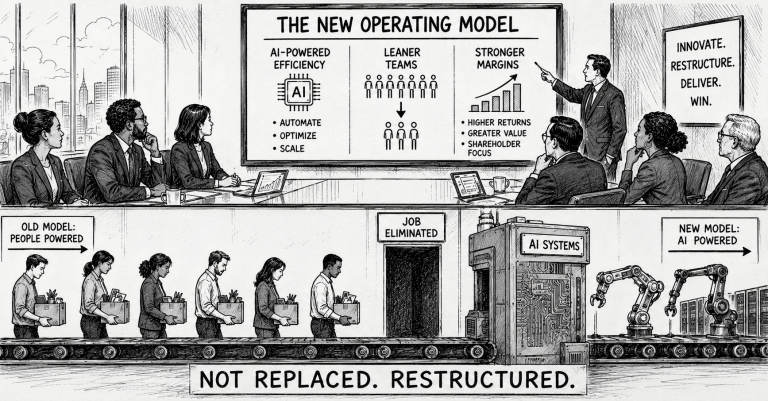
The AI question sits directly underneath that reshaping, and Zillow has taken two different positions on it within the same news cycle. KIRO 7’s coverage framed the cuts as the company “leaning harder into AI.” Real Estate News reported that Wacksman told industry executives at the T3 Leadership Summit in April that Zillow employees were being retrained to use AI in their roles, with productivity gains he described as “small, but they’re compounding.” But when Real Estate News asked Zillow directly whether Tuesday’s layoffs were connected to AI adoption, a company spokesperson said no, the cuts were about “better positioning Zillow for the path ahead,” not automation.
Those two statements aren’t necessarily contradictory in the narrow legal sense, a company can retrain staff toward AI-assisted workflows while also saying a specific round of layoffs wasn’t AI-driven. But the distinction is doing a lot of work for a company that’s actively signaling AI investment to its industry while denying AI displacement to the employees it just cut. Either AI produced enough efficiency that certain roles became redundant, in which case that is an AI-driven layoff by any reasonable definition, or it didn’t, in which case Wacksman’s framing of “small, but compounding” gains four months earlier was overstating what the technology was actually delivering. Both versions can’t be true at once, and Zillow has now put both versions on the record in the same season.
The market’s reaction adds a third layer to the disconnect. Zillow’s stock is down 45 percent this year, according to RISMedia, despite the revenue growth, the profit increase, and the company explicitly outperforming a flat housing market. That’s the real mechanism worth naming: investors are not rewarding Zillow for growing faster than its industry. They’re pricing in something else, likely a broader repricing of growth-stage tech and real estate platform stocks against a housing market that remains stagnant regardless of any single company’s execution. A CEO under that kind of stock pressure has a direct incentive to demonstrate cost discipline publicly, independent of whether the underlying business actually needs it. Layoffs are one of the fastest, most visible signals a public company can send to that pressure, which is a different explanation than either “AI is replacing workers” or “the company is struggling,” and arguably the more accurate one here.
This is the second round of cuts at Zillow this year. In January, the company cut roughly 200 positions, which it characterized at the time as performance-related, tied to normal annual review cycles rather than a broader restructuring. Tuesday’s cuts carry no such framing. They’re explicitly described as organizational, hitting “nearly all levels,” disclosed the same week as earnings, timed for maximum visibility to the market watching Wednesday’s report.
What happens next depends on what Wednesday’s earnings call actually reveals, whether Wacksman frames these cuts to investors as AI-driven efficiency, cost discipline independent of AI, or something else entirely. Whichever explanation he gives to shareholders is likely to be the more candid one, since that’s the audience with the least patience for a story that doesn’t fully add up. If the earnings call leans into AI as the efficiency driver, it will confirm what the spokesperson denied to reporters this week. If it doesn’t, the more uncomfortable read stands: a profitable company outperforming its industry cut 500 people primarily to satisfy a stock price that a strong quarter alone couldn’t move.