Zara Is Selling $46 Pants That Are Sending People to the Emergency Room. The Company Has Nothing to Say About It.
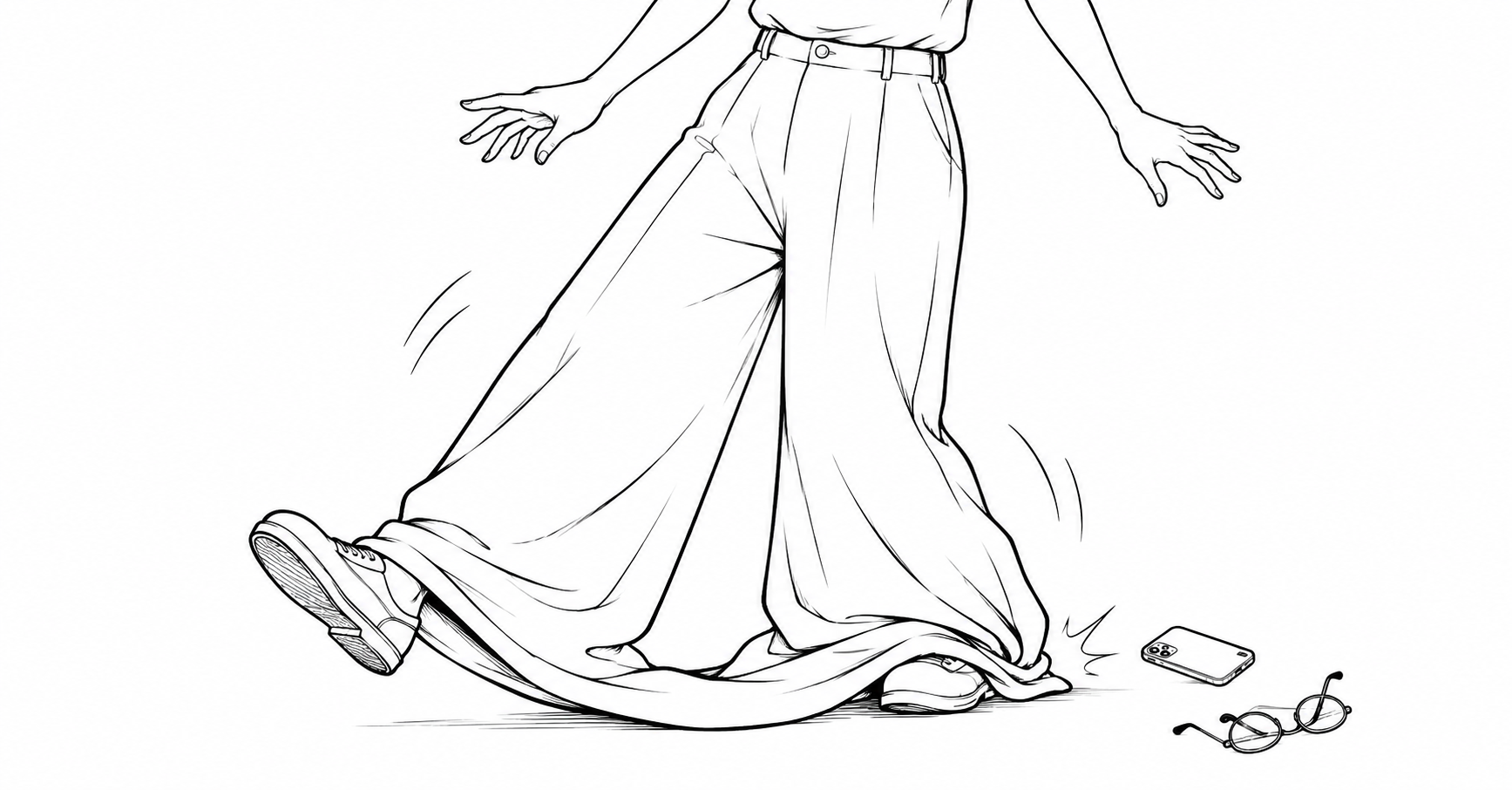
Victoria Vesovski, writing for Moneywise, reported this week that Zara’s “Flowy Wide Leg Pant” — a $45.90 palazzo-style trouser currently going viral on TikTok — has earned a second, less marketable name: the death pants. The moniker is hyperbolic. The injuries are not. Across social media, wearers have documented fractured knees, broken wrists, forearm gashes, and at least one escalator incident that ended in embarrassment if not the emergency room. Zara has not responded to press inquiries. Parent company Inditex just reported $10.17 billion in first-quarter sales, with May revenue up 11.5% year-over-year, beating analyst expectations. The math of this situation is not complicated.
Holly Gilmer, a TikTok user whose video begins with her limping in the pants and ends with her in a hospital wheelchair, put it plainly: “These Zara pants need to come with a warning because now I have a fractured knee.” Under her post, the comments filled quickly with users who had broken elbows, fallen while seven months pregnant, and tripped on escalators across three continents. Ellin Costa, a 50-year-old Toronto resident who spoke to CBC News, broke her wrist, sustained a deep cut to her temple requiring medical gluing, bruised half her face, and destroyed her glasses and Apple Watch. “Those pants almost killed me a couple weeks ago,” she said. She is in a cast for six weeks.
The pants cost $45.90. An emergency room visit in the United States costs between $1,500 and $3,000 on average, before follow-up care, physical therapy, or income lost during recovery. Costa’s bill — in Canada, where healthcare functions differently — still included the permanent scar her temple injury is expected to leave, six weeks of immobility, and the replacement cost of personal items destroyed in the fall. Zara kept the $45.90. Costa absorbed the rest.
This is the fast fashion cost-transfer in its most literal form. The entire business model of a company like Zara — which can move a trend from runway to store floor in roughly two weeks — depends on speed and price compression at every stage of production. That compression shows up in labor conditions, in environmental waste, and, apparently, in the decision to manufacture a palazzo pant whose extra-wide, floor-grazing hem can wrap around a wearer’s feet mid-stride and send them into the concrete. The UK’s Fashion Times noted that the leg width is a specific design risk: the extra fabric catches underfoot while walking, turning a fashion choice into a physics problem. That is a design flaw. It is also a choice. Someone approved these pants for production. Someone decided the silhouette was worth the risk. That someone works for a company with $10 billion in quarterly revenue that is currently declining to comment.
The silence is its own structural statement. When a car seat is found to injure children, there is a recall. When food is found to make people sick, there is a recall. When a pharmaceutical causes adverse events at scale, there is a recall, a black box warning, or both. Fast fashion operates under no equivalent accountability framework. Zara can watch dozens of customers document injuries tied to a specific product on public social media platforms, receive press inquiries about those injuries, and respond with nothing — and face no regulatory consequence for that silence. The pants remain on sale.
Inditex’s quarterly numbers tell you what the company has decided this moment is worth responding to, and it is not the death pants. RBC analyst Manjari Dhar told Reuters that Zara is “clearly still gaining share” and “clearly the outperformer” in the fast fashion category. Sales are up. Margins are up. The viral moment, from Inditex’s perspective, may well be functioning as free advertising — the pants are talked about everywhere, they remain in stock, and the people buying them are apparently willing to accept the risk or assume they will be more careful than the people who fell.
That is also a structural design — not of the pants, but of how fast fashion has trained its consumer base to self-manage the externalized costs of cheap production. The Moneywise article ends by suggesting buyers simply factor in the cost of hemming the pants before purchase. That is reasonable advice. It is also a perfect illustration of where the accountability lands in this model: with the consumer, who bought a product that needed to be altered before it was safe to walk in, from a company that will not acknowledge the problem exists.
Vogue described wide-leg trousers this season as “one of those rare wardrobe staples that truly work for almost everyone, in almost every setting.” Ellin Costa is in a cast for six weeks. The setting she is currently in is not the one Vogue had in mind. Zara has nothing to say about the difference.
Source: Moneywise / Yahoo Finance — Victoria Vesovski — https://finance.yahoo.com/healthcare/articles/zaras-45-wide-leg-pants-174000480.html