They Climbed the Empire State Building. The Internet Didn’t Ask Why. It Asked Where’s the Video?
The stunt produced a marriage proposal, a peace banner, felony charges, and millions of views. The sequence of what came first tells you everything.
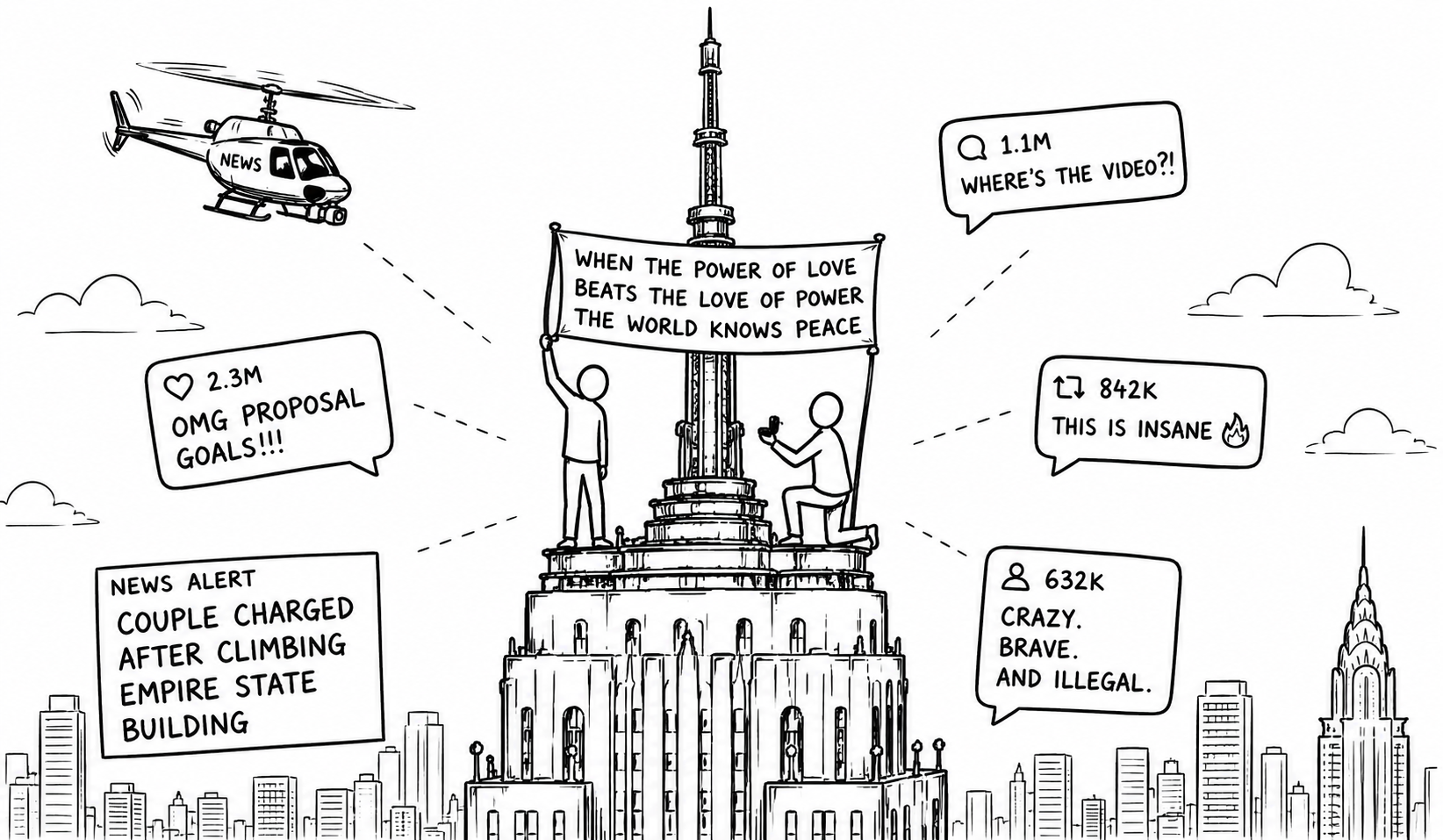
CNN reported that Angela Nikolau, 33, and Ivan Kuznetsov, 32 — known online as Ivan Beerkus and the subjects of the 2024 Netflix documentary “Skywalkers: A Love Story” — hid inside the Empire State Building after visiting hours July 1, accessed the 103rd floor through a maintenance hatch not open to the public, and climbed the building’s 200-foot broadcast antenna with no visible safety equipment. At the top, they unfurled a banner reading “When the power of love beats the love of power the world knows peace,” and Kuznetsov dropped to one knee while NBC New York’s helicopter circled overhead. They were charged with felony burglary, reckless endangerment, and criminal mischief, among other offenses, arraigned the following day, and released under court supervision.
The internet’s response tracked the proposal first, the charges second, and the banner almost not at all.
Attention economies don’t reward the message. They reward the moment — specifically the moment that makes every other piece of content on the feed feel flat by comparison. A marriage proposal 1,450 feet above a city, broadcast live from a spire most people can only see from the street, is not competing with other proposals. It’s competing with everything else a viewer might be looking at, and it wins that competition before the person watching has processed why they’re watching. Nikolau’s Instagram account, which features dozens of posts from the tops of buildings across the globe, had already built the audience that made this particular stunt land the way it did. The Empire State Building wasn’t chosen because it was meaningful. It was chosen because it was the next escalation.
That escalation logic is what makes this a structural story rather than a novelty item. The documentary exists. The Netflix deal exists. The charges from previous stunts exist. What Nikolau and Kuznetsov have built is a career architecture where the product is access to places audiences cannot go, and the business model requires the access to keep getting more extreme to stay valuable. Spectacular views are no longer scarce. Rooftop bars sell them. Travel accounts document them by the thousands. What remains genuinely scarce is unauthorized proximity to something recognizable — a spire, a landmark, a moment that carries institutional weight — paired with the risk of losing everything to get there.
Prosecutors named the mechanism themselves. The Manhattan District Attorney’s Office described the pair in court as social media influencers who engage in extreme risk-taking behavior, including breaking into restricted areas of commercial buildings, hanging from rooftops, and free-climbing skyscrapers. That framing places the stunt inside a pattern rather than treating it as an isolated incident, which is the correct frame. The Empire State Building breach is the latest iteration of a content strategy, not a departure from one.
The Empire State Building’s own statement after the incident noted, with some precision, that its Observation Deck “does offer a practical way for the most memorable marriage proposals.” That line is doing more than public relations work. It marks the institutional response to a world where the unauthorized version of an experience generates more coverage than the authorized one. The building knows what the stunt was for. The stunt knows the building knew.
What the banner actually said — a line often attributed to Jimi Hendrix about love overtaking power — generated almost none of the conversation. The peace message didn’t trend. The proposal did. Whether that ratio reflects the audience’s values or simply the mechanics of how feeds are designed to surface emotion over argument is the part of this story that doesn’t resolve cleanly. It just continues.