Google’s Own AI Safety Team Doesn’t Trust Google’s AI to Read a Resume. They Just Didn’t Want You to Know That.
SSC News Desk
The people at Google who work on making artificial intelligence safe and aligned with human values have a message for job applicants: do not let the AI screen your resume.
The document existed quietly until Bloomberg obtained it. Google DeepMind’s AGI Safety and Alignment Team — the division responsible for ensuring the company’s most powerful AI systems behave as intended — created an internal form pointing job applicants away from Google’s standard AI-powered resume screening system. The form tells recruits directly that there is “a non-trivial probability your CV will be screened out incorrectly or take too long to reach us”and instructs them to fill out the alternative form so that “a real human on the team will get to see your application.”
At the top of the document, in capital letters: “PLEASE DO NOT SHARE THIS DOC WIDELY.”
That instruction is doing significant work. Google is among the most prominent advocates for AI integration in enterprise hiring. Its tools are pitched to companies across industries as a more efficient and less biased method of evaluating candidates than human review. The standard argument is that AI removes subjective judgment from early-stage screening. What the internal form says, quietly and to a limited audience, is that the system doing the removing is itself unreliable — and that the team closest to that technology decided the workaround was necessary.
The irony is precise. The AGI Safety and Alignment Team is specifically tasked with identifying where AI systems fail and ensuring those failures do not scale in harmful ways. These are not skeptics of AI from the outside looking in. These are the researchers who understand the technology’s limitations with more depth than almost anyone. When they look at AI resume screening and conclude that there is a non-trivial chance it produces incorrect outcomes, that assessment is not casual concern. It is an informed professional judgment made by the people whose job it is to make exactly those assessments.
The phrase “non-trivial probability” is worth sitting with. In technical communication, it signals something meaningfully above zero — not a theoretical edge case but a realistic and recurring possibility. Applied to resume screening, it means the tool eliminates real candidates who should advance. The team did not describe this as a bug they expected to be fixed. They built an internal workaround and kept it quiet.
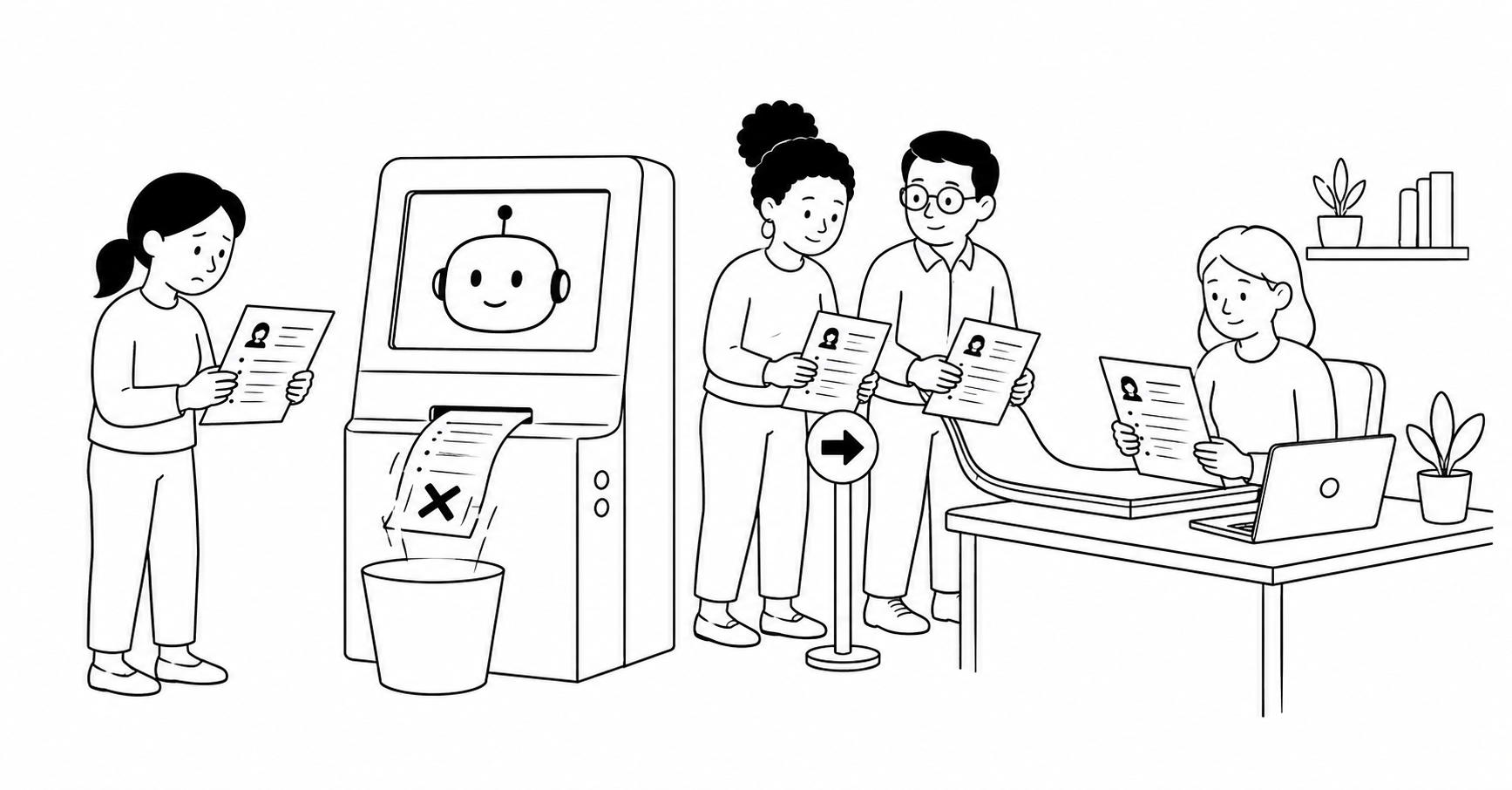
What makes this a business story, not just a technology one, is what Google sells versus what Google does. Across its enterprise products and public positioning, the company has consistently argued that AI integration into hiring reduces inefficiency and improves outcomes. That argument has been compelling: AI resume screening has become standard practice in large organizations, with estimates suggesting that 75 percent of resumes submitted to major employers are now filtered by automated systems before any human reviews them. The workers whose applications are screened out by those systems rarely know why, rarely have a path to reconsideration, and have no internal form they can fill out to reach a real human.
Google’s employees — at least those applying to one particular team — do.
The gap between those two groups is the more consequential part of this story. The people who have access to the workaround are the candidates the team is actively trying to recruit. The candidates who do not have access are everyone else applying to every other organization running AI screening tools that carry the same “non-trivial probability” of error. The form was marked do not share widely because its existence is an admission. Not that AI hiring tools are imperfect — that is broadly understood. But that the people who build them know the specific ways they fail, and protect their own hiring from those failures while selling the tools to everyone else.
AI resume screening will continue to expand. The efficiency case for it is real, and the labor market conditions of 2026 give employers less pressure to care about the candidates it misses. But the Google DeepMind document is a useful artifact. When the people designing the technology route around it for consequential decisions, they are telling you something about their actual confidence in the tool. They just asked you not to repeat it.