LinkedIn Didn’t Build a Background Check. Its Users Did.
One in five workers has used LinkedIn to research a romantic partner. The more important story is why that works — and what it means for what the platform is actually selling.
Part of Culture in Motion — examining how digital platforms evolve beyond the purpose they were originally built to serve.
NEWS DESK | SOCIAL STORYTELLERS COLLECTIVE
LinkedIn was built to find jobs. Its users have quietly reassigned it to a different function: confirming that a stranger is who they claim to be. The gap between those two purposes is where the platform’s most defensible business is sitting — unmonetized, underbuilt, and increasingly obvious to everyone except the company running it.
SFGATE’s Ariana Bindman reported in July that one in five U.S. workers surveyed by the resume platform Zety had used LinkedIn to research a potential romantic partner, and that one in eight had entered a relationship that began there. Most coverage handled the finding as a novelty. The more accurate reading is structural: LinkedIn’s user base has handed the platform a second assignment without waiting for permission, and that assignment is more durable than the first one.
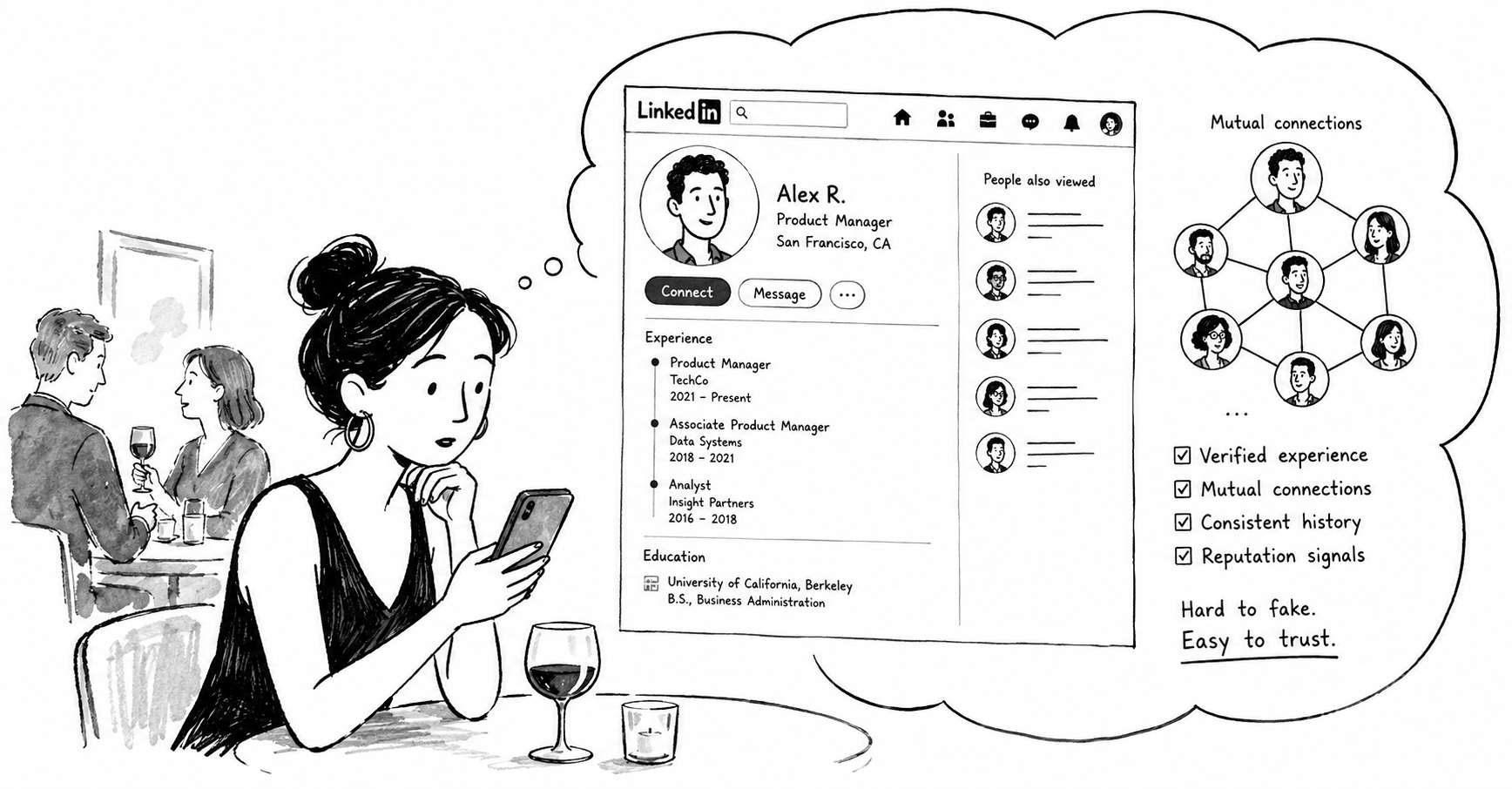
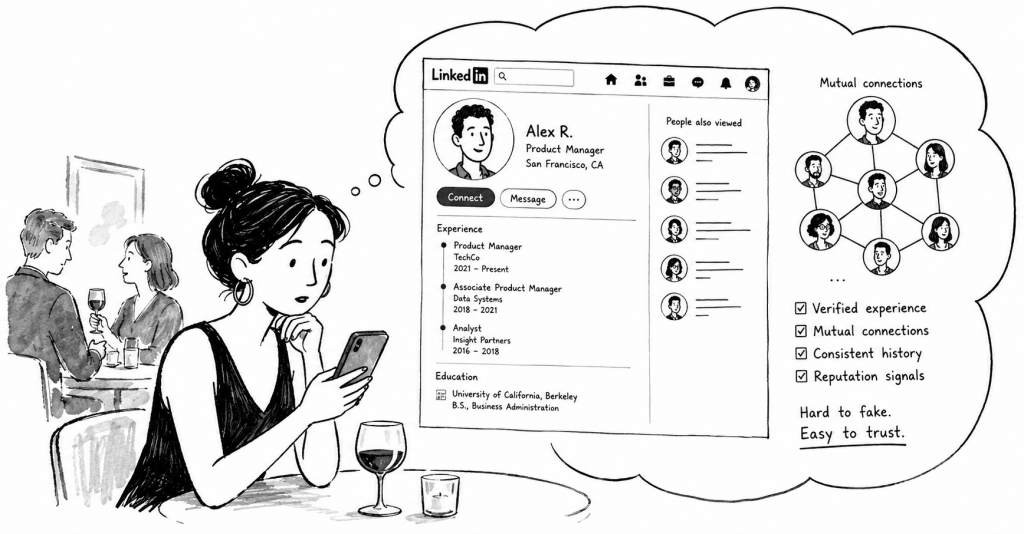
The mechanism sits in how the data gets made. A LinkedIn profile is not purely self-reported. Employers confirm job titles by hiring the person under them. Universities anchor degree claims. Former colleagues corroborate overlapping tenure. Mutual connections build a web that is difficult to fabricate at scale. Instagram, TikTok, and X ask users to describe themselves and then rank the description by engagement. LinkedIn asks users to describe themselves in front of the people best positioned to contradict them. That difference is what makes the record usable for verification — and it is the one asset the platform holds that a competitor cannot replicate quickly. Zety’s April 2026 survey of 1,023 U.S. workers found that 48% considered LinkedIn profile information more trustworthy than what appears on dating apps, with mutual connections cited by 41% as a factor that shaped romantic interest. Photos still ranked first, as they do on every platform. What sits underneath the photo is the part dating apps cannot supply: a career sequence that either coheres or does not, and a list of people who could vouch for it.
This is happening while LinkedIn’s original function loses credibility. Users report duplicate listings, roles left posted for months, and openings that companies show little intent to fill. As the employment layer degrades, the value users still extract concentrates in the layer they cannot get anywhere else. People are not leaving the platform. They are using a different part of it — the part LinkedIn hasn’t built a product around yet.
Platform history has run this pattern before. Twitter operated as a breaking-news wire for years before its executives built products around that use. Reddit became one of the internet’s largest recommendation engines while its leadership still described it as a forum. Facebook turned into community infrastructure for groups and local commerce well after the news feed defined it publicly. In each case the second function arrived from the user base, and what followed depended entirely on how quickly the company recognized the assignment it had been handed. LinkedIn is being handed one now. Microsoft, which has owned the platform since 2016, already operates in identity infrastructure through Azure Active Directory. The adjacency is direct. Recognition, here, would mean building the identity business explicitly rather than letting it remain a byproduct — paid verification tiers, credential authentication sold to employers, trust signals attached to freelance and B2B transactions, API access for third parties running background checks. All of it sits within reach of what the platform already stores.
The cost of that position is accuracy. Once a profile functions as a background check, stale titles, inflated tenures, and abandoned accounts stop being cosmetic problems and start feeding real decisions — about who gets hired, who gets the contract, and who gets a second date. LinkedIn currently offers no meaningful correction process for someone misrepresented on the platform and no appeal for a profile that has been scraped, cloned, or impersonated. A verification layer without a dispute mechanism pushes the risk onto the people being verified — and the people most likely to be misrepresented are the ones with the least institutional visibility to contest it.
The identity function will get productized within the next two years. Verification will move from a free badge to a priced tier. Third-party licensing of confirmation signals will follow. Dating platforms will be among the earliest buyers, since they carry the highest fraud exposure and the thinnest identity data of anyone in the market. The competitive pressure on LinkedIn will stop coming from Indeed and start coming from whoever else can prove, at scale, that a stranger is real. The users already know what LinkedIn is for. The question is whether LinkedIn figures it out before someone else builds the same thing with a cleaner dispute mechanism and a better answer for the people getting verified rather than just the people doing the verifying.
Why This Matters
The behavioral shift documented in the Zety survey is not a story about dating. It is a story about trust infrastructure — about which platforms have earned the right to confirm identity and which ones are still asking users to take claims on faith. LinkedIn earned that right not by building a verification product but by creating the conditions under which verification happens as a byproduct of normal professional activity. That is a significant structural advantage. It is also a responsibility the platform has not yet built the systems to honor — and the gap between what users trust LinkedIn to confirm and what LinkedIn can actually defend is where the next round of fraud, impersonation, and misrepresentation will land.