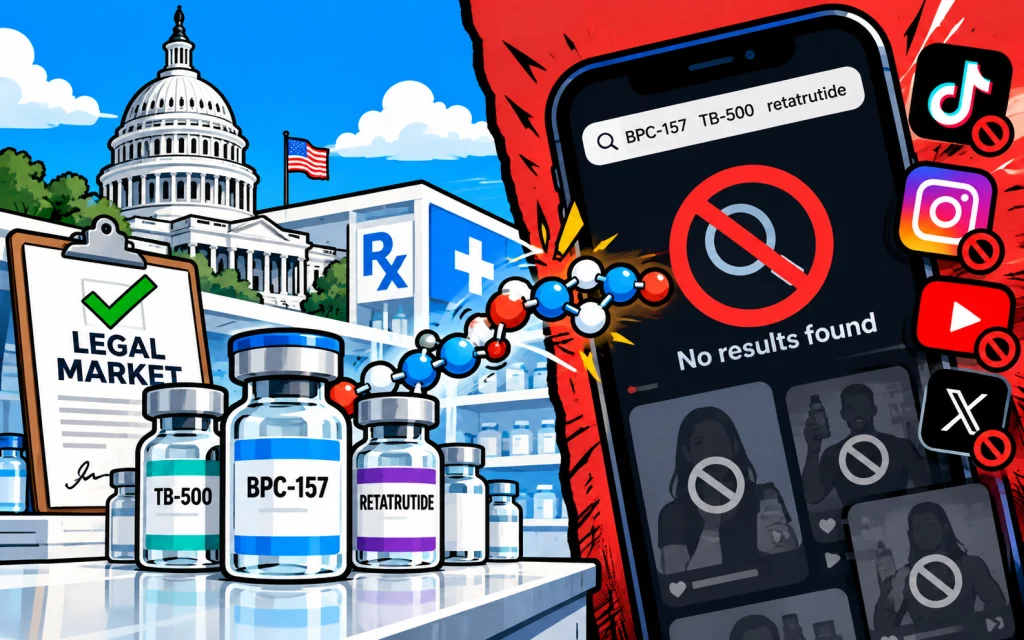
Health Secretary Robert F. Kennedy Jr. says the administration wants a regulated marketplace for peptides that remain unapproved and largely unproven. On the same day, TikTok began blocking searches for some of the most popular ones. The products are moving toward the mainstream before the science or the rules have caught up.
On Tuesday, two of the most powerful forces shaping America’s peptide boom moved in opposite directions. In Washington, Health Secretary Robert F. Kennedy Jr. said the Trump administration wants to expand access to peptides by creating a regulated marketplace for them. On TikTok, where an army of wellness influencers helped turn those same compounds into a trend, searches for several of the most popular ones began returning “no results found.” One side is trying to make peptides easier to buy. The other is making them harder to find. Neither move answers the question that matters most to the people using them: do these products actually work, and are they safe?
“Americans are going to be buying these anyway,” Kennedy said on Fox News’ “The Will Cain Show,” according to Reuters. “Our objective was to make sure that there is a regulated marketplace, so that what they’re getting is what they claim to be, that is safe, that the factories are inspected.” He was responding to a question about a proposed policy the Food and Drug Administration sent to the White House for review last week, which could make it easier for compounding pharmacies to produce certain peptides. As SSC reported Saturday, that interim policy could reportedly cover BPC-157, one of the most widely promoted peptides online.
The Case for a Regulated Market
Kennedy’s argument has a real logic to it. Peptides, short chains of amino acids, are already being sold through gray-market websites, wellness clinics and influencer-linked pharmacies, often with little assurance about what’s actually in the vial. People are using them for pain, muscle growth, injury recovery and skin, and many likely aren’t telling their doctors. A regulated pathway could bring inspections, quality standards and clearer labeling to a market that currently has very little of any of them. Harm reduction is a legitimate public health strategy, and the reasoning that people will use something regardless, so it should at least be safer, has guided policy in other areas.
But a regulated market is not the same as proof that a product works. The peptides under consideration have not been approved by the FDA as safe or effective, and there’s scant evidence from human studies for most of the uses promoted online. In July, outside advisers recommended that the FDA loosen restrictions on six of seven peptides under review, against the guidance of agency staff, who, as SSC reported earlier this month, have been pushing back. Kennedy has also personally promoted peptides, which makes it harder to read the administration’s push as neutral consumer protection. When the government builds a legal marketplace for an unproven product, it risks lending that product a credibility the science hasn’t earned.
TikTok Closes One Door
On the same day, The Verge reported that TikTok searches for terms including BPC-157, TB-500, retatrutide and semaglutide began returning no results. The block is easy to get around. Slight spelling variations still pull up videos, TikTok’s own search suggestions offered workarounds and a general search for “peptides” still returns plenty of content. There’s no sign that videos have been removed, and TikTok’s U.S. owner didn’t immediately respond to The Verge’s request for comment, so the reason for the change is unclear.
The list itself is revealing. Semaglutide is the FDA-approved active ingredient in Ozempic and Wegovy, while BPC-157 and TB-500, the pair influencers market as the “Wolverine” stack, have no FDA approval at all. Blocking them together blurs the difference between a proven medicine and an experimental compound, the same distinction SSC drew when we wrote that retatrutide is real medicine, but the danger is selling it like a lifestyle. A search block that hides accurate information about an approved drug while leaving the hype one typo away doesn’t make anyone safer.
Where People Actually Learn About Peptides
The TikTok move matters because of how central the platform has become to how people learn about health. As SSC reported this week, one in five Americans now regularly get news on TikTok, and the share is far higher among younger adults. For many of them, a creator explaining peptides in 60 seconds is the first, and sometimes only, source of information they encounter. That’s how wellness influencers have turned advice into a marketplace, often linking followers to affiliated pharmacies and suppliers of unknown quality.
That leaves consumers caught between two systems that aren’t working well. The government is moving to legitimize access before the evidence is in, and the platform that drove demand is quietly limiting discovery without explaining why. What’s missing in both cases is the thing people most need: clear, independent information about what these compounds do, what they don’t do and what the risks are. A regulated market could help if it comes with honest labeling and real oversight. Search blocks could help if they steer people toward credible medical information instead of simply hiding the topic. Right now, neither is doing that job.
What to Watch
The FDA’s interim policy is still under White House review, and its final details, including which peptides it covers and what safeguards come with it, will matter more than any statement on cable news. TikTok’s next move matters too: whether the block expands, gets explained or quietly disappears. Until then, the people buying peptides are doing what they’ve been doing all along, making health decisions based on what they see in their feeds, with the government’s blessing increasingly on the way and the science still far behind.
Reporting sources: Reuters, The Verge, Fox News’ “The Will Cain Show”