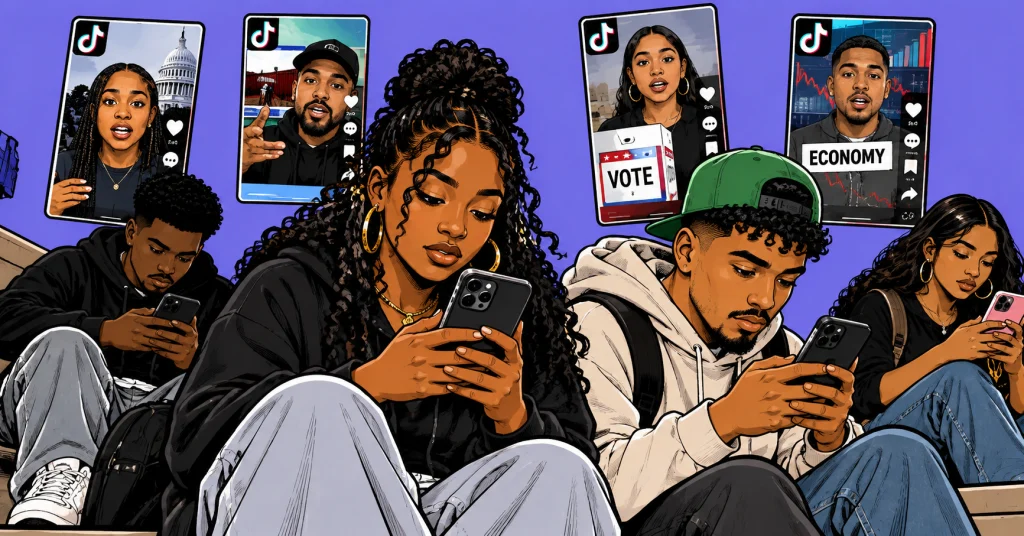
New Pew data shows a third of Black and Hispanic adults regularly get news on TikTok, more than double the rate for white adults. The shift isn’t about a platform. It’s about who now holds the power to decide what matters, what’s true and who gets believed.
For a growing share of young Black and Latino adults, the day’s first headline doesn’t come from a newspaper homepage, a cable chyron or a push alert from a legacy news app. It arrives inside a TikTok video, from a creator whose face they recognize and whose voice feels familiar, sandwiched between a dance trend and a recipe. That isn’t a quirk of Gen Z media habits. It’s a redistribution of power over the news, and it is happening two weeks before a midterm election.
Pew Research Center data released Oct. 19 shows that 20% of U.S. adults now regularly get news on TikTok, up from 3% in 2020. Among adults under 30, it’s 39%. The gap by race is even starker: 35% of Hispanic adults and 32% of Black adults regularly get news there, compared with 14% of white and Asian adults. More than half of all TikTok users, 53%, now say they regularly get news on the app, up from 22% six years ago.
One detail in the data matters more than the headline number. Overall TikTok news use didn’t grow this year, and among adults under 30 it slipped slightly, from 43% in 2025. The surge has leveled off, which means this is no longer a trend to watch. It’s the new baseline. For millions of younger Americans, especially young Black and Latino audiences, the place where news is introduced, framed and interpreted is no longer primarily the traditional press. The front page is now a For You Page.
The Editors Changed
For decades, mainstream news organizations controlled the hierarchy of public attention. Editors decided what led, producers decided what was urgent, and institutions with money, reach and legacy status decided which stories entered the national bloodstream and which ones stayed on the margins. The internet loosened that grip, but many of the same institutions remained the referees of what counted as legitimate news.
TikTok rearranges that structure. Information doesn’t move from institution to audience. It moves through creators, personalities and a recommendation algorithm. A young viewer may first hear about immigration enforcement, layoffs, policing, a war overseas or a ballot measure not from a newsroom, but from someone explaining it straight to camera in 90 seconds. That person may never have worked in journalism. In Pew’s study of news influencers, 77% had no affiliation with or background at a news organization. Yet 37% of adults under 30 regularly get news from them, and 65% of people who follow them say the influencers have helped them better understand current events.
These creators are doing editorial work whether or not anyone calls it that. They decide what’s important enough to mention, how to explain it and what emotional frame to place around it. Those are the same decisions a front-page editor makes, just without the masthead.
Trust Followed the Relationship
The more revealing number isn’t about where young people find the news. It’s about whom they believe. According to Pew’s 2025 report on young adults and the future of news, adults under 30 trust information from social media (50%) about as much as information from national news organizations (51%), and more than any older group does. The old hierarchy of credibility, with institutions on top and everyone else below, has nearly flattened for an entire generation.
That trust didn’t appear by accident. Legacy outlets have long covered communities of color episodically, showing up for tragedy, protest, scandal or election-season outreach and then disappearing again. Even accurate reporting can feel distant from everyday life, reading as observation rather than recognition. A creator, by contrast, may speak in a familiar cultural voice, explain a policy story through references the audience immediately gets and feel accessible in a way a network anchor never does. People tend to trust someone who seems to understand their world over someone who merely claims authority over it.
This is also why the gap shows up so sharply by race. Black and Hispanic audiences were never fully served by a media system built for a broad, presumed-neutral mainstream audience, and that audience no longer exists in the way legacy media imagined. As SSC has reported, America is on social media, but we’re not all in the same conversation. The same pattern shows up beyond TikTok: Univision reached 14.6 million people in September, most of whom weren’t watching the major English-language networks.
An Editor Weighs Significance. An Algorithm Weighs Engagement.
None of this answers the harder question: when the news comes through a creator and an algorithm, who decides what is true and what matters? A creator can be insightful, informed and deeply responsible. A creator can also be sloppy, reactive or wrong. So can newsrooms, but newsrooms at least operate, in theory, with layers of editing, standards, corrections and institutional accountability. Creators operate with speed, intimacy and instant audience feedback, usually without those formal guardrails.
Then there’s the algorithm, which is the most powerful editor in the room and the least accountable. It doesn’t elevate a story because it’s civically essential. It elevates whatever keeps people watching, commenting and sharing. A careful explainer on school funding can lose out to an angrier, simpler take on the same subject. A rumor can sit in the same feed as a verified report, and commentary, reporting, activism and entertainment all look alike, each tuned for the same thumb-stopping second.
That tension is sharpest right now. With early voting underway and Election Day on Nov. 3, many first-time and young voters are learning about candidates, ballot measures and even how to vote through their feeds. The intimacy that makes a creator trustworthy can also make an audience less skeptical, at exactly the moment when misinformation travels fastest.
Condescension Is the Wrong Response
It would be easy for traditional media to answer all of this with condescension, and that has long been one of the laziest instincts in these conversations. The rise of creator-led news is not evidence that young audiences became unserious. It’s evidence that many people found traditional political and journalistic language unresponsive to their lives, and went looking for messengers who felt more legible and more accountable to them.
Some of that shift is liberating. It opens room for new voices, new cultural frames and new ways of explaining the world, and it lets stories that legacy outlets overlooked find an audience without asking permission. Some of it is unstable. The system that widens access can weaken verification, and the algorithms that surface undercovered stories can also reward distortion, flatten complexity and deepen polarization.
The future of news, then, isn’t a simple fight between old media and new media. It’s a contest over who gets to define reality for audiences that no longer look to traditional institutions first. For young Black and Latino adults, that power has already shifted. The front page still exists. It just doesn’t look like paper anymore, and it no longer belongs only to the institutions that assumed it always would.
Reporting sources: Pew Research Center, “1 in 5 Americans Regularly Get News on TikTok” (Oct. 19, 2026); Pew Research Center, “Young Adults and the Future of News” (Dec. 2025); Pew Research Center, “America’s News Influencers” (Nov. 2024)