
The newest Lilly trial shows a drug that could change diabetes care. How it gets priced, marketed and bootlegged will decide whether that happens.
Let’s start with what’s true. On Tuesday, Eli Lilly released phase 3 results for retatrutide in people living with obesity and type 2 diabetes. They are the kind of numbers that make doctors put down their coffee. The study ran for 80 weeks and randomized 1,152 adults to weekly injections or a placebo. On the highest dose, patients lost an average of 18.8% of their body weight, compared with 5.1% on placebo. Almost half of that group lost at least a fifth of their starting weight, and nearly a third lost a quarter. Seventy-two percent brought their blood sugar below the threshold used to diagnose diabetes, compared with 29% on placebo. Blood pressure, cholesterol and a key marker of inflammation all improved too. The results were published in the Lancet and presented in Milan, and Lilly’s chief scientific officer called them a “new high-water mark.” On the science alone, it’s hard to argue.
The tabloid nickname is “Godzilla,” and it will do the drug no favors. Retatrutide acts on three gut hormones, GLP-1, GIP and glucagon, where Wegovy targets one and Mounjaro targets two. The glucagon piece appears to increase how much energy the body burns, not just how hungry a person feels. That matters most for patients with type 2 diabetes, who have historically lost less weight on these drugs than people without it. When we covered Lilly’s earlier retatrutide results in May, the headline number was bigger. That piece asked who actually gets to take a drug that rivals bariatric surgery. This week’s number is smaller, but in some ways it matters more, because it comes from the population with the most at stake. These are people whose weight is tied to kidney disease, amputations, heart attacks and early death, not people hoping to fit into last summer’s clothes.
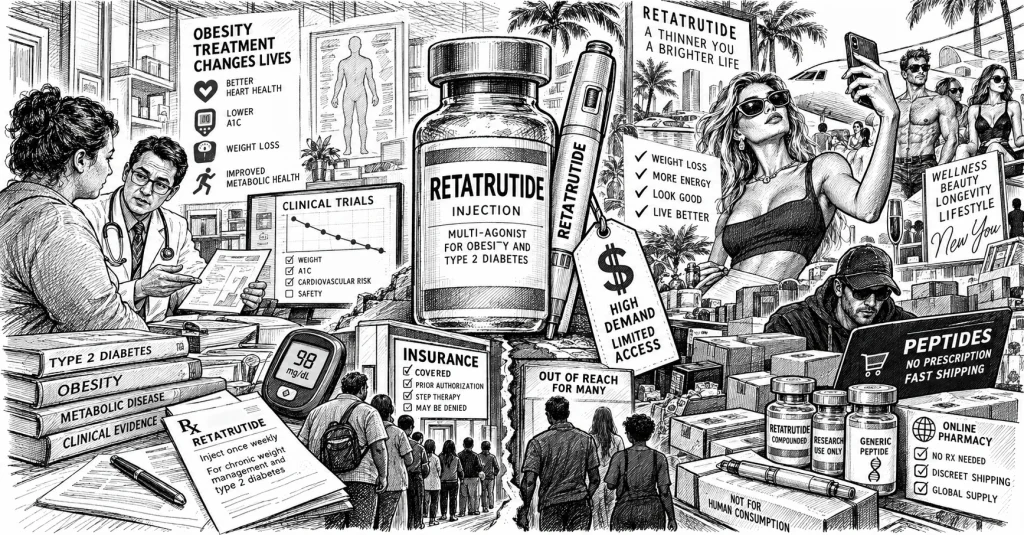
That is exactly why I worry about the direction this story is already taking. The same week this trial landed, the Guardian reported concern that a weight-loss drug maker had sponsored a Vogue World fashion event. You can see where this is going. The most important metabolic drug of the decade is being introduced to the public on a runway, surrounded by the language of glow-ups and transformation, instead of in an endocrinologist’s office. When a medicine is marketed like a luxury good, it gets priced like one, prescribed like one and distributed like one. The patients who benefit first are the ones who already have the best insurance, the most flexible schedules and a doctor who returns their calls.
We’ve seen this movie. GLP-1 drugs have been on the market for years, and prescribing still follows the same lines of race, income and geography as the rest of American health care. In several states the cost of treatment eats up a double-digit share of a typical household’s income. Rates of obesity and type 2 diabetes are highest in Black, Latino and rural communities, and those are the communities least likely to get these drugs through a clinic. That’s the cruel arithmetic of a breakthrough. The better the drug works, the bigger the gap between the people who get it and the people who need it.
The gap won’t stay empty, either. In April we reported that the body is becoming a marketplace, and retatrutide was already at the center of that story before it was approved anywhere. Unapproved “research peptides” sold online carry no guarantee of dose or purity, and influencers push them to people who will never see a doctor. Compounding pharmacies operate in a gray zone that Washington’s current leadership seems more interested in widening than closing. We wrote about a bodybuilder who developed necrotizing pancreatitis after taking retatrutide without supervision. Every splashy headline like this week’s is free advertising for that underground supply chain. When a drug is called “Godzilla” but can’t legally be prescribed, the black market isn’t a side effect of the hype. It is the business model.
None of this is an argument against the drug. The side effects in the trial were mostly the familiar stomach problems that come with this class of drugs. Diarrhea hit about a third of patients on retatrutide and nausea hit up to 28%, rates far above placebo but in line with what doctors already manage. Seven participants died during the trial, including one on placebo, and investigators judged none of the deaths related to the drug. Real questions remain about long-term use, about what happens when people stop, and about pregnancy, where a separate study presented in Milan said more research was urgently needed. Those questions are why this belongs in medicine, with monitoring, dosing and follow-up. They are not a reason to keep it away from the people it was tested on.
So here’s where I land. Lilly has earned its moment, and the scientists behind this trial deserve credit for a result that could change diabetes care. But a breakthrough is measured by who it reaches, not by what it can do in a trial. If retatrutide is approved and launched at a price only the well-insured can afford, advertised through fashion and wellness culture, and left to the gray market everywhere else, it will be remembered as another tool that widened a gap it could have closed. Regulators should move quickly on approval and just as quickly on the counterfeit and compounded supply. Insurers and Medicare should treat obesity with diabetes as the chronic disease it is. And the rest of us, the media included, should stop calling a diabetes medication a monster.
The science has done its part. The next test is ours.
Sources: Scientific American (Sept. 29, 2026); The Guardian (Sept. 29, 2026); The Lancet; Eli Lilly; Social Storytellers Collective reporting (April 17 and May 21, 2026).