Last week, Social Storytellers Collective reported that the Trump administration was considering a temporary pathway that could expand access to experimental peptides while federal regulators worked through a much longer rulemaking process. At the time, nothing had actually changed. Now something has.
The Food and Drug Administration has now submitted an “Interim Access Policy for Compounding Using Certain Peptides” to the White House Office of Management and Budget for review. The filing, received October 14, does not say which peptides would be covered or how the program would work. But the Associated Press, citing two people familiar with the matter, reported that the policy would allow pharmacies to make some popular peptides, including BPC-157, according to Reuters.
That does not mean the FDA has approved BPC-157, TB-500 or the other experimental peptides now circulating through wellness clinics, gyms and online communities. It means the federal government is getting closer to a legal pathway that could make some of them significantly easier to obtain.
What Changed Since We Last Reported
When we examined the proposal on October 9, officials were weighing whether to let licensed compounding pharmacies temporarily produce certain peptides while the FDA completed the formal process required to change its compounding rules. There was no published interim policy, and a day later we reported that FDA staff were pushing back. Now a policy is moving through federal review, and the White House regulatory office lists it as pending, with no legal deadline for a decision.
Adding a substance to the FDA’s 503A Bulks List, the list of ingredients compounding pharmacies may use, is a formal process that can take years. An interim policy could serve as a bridge around that timetable. The FDA already uses interim policies in which it says it does not intend to take enforcement action against certain nominated substances while it evaluates them, and legal analysts at Buchanan Ingersoll & Rooney note the peptide policy “could serve a similar bridging function,” though its title alone does not establish the approach. Washington may be preparing to open the peptide door before it finishes rebuilding the doorway around it.
The Scientific Disagreement Has Not Gone Away
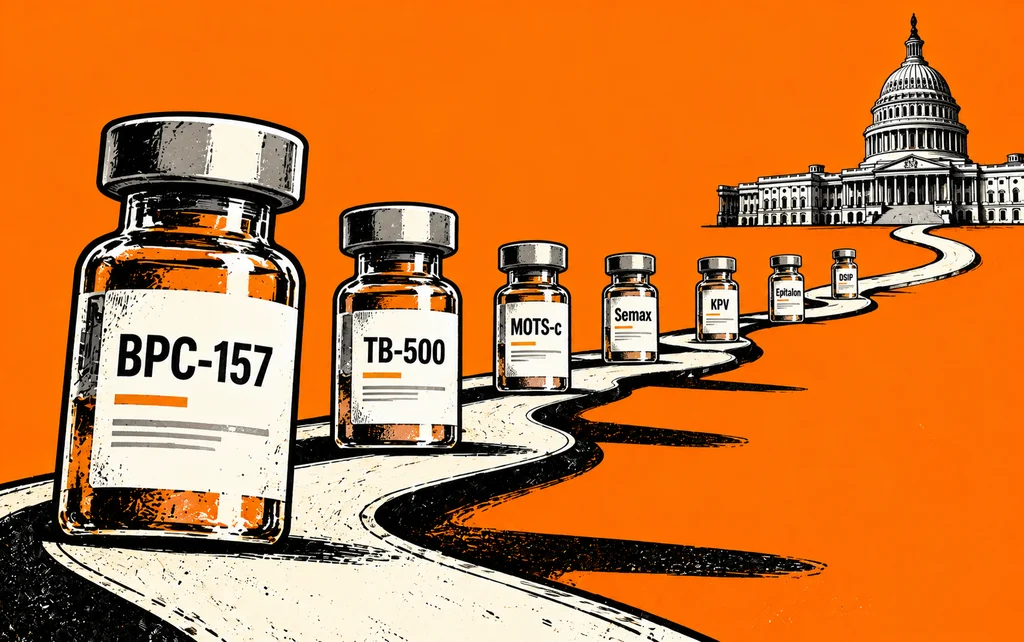
The policy is moving even though the central scientific question remains unresolved. At a July 23–24 meeting, the FDA’s Pharmacy Compounding Advisory Committee considered seven peptides: BPC-157, KPV, TB-500, MOTS-c, Semax, Epitalon and emideltide, also known as DSIP. It recommended adding six of them to the Bulks List, rejecting only emideltide in a 7–6 vote. The votes are nonbinding, and none of the six has been added to the list.
FDA career scientists had argued against easing the restrictions, finding insufficient evidence of safety and effectiveness. The agency’s meeting materials show regulators evaluating proposed uses that ranged from wound healing and inflammation to obesity, osteoporosis, insomnia and neurological conditions. Those concerns did not disappear because the committee voted differently, and an interim access policy would not resolve them either.
An FDA-approved drug generally reaches patients after regulators have reviewed clinical trial evidence showing its benefits outweigh its known risks for a particular use. A compounded peptide made available under an interim policy would not suddenly meet that standard. The regulatory status would change, but the underlying science would not.
Kennedy Has Made Peptide Access Part of His Health Agenda
Health Secretary Robert F. Kennedy Jr. calls himself a “big fan” of peptides and has said he used them on injuries with “really good effect,” a position we examined in April in RFK Jr. Wants to Legalize the Peptide Market. The Science Isn’t Ready. That stance has aligned him with a fast-growing wellness economy built around recovery, longevity, body composition and energy, and it has put political leadership at odds with some of the agency’s own scientists.
The disagreement grew sharper after Kennedy reshaped the advisory committee ahead of its peptide review. He appointed eight of its 19 members, and six of those eight run clinics that sell peptides, NOTUS reported. The committee does not make the FDA’s final decision, but its recommendation handed supporters an important regulatory victory, and the interim policy now at the White House could turn that recommendation into something consumers feel much sooner.
This Could Reshape the Peptide Business
The peptide economy did not wait for Washington. BPC-157 and similar products are already widely available through online sellers, wellness clinics, telehealth providers and vendors labeling them “for research use only,” and influencers have turned the category into a marketplace of its own. That is the situation we have followed all year: consumer demand has expanded faster than the system responsible for deciding what is safe, effective and legal. Hims & Hers has already said it plans to offer peptides if regulations allow.
Opening licensed compounding pharmacies to some of these products could move part of that business into a more conventional health care setting. Supporters see that as an improvement, arguing that if people are going to get peptides anyway, licensed pharmacies operating under state and federal standards are safer than anonymous websites or overseas manufacturers.
But pharmacy access can also create something the gray market cannot easily provide: the appearance of medical legitimacy. A vial filled by a licensed pharmacy with a prescription looks and feels very different from one bought online with a research-only label. Consumers may reasonably assume the product has passed a level of scientific review that it has not, and the question stops being only whether a product is legal.
The FDA May Be Separating Access From Approval
This is the direction peptide regulation has been moving for months. In March, we reported that claims the FDA had “approved 14 peptides” were wrong. Regulatory reconsideration, compounding eligibility and drug approval are separate processes, even though the differences routinely vanish once the conversation reaches social media and the wellness marketplace.
An interim policy could make that confusion even harder to navigate. If it is adopted, a peptide could remain unapproved as a drug while becoming easier to get from a licensed compounding pharmacy, and both statements would be true. Expect clinics, influencers and peptide businesses to lean on that gap when they start marketing whatever access the administration ultimately allows.
What Happens Next
The White House is reviewing the policy. The public filing does not name the peptides covered, the conditions pharmacies would have to meet or when an interim pathway could begin, and the administration could change the proposal before it is released. The FDA also still has to decide how to respond to its advisory committee’s July recommendations.
In the spring, peptide advocates wanted Washington to reconsider its restrictions. In July, an FDA advisory committee recommended broader access to six experimental peptides, earlier this month the administration was reported to be weighing a temporary pathway, and now an interim access policy is formally sitting at the White House.
For consumers, none of that answers the most important question: whether these products have been proven safe and effective for what people are using them to do. The government may be getting closer to answering where people can get experimental peptides. It has not yet answered whether they should be taking them.