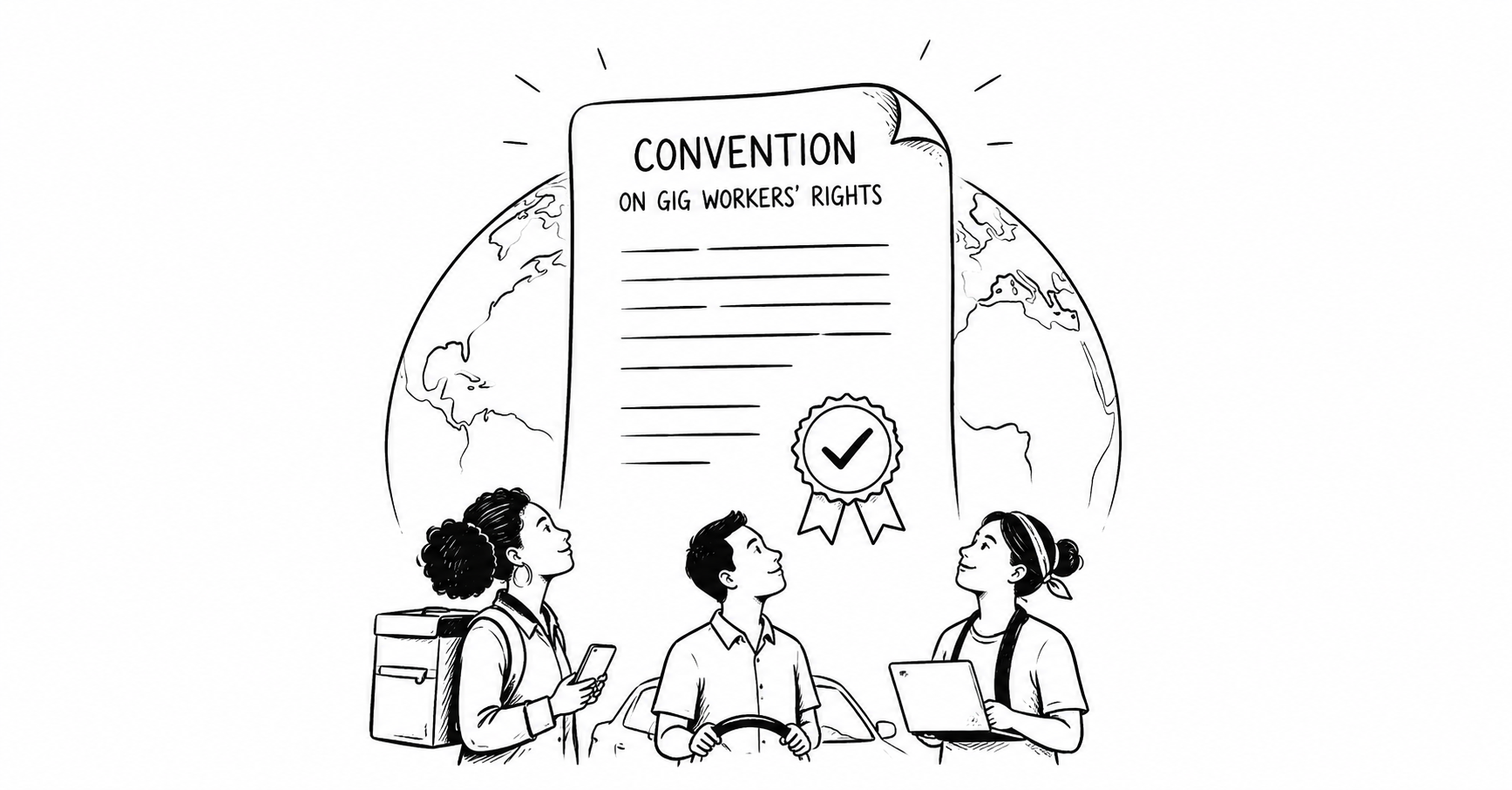
The World Just Gave Gig Workers a Bill of Rights. The U.S. Didn’t Sign It.
ILO Convention No. 193 passed 406 to 8. One of the eight no votes was the United States.
On June 12, 2026, the International Labour Conference adopted ILO Convention No. 193, the Decent Work in the Platform Economy Convention, by a vote of 406 to 8 with 36 abstentions. It is the first binding international labor standard designed specifically for gig and platform workers. The World Bank estimates that approximately 435 million people globally earn income through digital labor platforms. For most of them, the introduction of an app into their work arrangement has functioned as a near-automatic exclusion from labor protection — minimum wage, social security, occupational safety, sick leave, and the right to challenge termination — because platforms classify workers as independent contractors rather than employees. Convention 193 addresses that classification problem directly. It does not require countries to classify all platform workers as employees, but it requires that core protections apply regardless of classification. The reality of the work determines the rights, not the contract.
The algorithmic management provisions are the most significant development in the convention’s text. Amanda Brown, vice chair of the ILO Workers’ Group, described it as the first time in the history of international law that workers managed by automated systems have been formally recognized and protected. Under Articles 13 through 15, platforms must disclose that automated systems are monitoring workers and explain how those systems shape access to work and pay. When an automated decision results in withheld pay, suspension, or account deactivation, the worker is entitled to a documented explanation and human review. That is a direct structural challenge to the operating model of the largest gig platforms, which have used algorithmic opacity as a management tool — adjusting pay rates, allocating tasks, and terminating access without providing the kind of accountability a traditional employer would face.
Lena Simet, senior economic justice adviser at Human Rights Watch, said the adoption confirms that companies cannot use new technologies as a loophole to avoid workers’ rights. The U.S. voted against. New Zealand also voted against. The U.S. position reflects the domestic political economy: the gig platform industry is large, politically connected, and has spent years defeating or diluting worker classification legislation at the state level. Ratification of an ILO convention requires Senate approval, which is not happening under the current administration or the current Senate. U.S.-headquartered companies will nevertheless feel the convention’s effect in any country that ratifies and implements it — which means Uber, DoorDash, Amazon Flex, and their equivalents operating abroad will face binding standards in markets where the convention takes hold, while their domestic workforce remains outside it.
Convention 193 is not self-executing. Ratification is voluntary, implementation requires national legislation, and the ILO’s enforcement mechanisms are limited to formal complaints and public pressure. What the convention does is shift the terms of debate in every country that ratifies it. It creates a legal floor that domestic courts and legislatures can build from, an international standard that worker organizations can invoke, and a baseline against which platform companies can be publicly measured. The U.S. absence from that framework is not a neutral position. It is a decision about whose interests the American government chose to represent when the world’s labor body asked for a vote.