The Four-Year Degree Is Losing Its Monopoly. Colleges Are Starting to Shorten the Product.
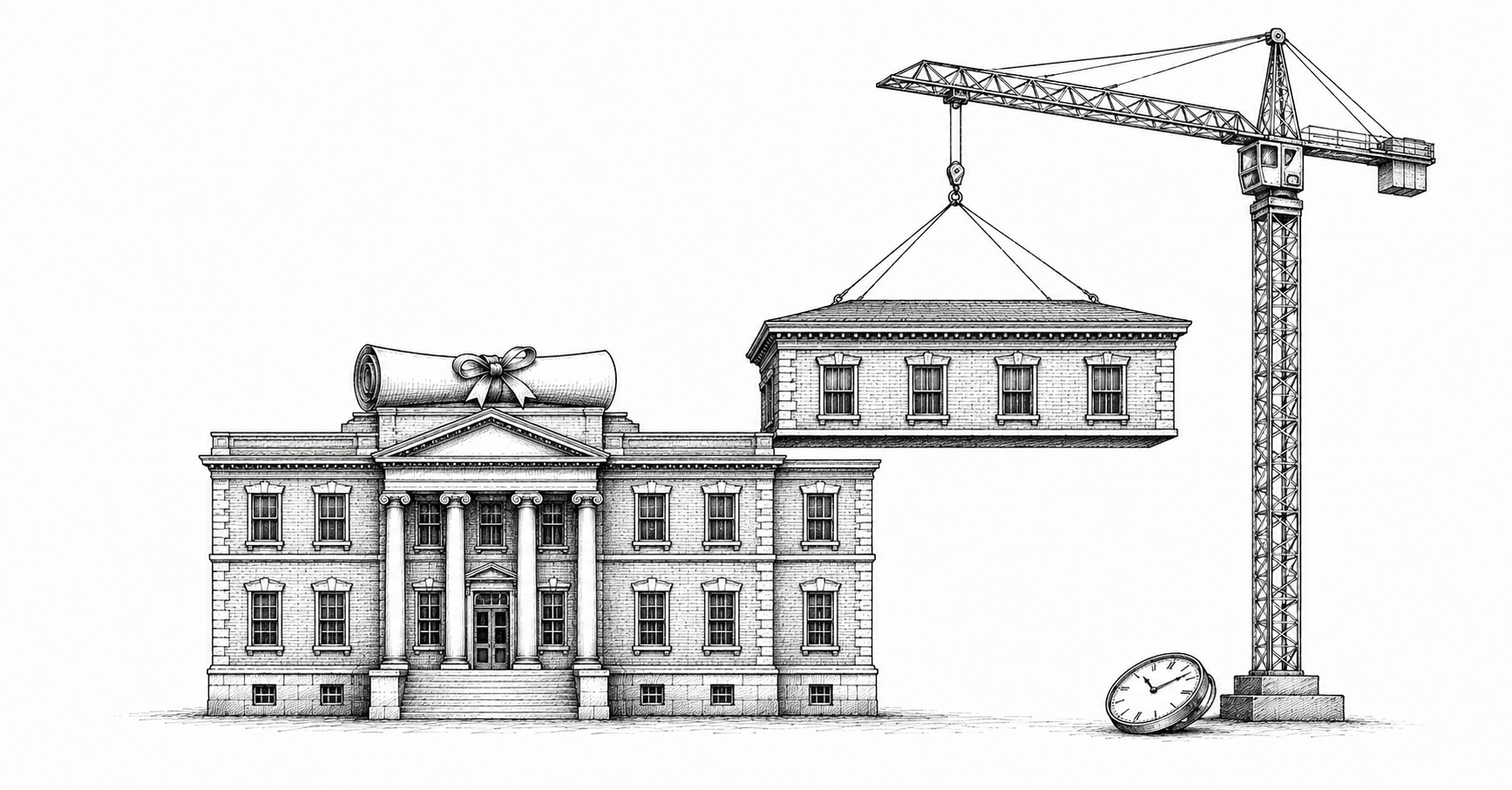
Virginia and Ohio are working on a different proposition: 90 credits, three years, same credential category. The State Council of Higher Education for Virginia announced that institutions in the two states are developing a model for three-year bachelor’s degrees, with participating colleges expected to propose two 90-credit programs by spring 2028.
Gallup and the Lumina Foundation found this year that 93% of college alumni would choose to earn their degree again and 71% say their education was worth what it cost. Only 11% of bachelor’s degree holders believe colleges charge fair prices, and 52% of borrowers say student debt has delayed at least one major life milestone. People have not stopped believing education has value. They are questioning why obtaining that value has to require so much money and time.
Virginia currently requires at least 120 semester hours for a bachelor’s degree, with Ohio operating under a similar standard. Cutting the requirement to 90 credits removes roughly a quarter of the traditional credit requirement and potentially an entire year of tuition, housing and foregone earnings. Virginia officials explicitly describe affordability and alignment with employer needs as goals of the initiative.
Virginia and Ohio are not isolated. Massachusetts has already approved shorter applied bachelor’s programs at Merrimack College and Suffolk University requiring 96 and 94 credits, respectively. Higher Ed Dive reported in June that at least 70 institutions nationally either offer three-year degrees or are considering them. The model remains unusual, but it is no longer theoretical.
Faculty groups have raised a legitimate counterargument. The American Association of University Professors and American Federation of Teachers have warned that reducing credits could strip away the broad intellectual development that distinguishes a bachelor’s education from occupational training. If institutions respond to affordability pressure simply by removing general education, writing, history, science and other courses that do not map neatly to a first job, a faster degree can become a narrower one.
Colleges are no longer the only institutions deciding what counts as sufficient value. The federal government is moving toward the same economic test. Under new Education Department rules finalized this summer, undergraduate programs will eventually be required to demonstrate that their graduates earn more than typical workers whose highest credential is a high school diploma. Programs that repeatedly fail the earnings threshold can lose access to federal Direct Loans, with additional Title IV consequences possible after persistent failure. The first accountability year is 2027.
Public confidence is moving in the same direction. Gallup found in July that only 38% of Americans have a great deal or quite a lot of confidence in higher education, down from 57% when Gallup first measured it in 2015. Among people expressing low confidence, cost and inadequate preparation for the workforce were among the most frequently cited reasons. Yet 73% of adults without a degree told Gallup and Lumina that earning a two- or four-year degree remains as important today as it was 20 years ago.
Americans still want what college has historically promised: mobility, knowledge, professional access and higher earnings. They are becoming less willing to accept the traditional delivery system without asking what each additional year and dollar produces.
Alternatives are becoming more credible. Young workers are showing greater interest in skilled trades partly because they offer lower debt, solid wages and work perceived as harder to automate. Technology companies are also challenging the default credential directly: Palantir has created a fellowship explicitly pitched as an alternative to college, while the Thiel Fellowship has long paid young people to leave or skip school and build companies instead.
The bachelor’s degree’s earnings advantage, alumni loyalty and cultural power remain substantial. What is disappearing is the assumption that four years is the only legitimate architecture for getting one.
For generations, students had to prove they were worthy of admission to college. Colleges increasingly have to prove that the additional semester, the additional course and eventually the additional year are worth buying.