
UC Faculty Wanted the SAT Gone. Now Some of the Same People Want It Back.
The debate isn’t really about a test. It’s about what happens when a 10-campus system tries to apply one admissions policy to schools with acceptance rates ranging from 11 percent to over 95 percent.
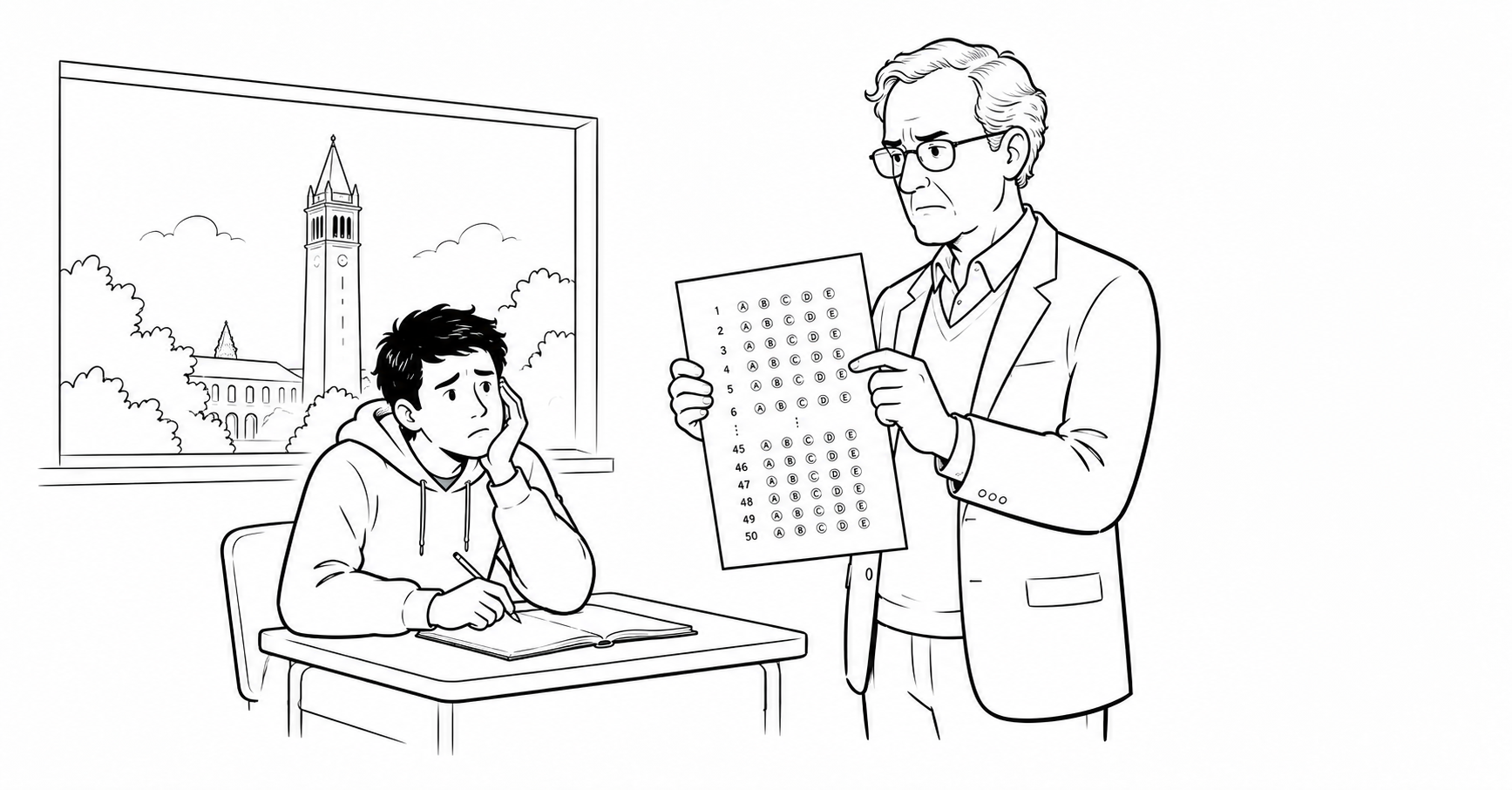
Randy Schekman supported the University of California’s decision to drop the SAT. Now the Nobel Prize-winning molecular biologist, who teaches introductory biology each fall at UC Berkeley, says the opposite: “I really feel we made a mistake,” he told Bloomberg’s Liam Knox and Andrew Oxford, describing a growing number of students arriving unable to grasp concepts the course assumes they already have.
He’s not alone, and the numbers behind that shift are large enough to force institutional action. More than 3,000 UC faculty members have signed open letters since spring 2026 demanding the system reinstate standardized testing, according to Campus Reform, up from roughly 900 signatures in late May and 1,400 by June. Seven of the university’s nine math department chairs have signed. UC Berkeley math professor Mina Aganagic told the San Francisco Standard that some incoming freshmen in her classes “cannot do basic multiplication,” a skill the state expects of third graders, and that after two decades of teaching, she’s watching students admitted to study science and engineering arrive with “no mathematical infrastructure built at all.”
The mechanism faculty are pointing to isn’t really about the SAT as a test. It’s about what UC used to replace it with. When the system went test-blind, following a 2020 Board of Regents vote and a subsequent court order stemming from a disability-discrimination lawsuit, admissions decisions leaned more heavily on high school grades, which faculty argue don’t carry consistent meaning across thousands of different high schools with wildly different grading standards. A standardized test, whatever its flaws, produced one number that meant the same thing regardless of which school a student attended. Grades alone don’t do that, and faculty are describing the gap between what a transcript promised and what a student can actually do in a UC classroom.
That gap isn’t a new discovery. In February 2020, a UC faculty task force spent over a year producing a 200-page report that found standardized tests were better predictors of first-year UC success than high school GPA, and the faculty-led Academic Senate voted unanimously, 51 to 0, to preserve testing for five years. The Board of Regents, led by then-vocal testing critic John A. Pérez, overrode that recommendation months later. The current faculty campaign is, in a real sense, a continuation of an argument the faculty already won once at the Senate level and lost at the Regents level, which is part of why the current review carries different institutional weight: the Academic Senate is now the body overseeing it directly, under chair Kathleen Treseder, with recommendations expected by the end of the 2026-27 academic year and a revised timeline moving faster than originally planned.
The case against reinstating testing hasn’t disappeared just because the faculty letters are louder. A fall 2025 report from UC Berkeley’s Center for Studies in Higher Education found that grades were a stronger predictor than test scores of first-year success specifically at Ivy League and other elite institutions, and that admissions decisions weighted toward SAT scores disadvantaged Black, Latino, low-income, and first-generation applicants. Pamela Burdman, executive director of the policy institute Just Equations, frames the tension directly: “Is UC’s mission only to admit the best-prepared students or is it to serve the broad diversity of California? There’s a tension there, but our public universities have an obligation to residents from across the state, not just those with access to SAT prep programs or high-performing schools.”
That tension is sharper at UC specifically than it would be at a single, uniformly selective private university, because UC isn’t one school making one admissions decision. It’s ten campuses with radically different acceptance rates under one shared policy. UCLA accepts around 11 percent of applicants. UC Merced accepts more than 95 percent. Ahmet Palazoglu, a UC Davis chemical engineering professor who chairs the Academic Senate body overseeing the testing review, put the distinction plainly: “We are in a very different place as a public, land-grant institution,” a comment aimed at the instinct to simply copy what Harvard, MIT, Stanford, and now Columbia have already done in bringing testing back. A test requirement calibrated to filter Berkeley’s applicant pool and a test requirement applied to Merced’s are not solving the same problem, even if they’re written into the same policy line.
The political backdrop adds another layer that UC can’t fully insulate itself from. The Trump administration has pushed publicly for a broader return to standardized testing in college admissions, which puts a UC decision to reinstate the SAT in the position of aligning with a federal push it may not want to be seen agreeing with, regardless of what the internal faculty data shows. That doesn’t change the classroom-level evidence Schekman and Aganagic are describing, but it does mean the Regents’ eventual decision will be read by some observers as an academic judgment and by others as a political one, whatever the actual reasoning behind it turns out to be.
The Board of Regents isn’t expected to vote until June 2027, and the change, if it comes, won’t affect students applying for fall 2027 admission. That gives UC nearly a full additional admissions cycle of test-blind decisions before any reversal takes effect, which means the preparedness gap faculty are describing right now will keep compounding through at least one more incoming class before the policy that shaped it is revisited at all.