The First Jobs Are the Ones Disappearing First
The labor market does not have to collapse for workers to lose access. A slower hiring economy can close the first rung before anyone calls it a crisis.
The Associated Press reported Thursday that U.S. employers added only 57,000 jobs in June, a sharp hiring slowdown that left the unemployment rate at 4.2% largely because fewer people were looking for work. The labor market did not break. It narrowed.
That distinction matters because the workers most exposed to a slower hiring economy are often not the ones already inside stable roles. They are the people trying to get in: recent graduates, displaced workers, younger workers, people changing industries, people without elite networks, and workers whose experience looks harder to translate on a resume.
A low-hire, low-fire economy protects some workers by limiting layoffs. It also punishes others by limiting openings. The employed may feel relatively secure, while job seekers face a market where companies post roles, delay decisions, raise requirements, or decide they can get by without adding another person. Stability for insiders becomes scarcity for outsiders.
That is how access closes quietly. A recession announces itself through layoffs, unemployment claims, and business failures. A hiring slowdown works through fewer interviews, longer searches, entry-level roles that require experience, and employers who treat open positions as optional. The damage is less visible because nothing dramatic has to happen to the people already counted as employed.
The June report showed that caution clearly. The AP described employers as still wary of the economy, with inflation high and consumer confidence weak. Hiring improved in the first half of the year compared with last year’s near-stall, but the spring numbers were revised down: May fell from 172,000 to 129,000, and April fell from 179,000 to 148,000. The labor market was not as strong as it first looked.
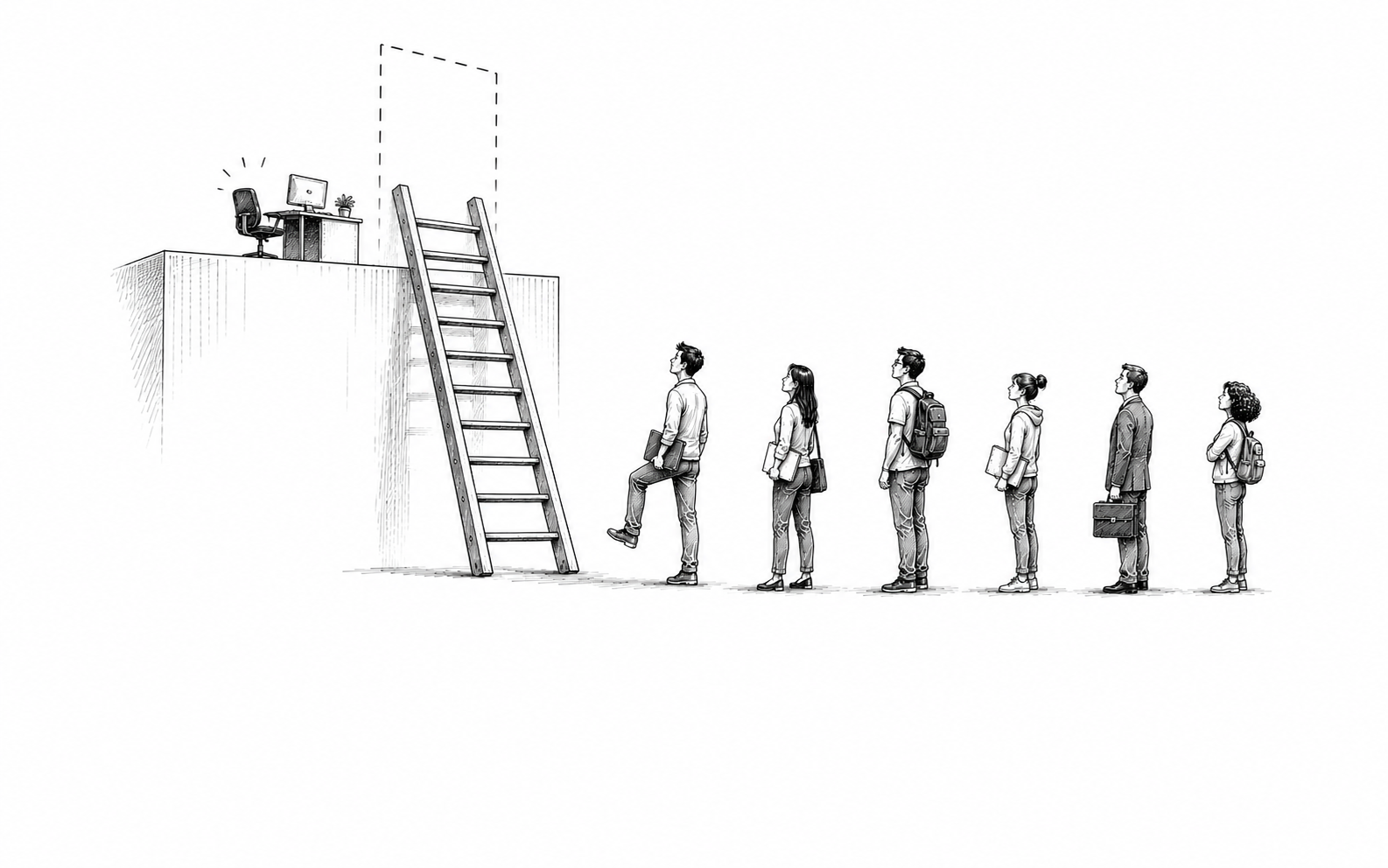
That matters for career mobility. Entry-level jobs are not just paychecks. They are training systems. They are where workers learn professional norms, build references, move into better roles, and develop the confidence that they belong in a field. When those jobs thin out, the economy does not only reduce employment. It reduces the machinery that turns workers into experienced workers.
Employers have an incentive to make the first rung harder to reach. In uncertain conditions, they can demand more experience, more technical fluency, more scheduling flexibility, and more proof of productivity before making a hire. That logic is rational at the firm level. It is corrosive at the labor-market level because it shifts the cost of training from institutions onto individuals.
The result is an economy where opportunity depends more heavily on private buffers. A worker with family support can wait longer, take an unpaid opportunity, pay for a credential, or move to a stronger market. A worker without those buffers has less room to absorb a long search. The same hiring slowdown hits both people, but it does not hit them equally.
This is where the equity story sits. The labor market does not need mass unemployment to reproduce inequality. It only needs fewer stable entry points and higher informal barriers. When employers stop hiring broadly, the workers with weaker networks and less financial cushion are filtered out first.
The next labor crisis may not look like a wave of layoff notices. It may look like thousands of people never getting the first yes.