The Unemployment Rate Fell Because Workers Disappeared From the Count
A lower unemployment rate is supposed to be good news. This one is a warning dressed up as one.
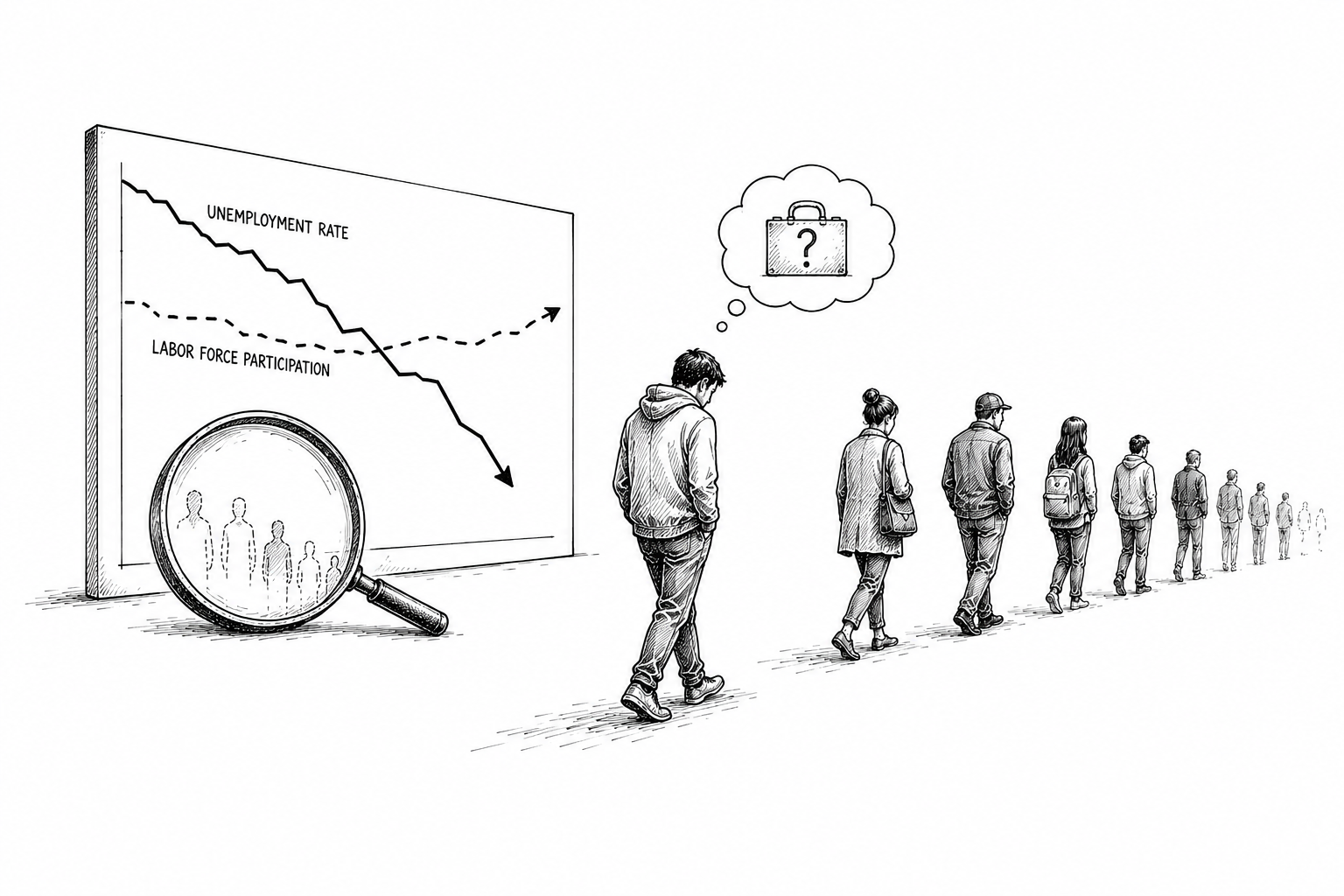
The Bureau of Labor Statistics reported Thursday that the U.S. economy added just 57,000 jobs in June, well below the roughly 113,000 economists expected, while the unemployment rate ticked down to 4.2% from 4.3%. Those two numbers moving in opposite directions is not a contradiction. It’s the story. The rate fell because 720,000 people stopped looking for work and dropped out of the labor force entirely, not because more people found jobs. Labor force participation among workers ages 25 to 54, the prime working years, fell to 61.5%, the lowest level in 50 years outside the pandemic.
The unemployment rate only counts people who are actively looking for work. Someone who gives up the search, whether from discouragement, a caregiving obligation, early retirement, or simply concluding the effort isn’t worth it, disappears from the denominator entirely. The rate can improve on paper while the underlying picture of who is working and who wants to be working gets worse. June’s report is what that mechanism looks like in practice: a headline number moving the right direction while the number underneath it, participation, moves the wrong way by more.
The report also included sharp downward revisions to prior months. April’s job gains were cut by 31,000 and May’s by 43,000, meaning the labor market has been weaker for longer than the earlier reports suggested. The average monthly job gain over the past year is now just 36,000, according to the BLS, and June’s total was the lightest month of hiring since February, when the labor market briefly contracted outright.
Where the jobs are still being created matters as much as how many. Employment growth in June was concentrated almost entirely in education, healthcare, and social assistance, which together added 69,000 jobs, more than the total net gain across the entire economy. That means most other sectors were flat or shrinking, and the jobs report’s positive headline number depended almost entirely on one part of the economy carrying the rest.
BlackRock CIO of Global Fixed Income Rick Rieder, writing after the report, argued that one month’s payroll data rarely defines a trend and that the broader labor market looks like an economy cooling gradually rather than one experiencing widespread job destruction. He’s not wrong that stability, not strength or collapse, has been the defining feature of the labor market for months. But stability measured by the unemployment rate and stability measured by labor force participation are not the same thing, and June’s report is a clear case of the first improving while the second deteriorated.
Rieder also pointed to a second force running underneath the monthly numbers: the early effects of AI on employment. The investment boom around AI is creating jobs through infrastructure, power, and data-center buildouts, even as some of the sectors most exposed to automation see slower hiring and elevated layoffs. Those two dynamics, AI-driven infrastructure hiring and AI-exposed sector caution, can coexist inside the same jobs report and cancel each other out in the headline number while reshaping which jobs actually exist underneath it.
A participation rate this low means the labor market’s capacity is being measured against a shrinking pool of people who are even trying to be counted. An unemployment rate that improves because the denominator shrank isn’t the same achievement as one that improves because more people got hired. The next few months of data will show whether June was a blip in an otherwise cooling-but-stable economy, or the start of a trend where the headline rate keeps looking fine while fewer and fewer people are inside the number it’s measuring.