Airbus Workers Are Turning Office Attendance Into a Labor Fight
Return-to-office policy is moving from management preference to contested workplace power.
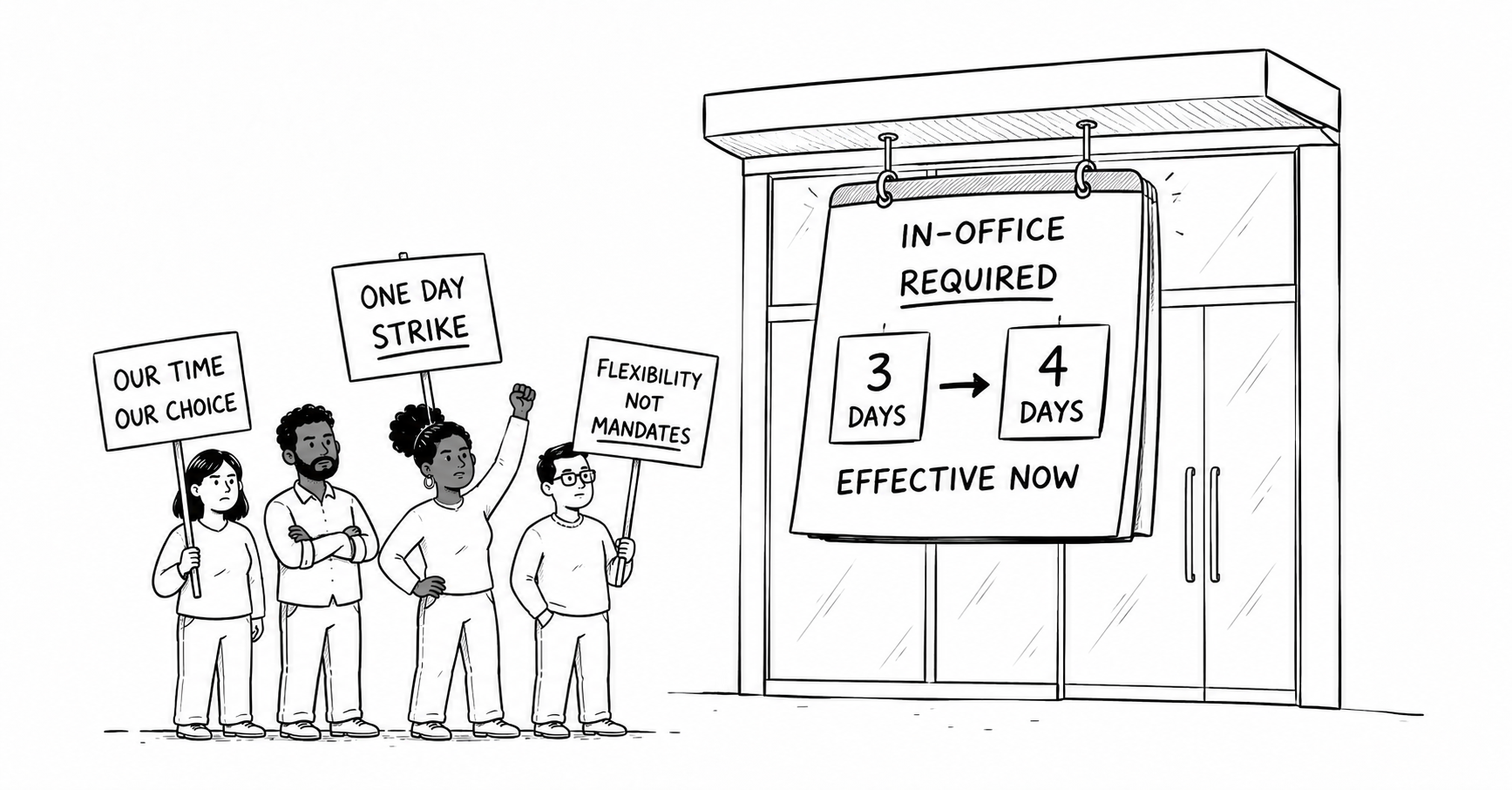
Gianluca Lo Nostro reported for Reuters that French unions staged rare strikes and protests at Airbus after the company moved to increase office attendance for white-collar staff from at least three days a week to four. The action followed a June 9 letter from CEO Guillaume Faury, who called for more focus, quality, and individual presence on-site after a slow start to commercial deliveries.
Return-to-office mandates work like a test of who controls the modern employment bargain. Employers describe physical presence as a coordination tool. Workers experience the same rule as a change in time, commuting cost, autonomy, child-care logistics, and the practical meaning of flexibility. The conflict becomes sharper when remote-work arrangements were formalized during one phase of the labor market and then narrowed when management priorities changed.
Airbus has a specific production argument. Reuters reported that the company is under pressure to meet an annual delivery target of 870 jets while dealing with supply-chain strain. That pressure gives management an incentive to pull employees closer to the production apparatus, even when the affected workers are engineers and other white-collar staff rather than assembly workers on the shop floor.
The unions are contesting that move as a contract issue, not a lifestyle complaint. The CGT called workers to gather at the Blagnac site near Toulouse, where more than 100 staff rallied. The CFDT called a separate rally and said it was studying legal action, arguing Airbus was applying its 2024 remote-working agreement in bad faith. FO, the largest Airbus union in France, called for changes to be paused pending a July 7 works council meeting and said the hybrid agreement remains valid through 2028.
The mechanism is withdrawal. Flexibility becomes valuable enough for workers to treat it as part of compensation, but employers often treat it as a management-controlled privilege. That mismatch turns office attendance into a labor dispute because the policy redistributes time. A fourth required day in the office is not only one more day at a desk. It is another commute, another rearranged household schedule, and another assertion that the employer can reclaim flexibility without renegotiating the bargain.
The dispute also separates workers inside the same company. Assembly workers and technicians often never had the same remote-work options available to engineers and other office staff. That difference can make hybrid work look like a white-collar benefit, but it also reveals how the company assigns flexibility according to job classification. The fight is not only over where people work. It is over whose work is trusted to happen outside direct supervision.
That trust has economic value. Workers who organize their lives around hybrid schedules treat predictable flexibility as part of the compensation package, even when it does not appear on a paycheck. Employers who remove it are effectively reducing a noncash benefit while describing the change as an operational adjustment.
Power moves from employees who had incorporated hybrid work into their lives back to managers trying to standardize presence. The company may still keep some flexibility, and Airbus told Reuters that flexibility remains part of its culture. But the new policy shows how quickly autonomy can narrow when delivery targets, executive pressure, and production anxiety rise.
The next wave of return-to-office fights will not be settled by slogans about collaboration. They will be settled through labor agreements, courts, retention risk, and whether workers can prove that flexibility has become a material condition of employment. Once hybrid work enters the contract, taking it back becomes a workplace power shift, not an office preference.