Las Vegas’s Biggest Union Stopped Fighting Automation and Started Negotiating It. Whether That Was Wisdom or Surrender Depends on One Number.
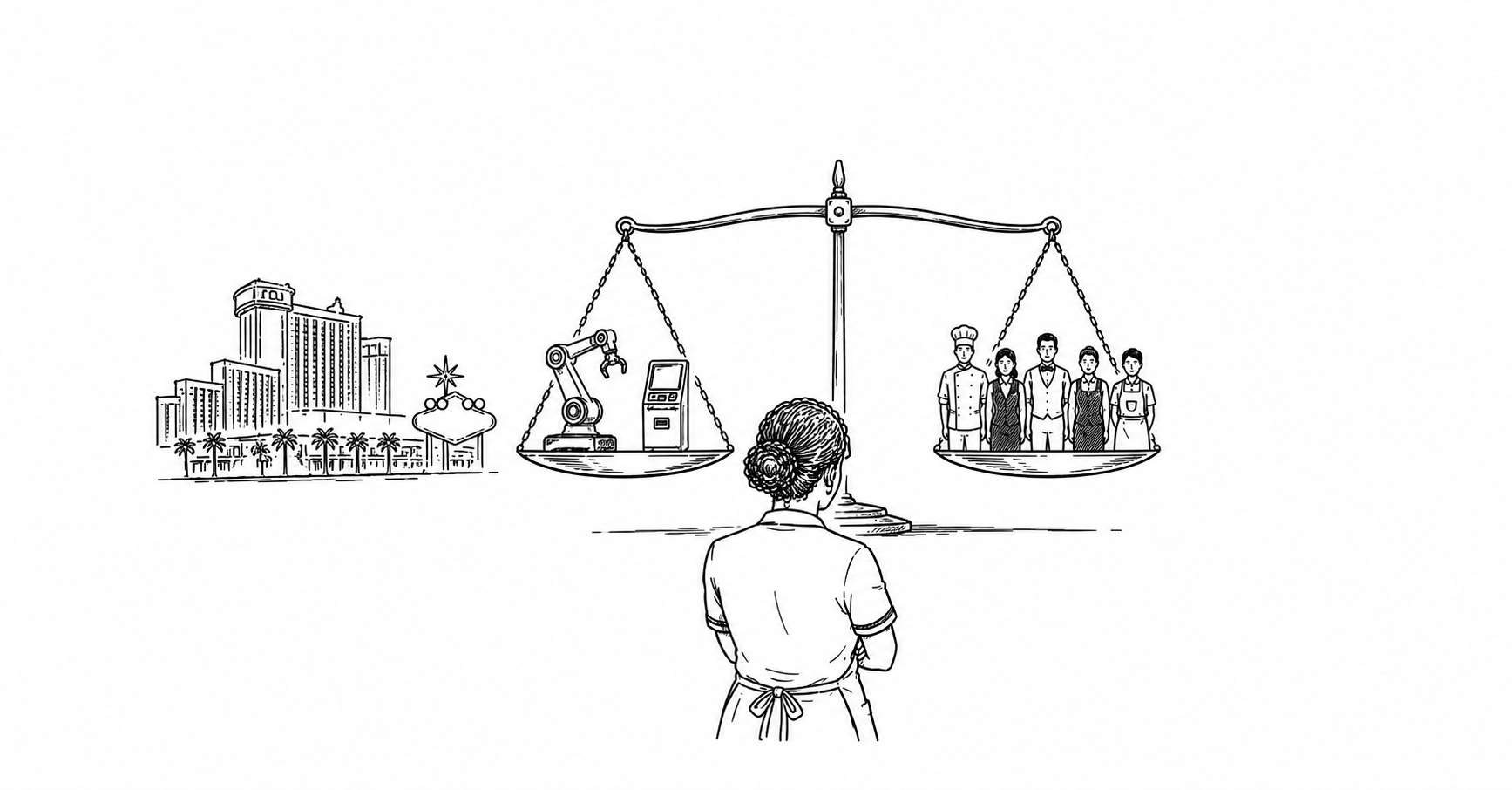
The Culinary Workers Union ratified a contract guaranteeing six months of benefits and severance for workers displaced by AI. That number is either a floor to build on or a ceiling that defines what workers can expect when the machines arrive.
The Culinary Workers Union Local 226 represents approximately 60,000 hospitality workers across Las Vegas. In March 2026, the union ratified a new contract — approved by 85 percent of members — that includes direct provisions governing how automation can be introduced on the job.
The contract requires six months’ notice before implementing new technology, mandates negotiation over AI deployment, provides free retraining for workers whose positions are altered or eliminated, and guarantees six months of health and pension benefits plus severance for anyone displaced by automation.
That is more than most workers anywhere in the U.S. labor market have extracted from any employer on automation. It is also the beginning of a question, not an answer.
For decades, labor’s dominant response to automation was opposition — or making machines expensive enough that human labor remained competitive. The Culinary Union has chosen a different position. Automation is coming regardless of whether workers negotiate it. The relevant question is what workers receive when it arrives.
That calculation is not unreasonable. Robots are already pouring drinks in some Las Vegas casinos. Self-service check-in has expanded across the Strip. AI systems handle scheduling, pricing, and customer service functions that once required human judgment. The union is negotiating within a reality it cannot reverse.
The six-month guarantee is the number that defines whether this contract holds.
Six months is enough time for a worker in her thirties to retrain, relocate, or transition. For a 55-year-old room attendant with twenty years in the same hotel whose pension vests in three, it may not be enough time to find an equivalent position before her financial security begins to erode.
Automation does not arrive uniformly. It targets the most repetitive and predictable tasks first — the jobs concentrated among workers who have been in the industry longest and who have the fewest transferable credentials in a labor market that now demands them.
The union’s contract represents a serious attempt to extract real protection from employers who would otherwise offer nothing. What the next contract must answer is whether six months was the most workers could win, or simply the first number both sides could agree to.
What workers accept now becomes the standard the industry will cite when the next wave of automation arrives.
—
Sources: Culinary Workers Union Local 226 contract ratification, March 2026; reporting by Modern Treatise and Hotel Dive on hospitality automation negotiations.*