The Education Rights System Is Becoming a Referral Maze
As enforcement authority fragments, protecting civil rights increasingly requires knowing where to knock.

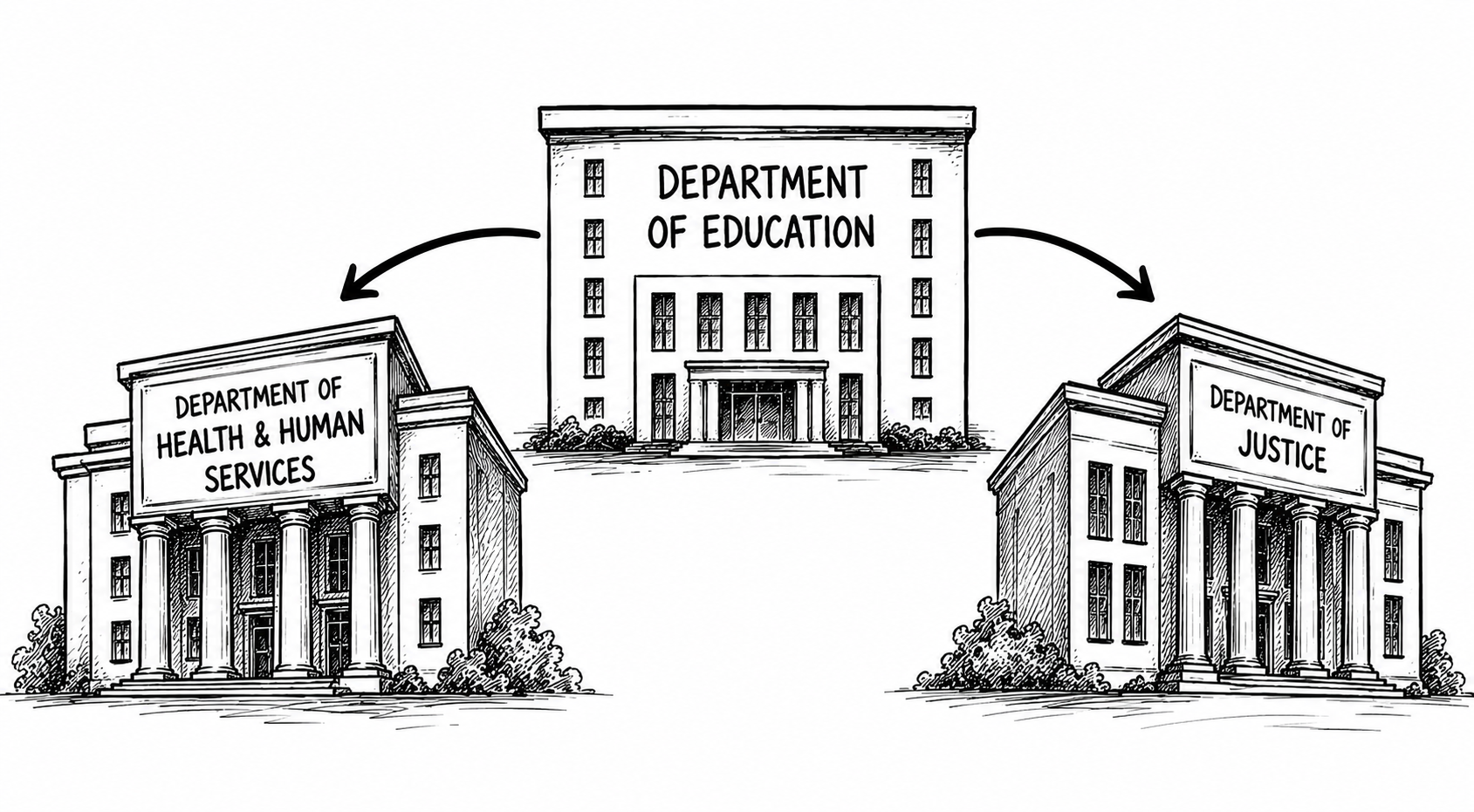
The Department of Education will move oversight of special education programs to the Department of Health and Human Services and shift its Office for Civil Rights to the Department of Justice, NPR’s Jonaki Mehta and Cory Turner reported June 16, citing a letter the department sent to staff. The agreements transfer two of the department’s largest functions: enforcement of the Individuals with Disabilities Education Act, which guarantees disabled students access to public education, and investigation of discrimination complaints based on disability, race, sex, and national origin in schools and colleges that receive federal funding. Education Secretary Linda McMahon called the moves part of a commitment to “bolstering the efficacy of federal oversight where it is essential.”
The announcement extends a pattern McMahon has run since taking office: relocate a function, label it a partnership, and let a different agency absorb work the Education Department no longer wants to do directly. The department’s Office for Civil Rights has spent months in turmoil already, targeted for staff cuts and then partially restored, under the same administration now reassigning its core mission elsewhere. Moving that office to the Department of Justice and special education to HHS does not require Congress to vote on abolishing the Education Department, something Trump has said for years he wants to do. It produces a version of that outcome through agreements between department heads instead, without the vote.
The administration frames the change as access to specialized expertise: HHS already runs health and disability programs, and DOJ already enforces civil rights law. But specialization cuts both ways. The civil rights attorneys at the Office for Civil Rights built their caseload and institutional memory specifically around how discrimination shows up inside classrooms — IEP denials, accessibility gaps, disparate discipline. The Justice Department’s Civil Rights Division will now evaluate and resolve those same complaints alongside its existing portfolio of voting rights, housing, and policing cases, none of which share a school district’s academic calendar or its specific legal standards. Denise Forte, president and CEO of Ed Trust, an education-equity think tank, called the move “another vindictive attempt to undermine public education,” adding that “at this moment, when we know that children with disabilities need more support, not less — HHS is not the place for that.” Critics outside the administration raise a related, more structural objection: announcing a transfer is not the same as legally absorbing the authority and staff the Education Department currently holds, which several have argued requires congressional approval the administration has not sought.
A family that files a disability discrimination complaint against a school district experiences this as which office answers the phone, how long the case sits, and whether anyone on the other end understands special education law as well as an office that specialized in nothing else did. This decision moves power away from a dedicated education civil-rights apparatus, built around the specific mechanics of school discrimination, and toward general-purpose justice and health bureaucracies where education complaints will compete for attention with everything else those agencies already handle. It also moves power away from Congress, which has not voted to restructure these functions, and toward department heads who can reassign federal responsibility through paperwork instead of legislation. The test of this reorganization won’t be the press release. It will be whether a disabled kindergartner’s case moves faster or slower once “specialized expertise” means an agency that specializes in everything except schools.