White Men Have the Highest Suicide Rates and the Highest Rates of Alcohol Use Disorder at Midlife. New Research Says the Same Forces That Built Their Advantage Are Building Their Crisis.
A study published in the American Journal of Public Health on April 30, 2026, offers a conclusion that cuts against the dominant frame of every conversation about white male identity in contemporary America: the structural systems that advantage white men are also, in measurable ways, killing them. The research — conducted by Derek M. Griffith of Penn LDI and Caroline R. Efird of Georgetown — examines the relationship between structural dominance and behavioral health outcomes among white men at midlife and finds a pattern that neither progressive nor conservative political framing has been willing to fully account for.
White men hold the highest rates of alcohol use disorder and the highest rates of suicide at midlife compared to other demographic groups. That is not a new finding. What Griffith and Efird argue is new — or at least newly precise — is the mechanism. The same structural forces that extend advantages to white men through whiteness, social dominance, and access to institutional power also generate specific psychological conditions that make them vulnerable to catastrophic health outcomes when those advantages prove insufficient, incomplete, or no longer guaranteed.
The argument is structural, not sympathetic. It is not an argument that white men deserve more attention or that their suffering is greater than that of communities who have been systematically excluded from the advantages white men receive. It is an argument about how power structures work on the bodies of everyone inside them — including those at the top.
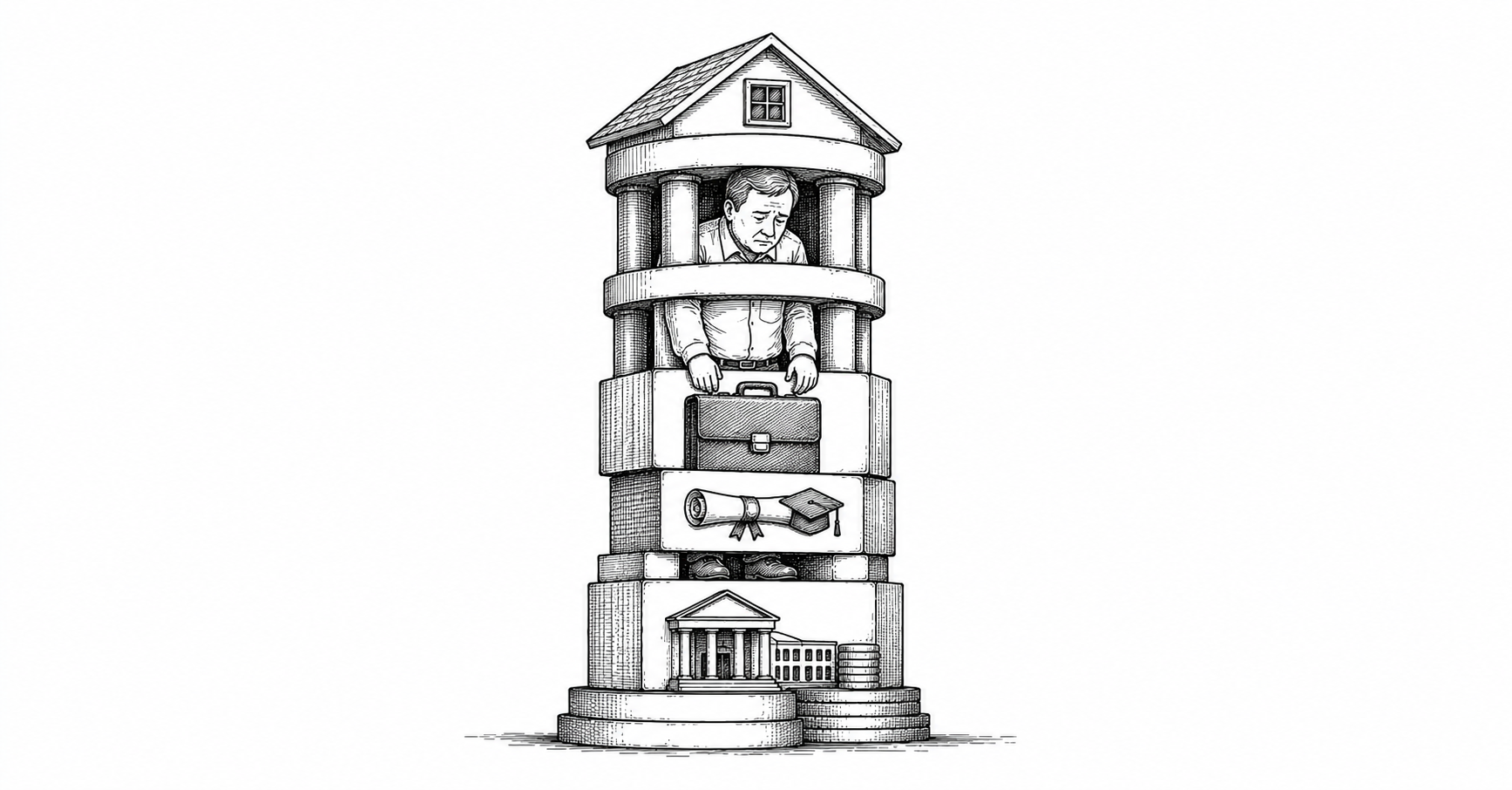
Masculinity norms are a key part of the mechanism Griffith and Efird describe. The same cultural standards that reward stoicism, self-sufficiency, and emotional restraint in white men — standards deeply tied to a particular construction of white male identity — also discourage help-seeking, therapy, vulnerability, and the kinds of social connection that buffer against depression, addiction, and suicidal ideation. White men are socialized to perform dominance, and that performance has a cost that accumulates over decades. At midlife, the bill arrives.
The political implications of this research are significant and likely to be distorted in both directions. On one side, the findings will be co-opted by movements that want to argue that structural racism and gender inequality are not the central problems — look, white men suffer too. That is not what this research says. Griffith’s framework is explicit that the disadvantages Black men, women, and other marginalized groups face are structural, sustained, and not analogous to the crisis white men face at midlife. The populations are not comparable in the nature or scale of the structural harm they experience.
On the other side, the findings may be dismissed as politically inconvenient by advocates who are rightly focused on the disparities that make the suffering of Black, Latino, and Indigenous men far worse at every point on the health spectrum, not just at midlife. But dismissing the findings doesn’t make the mechanism they describe disappear. Understanding how structural advantage generates behavioral health risk is not a concession to white grievance politics. It is a clearer map of how inequality operates across the full social body.
Griffith has published extensively on the health of men of color and on the structural conditions that produce health disparities. His decision to study white men is not a pivot away from that work. It is an extension of the same structural framework — the insight that you cannot fully understand how inequality harms marginalized communities without also examining what it does to the communities positioned above them in the hierarchy. The hierarchy deforms everyone it organizes.
The alcohol and suicide data are the most alarming endpoints of a longer story about disconnection. The data does not show white men who are materially impoverished in the way that drives health outcomes among lower-income Black and Latino men. What it shows is a social and psychological impoverishment — an isolation that grows under conditions of expected dominance. The expectation of dominance, when it meets the reality of an uneven, precarious, changing economy, generates a particular kind of distress that the traditional resources white men are expected to draw on — stoicism, self-reliance, the quiet endurance of masculine identity — cannot resolve.
This is why the research matters beyond the health question itself. It surfaces a hidden cost of the way white supremacy has constructed white male identity. That construction serves political and economic power. It does not serve the men it is imposed upon. The suicide rate and the alcohol use disorder rate are not accidents of individual character. They are outcomes of a framework that told generations of men their worth was tied to dominance, their health was contingent on stoicism, and asking for help was a form of failure.
The SSC structural argument here is consistent: systems that concentrate power at the top do not leave that power available to the individuals positioned there without extracting a cost. The men most systematically advantaged by structural whiteness are also the men most systematically prevented from accessing the emotional, relational, and psychological resources that would protect their health. That is not an irony. It is a design consequence — and it is measurable.