Taco Bell Pulled the Lettuce. General Mills Pulled the Bread. GreenWise Pulled the Blueberries. Food Safety Doesn’t Move at the Same Speed.
Three Food Safety Recalls Happened This Week. They Don’t Tell the Same Story.
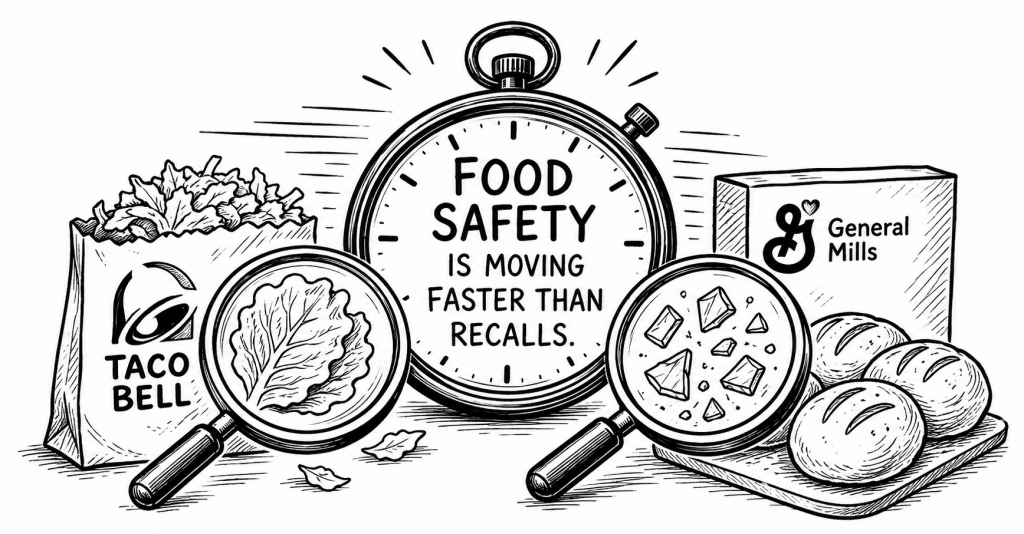
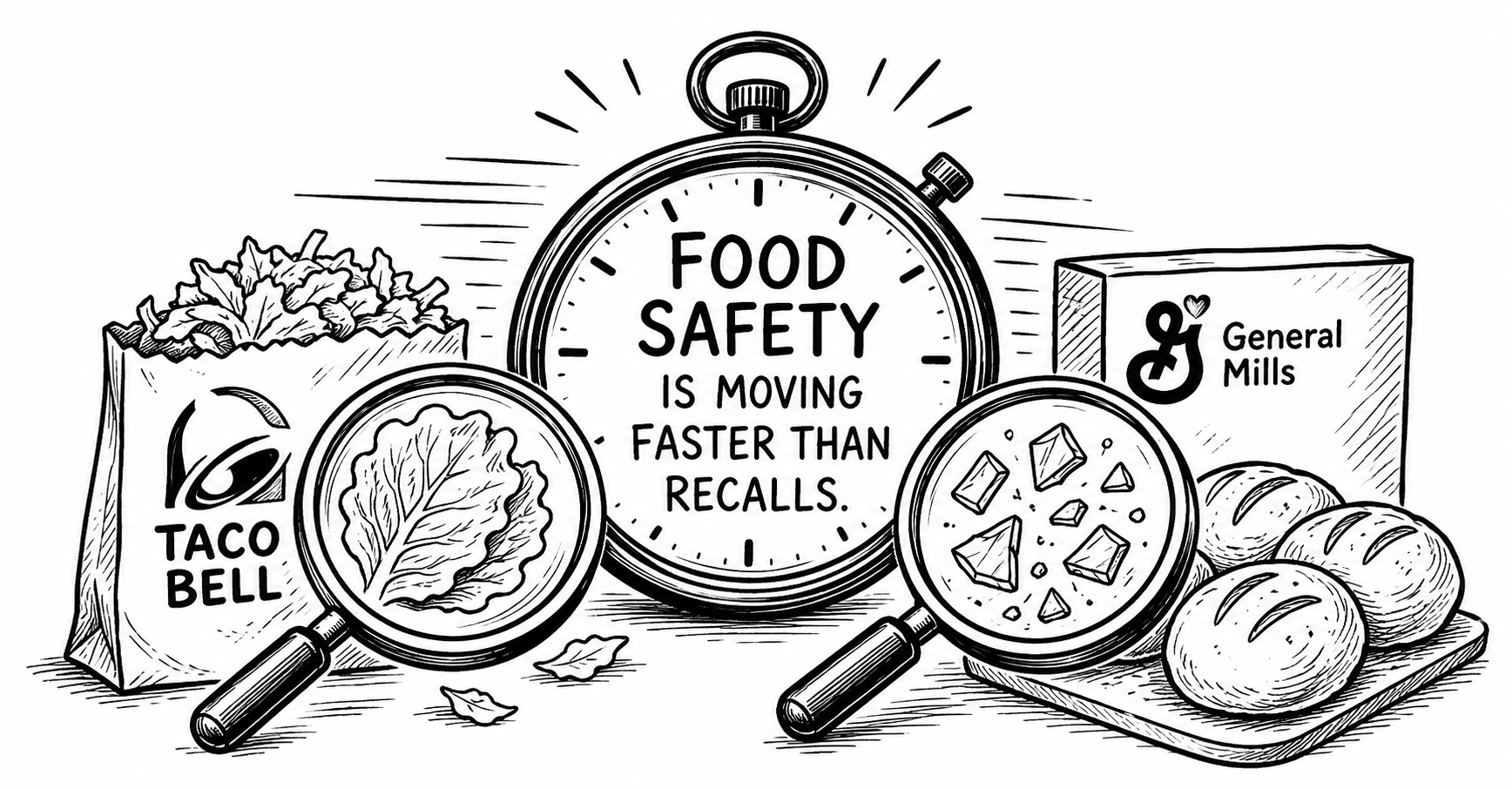
Within 24 hours, two of America’s largest food companies announced high-profile product removals tied to potential safety risks — before regulators required them to. The incidents are unrelated. The logic behind both decisions is the same.
General Mills voluntarily recalled approximately 736,000 frozen Pillsbury bread rolls after discovering possible glass fragments in Hard Roll Dough and Kaiser Roll Dough distributed to Walmart in-store bakeries and commercial food-service operations across 19 states. The FDA classified it as a Class II recall, meaning the exposure risk involves temporary or medically reversible harm rather than life-threatening injury. The company said all potentially affected products had already been removed from distribution before the public announcement.
A third event followed on a different timeline. Frutas y Hortalizas del Sur S.A., a Chilean supplier, recalled frozen GreenWise Organic IQF Blueberries sold in 10-oz packages at Publix stores across 8 states — Alabama, Florida, Georgia, Kentucky, North Carolina, South Carolina, Tennessee, and Virginia — after 12 confirmed cases of E. coliO145:H28 infections were linked to the product, resulting in 4 hospitalizations. Illnesses began as early as May 11 and extended through June 5. The company initiated the recall on July 3 after receiving illness reports from consumers. The affected lot — code 60401, best by February 9, 2028 — was sourced from San Carlos, Chile and distributed through an international agricultural supply chain that Publix did not control at the origin point. Unlike the General Mills and Taco Bell removals, the GreenWise recall followed confirmed illnesses rather than preceding them.
Taco Bell moved on a different timeline for a different problem. The chain pulled potentially affected shredded iceberg lettuce supplied by Taylor Farms from its supply chain nationwide — not after a formal regulatory advisory, but during active conversations with public health officials investigating a multistate cyclospora outbreak. Cyclospora is a parasite that causes severe gastrointestinal illness. More than 1,600 confirmed cases have been traced across multiple states, with investigators linking the outbreak to a single iceberg lettuce supplier in Mexico serving Taco Bell locations in five states. Taco Bell replaced the ingredient in affected markets before the investigation reached a formal conclusion.
Three food safety events in the same window, and they do not sit at the same point on the timeline. General Mills acted before any illness was reported. Taco Bell acted during an active investigation, before it reached a formal conclusion. GreenWise acted after 12 confirmed cases and 4 hospitalizations had already been documented. The variation is the story.
Large food companies have spent the last decade building supply-chain traceability systems precise enough to isolate a suspect ingredient or production batch before a formal investigation is complete. That infrastructure reshapes the risk calculus: waiting for a regulatory order extends consumer exposure and creates legal and reputational liability that early removal would have avoided. The voluntary removal, announced publicly and proactively, signals to regulators and customers that the company acted before it was required to. That signal has institutional value that a mandated recall does not.
But the GreenWise case shows the limits of that infrastructure when the supply chain runs through an international agricultural operation that a domestic retailer didn’t control at the source. Publix sold the product. The recall came from a Chilean supplier, after illness reports had already accumulated. The traceability systems that allowed General Mills and Taco Bell to act pre-emptively are not uniformly distributed across the food supply. The speed of a company’s response tracks closely with how much of the supply chain it can see in real time — and how much of it originates outside its direct control.
When early removal becomes the default corporate response to emerging safety risk in companies that have the infrastructure to support it, the formal recall stops being the primary consumer protection mechanism. The supply-chain decision made before the advisory is. What this week’s three events show, taken together, is that the system is moving in that direction unevenly — and that the gaps in speed and visibility are not random. They follow the geography of the supply chain.