Eight Days In, Apple’s New CEO Put His Name on a Hinge

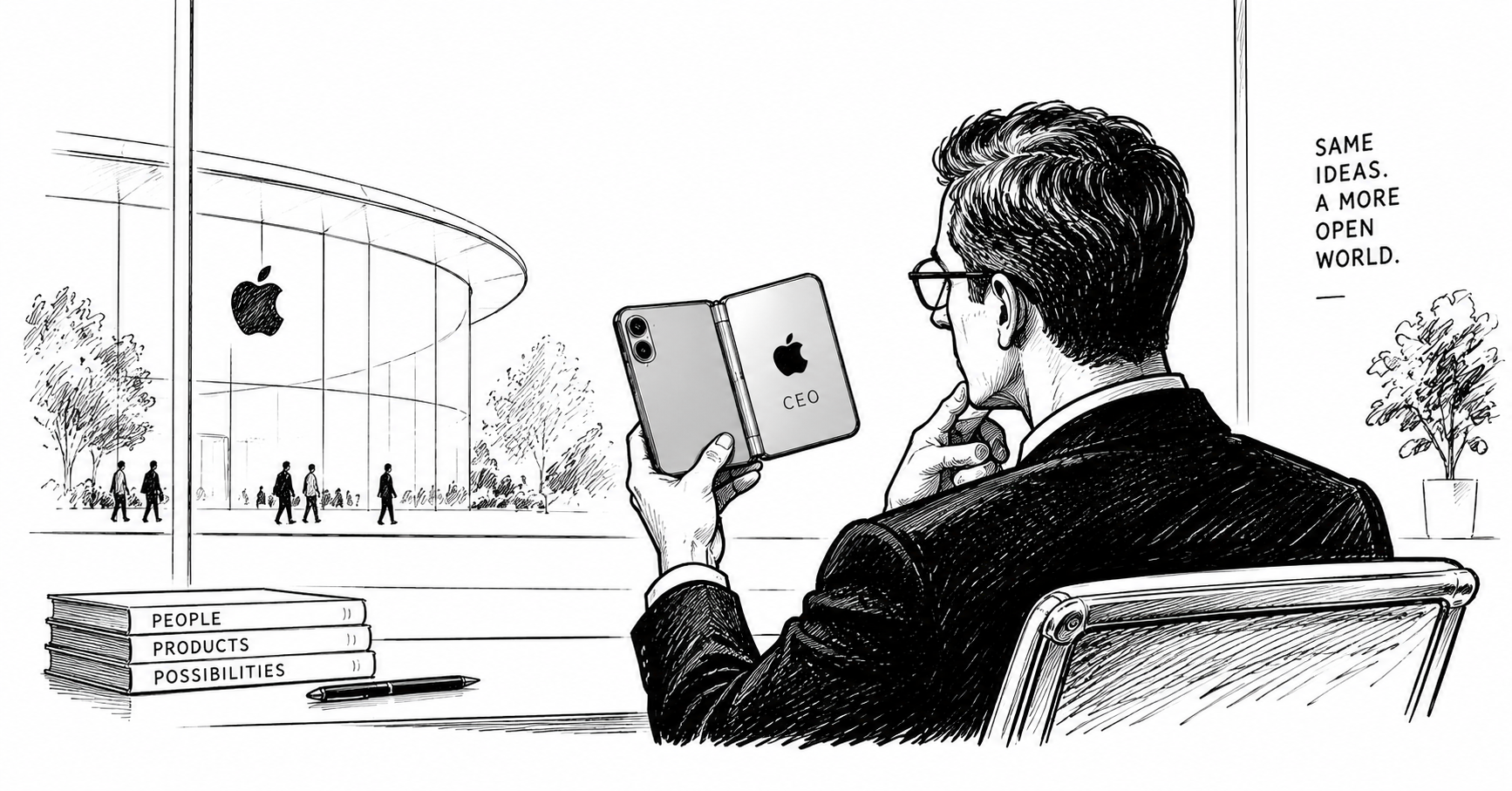
John Ternus has been chief executive of Apple for eight days. On Wednesday he walked onto the stage at the company’s Cupertino headquarters and introduced the first genuinely new iPhone shape in nineteen years.
The iPhone Duo is Apple’s first foldable. It opens sideways into a 7.6-inch inner display with an under-display camera, closes down to a 5.4-inch outer screen, and sits inside a machined titanium frame with a hinge Apple says is assembled from more than a hundred precision components. It starts at $1,999 for 256 gigabytes and climbs to $3,199 at two terabytes. Preorders open October 16. It ships October 23, in two colors Apple is calling star white and night sky.
Those are the specifications. The more interesting number is eight.
Apple’s board appointed Ternus in April and made the handoff effective September 1, with Tim Cook moving to executive chairman after fifteen years as chief executive. The transition was described as the product of long-term succession planning, and by every outward measure it was orderly. Cook stayed through the summer. Johny Srouji absorbed hardware engineering in an expanded chief hardware officer role. Ternus joined the board. Nothing about it was improvised.
But orderly is not the same as tested. Ternus is Apple’s eighth chief executive, and he inherits a company valued somewhere north of four and a half trillion dollars from a predecessor whose tenure grew the stock more than twentyfold. There is no version of that job where the first product launch is a soft open. And Ternus did not choose a soft open. He chose to stand in front of the most scrutinized product line in consumer technology and change its physical form.
There is a reading of Wednesday that says this was the safest thing he could have done. Ternus spent twenty-five years inside Apple’s hardware organization. He ran engineering for the iPad, for AirPods, for recent iPhone generations. He is, in the most literal sense, the person best positioned in the company to sell a device whose entire argument is mechanical. The foldable was in the pipeline long before he took the title. Introducing it is less a bet than a homecoming.
There is another reading, and it is the one worth watching. Ternus used the stage to draw a line against the competition, saying rival foldables feel like two phones stuck together — and he called the Duo the most transformational change to the iPhone since the original. That is not the language of a caretaker. That is a claim, made in his first public act as chief executive, that Apple’s seven-year absence from a category was discipline rather than delay.
Samsung shipped the first Galaxy Fold in September 2019. Apple’s launch landed almost exactly seven years to the day later. In the interim the foldable category has grown without ever quite arriving: roughly 19.6 million units shipped worldwide in 2025, a rounding error against total smartphone volume, with Samsung holding most of it and Google, Motorola, Honor, Oppo and Huawei splitting the rest. Apple has done this before — arrived late to wireless earbuds and to smartwatches and taken the category anyway — and the company clearly believes the playbook holds. The Duo is priced accordingly. At two thousand dollars it is not competing on value. It is asking buyers to accept that Apple waited because the crease, the hinge and the durability were not solved, and that they are solved now.
Wall Street was unmoved. Apple shares slipped 1.9 percent in afternoon trading, below where they stood when the livestream began. That is not a verdict on the phone. Foldable iPhone reporting had been running for months, third-party cases were on sale before the event, and there was almost nothing left to surprise anyone. But it does frame the position Ternus is in. The hardware was expected. The price was expected. The thing investors cannot price yet is whether the man introducing it can do the parts of Cook’s job that had nothing to do with hardware.
Those parts are considerable. Cook did not simply run Apple’s supply chain; he ran Apple’s relationship with Washington and Beijing, and he retains a policy role as executive chairman, which tells you something about how the board views the handoff. Meanwhile the strategic question sitting on Ternus’s desk is not a hinge. It is artificial intelligence, where Apple has spent two years visibly behind and where Wednesday’s answer — a rebuilt Siri, built into iOS 27, running on device where it can, leaning on Google’s Gemini where it cannot — is a partnership as much as a product. A hardware engineer inheriting a company whose central problem is software is not an obvious fit, and everyone involved knows it.
Which is why the Duo functions as a succession statement whether Apple intended it that way or not. It is a hardware answer to a hardware company’s identity question, delivered by a hardware executive in his first week. It says: we still make the thing. If it lands, Ternus buys himself the credibility to be judged on a slower timeline for everything else. If it does not, the first line of his tenure is a two-thousand-dollar phone that arrived seven years late into a market that never got large.
The device ships October 23. The judgment on the hinge will take a few weeks. The judgment on the man will take considerably longer, and it will not be made on the strength of a fold.