San Francisco Pride Shows How Public Celebration Becomes Civic Infrastructure
Pride still carries joy, but this year’s fights over rights, policing, and access showed how visibility becomes a public system under pressure.
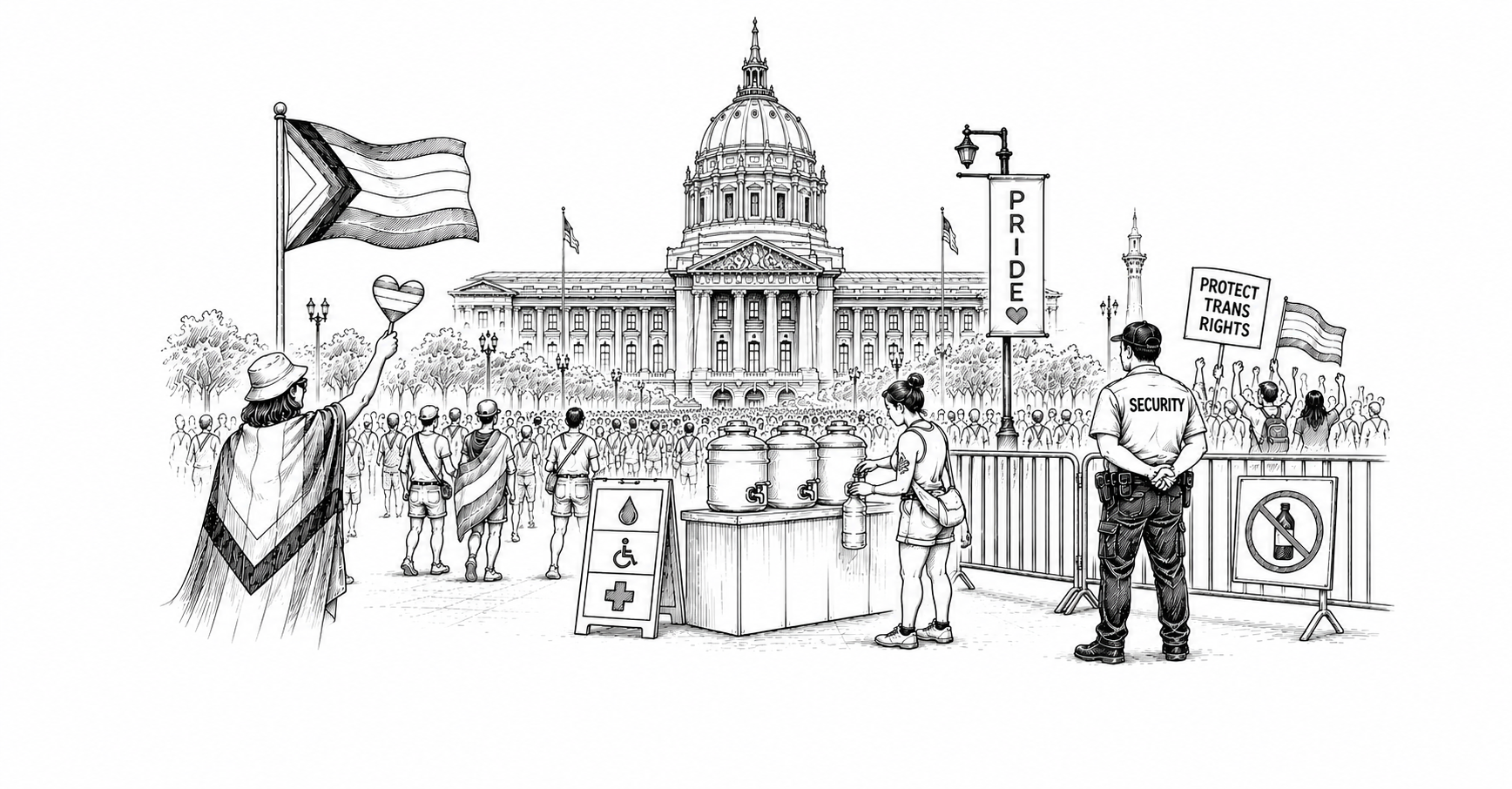
SFGate reported after San Francisco’s 56th Pride celebration that attendees raised safety concerns about water access at Civic Center Plaza, where security confiscated some bottles and refill stations were difficult for some people to find. The reporting followed a Pride weekend shaped by celebration, protest, and heightened pressure around transgender rights.
Public gatherings are infrastructure when people rely on them for more than symbolism. Pride is a parade, a festival, a market, a protest route, a health and safety operation, and a civic signal. It tells a city who is visible, who is protected, and whose presence requires planning.
That is the mechanism underneath San Francisco Pride. Visibility is not only cultural expression. It depends on permits, police deployment, barricades, water access, disability accommodations, sponsors, volunteers, transit, bathrooms, and communication. When any part of that system fails, celebration becomes a test of whether the city can support the people it invites into public space.
The water controversy made that visible in practical terms. SFGate reported that some attendees said bottles were confiscated even as they struggled to locate refill stations. SF Pride said it provided eight water refill stations and teams distributing free water, while also acknowledging communication problems. For people with medical needs or disabilities, the issue was not convenience. It was whether the event’s safety system matched the public promise of inclusion.
That gap matters because Pride’s political role has changed again. In years when formal rights appear secure, Pride can feel like recognition. In years when courts, legislatures, hospitals, schools, and federal agencies are narrowing protections, Pride becomes a counter-institution. It gathers people in public to show that community still exists even when policy turns hostile.
But counter-institutions need operations. A crowd cannot become civic power if the people inside it cannot safely stay there. Access is the difference between visibility as a slogan and visibility as a structure.
Power moved in this story between organizers, security contractors, city agencies, and attendees. Organizers controlled the event footprint. Security controlled what people could carry. The city controlled the public space. Attendees carried the risk when the rules changed or were not communicated clearly. That is how public events often work: decision-making sits with institutions, while the consequences land on the crowd.
San Francisco’s Pride also sits inside a national culture fight. Trans rights, queer healthcare, school policies, sports bans, and protest policing have all turned LGBTQ life into a recurring target for institutional control. In that context, Pride cannot be understood only as a celebration of identity. It is also a mass claim on public space.
That claim has to be built. It requires safety plans that assume disabled attendees will be there. It requires water rules that do not punish people for medical needs. It requires policing that does not turn protest into threat by default. It requires organizers and city agencies to treat access as central rather than secondary.
The lesson is not that Pride failed because some attendees struggled. The lesson is that civic belonging is operational. A city proves who belongs through the details of how people are allowed to gather, move, hydrate, protest, rest, and remain.
The next phase of Pride politics will not be only about visibility. It will be about whether cities can build public systems worthy of the communities they claim to celebrate. Rights may be argued in courts, but belonging is tested at the gate, the barricade, the refill station, and the march route.